
Pokémon Trainer (SSBU)
| Pokémon Trainer in Super Smash Bros. Ultimate | |
|---|---|
_SSBU.png) -Alt1_SSBU.png)   
| |
| Universe | Pokémon |
| Shares character slot with | Charizard Ivysaur Squirtle |
| Other playable appearance | in Brawl |
| Availability | Unlockable |
| Final Smash | Triple Finish |
| Tier | B+ (36) |

Pokémon Trainer (ポケモントレーナー, Pokémon Trainer) is a playable character in Super Smash Bros. Ultimate. He was officially revealed on June 12th, 2018 alongside his team of Pokémon: Squirtle, Ivysaur, and Charizard, the latter of whom returns to the team after appearing by itself in Super Smash Bros. 4. Although Pokémon Trainer lacks a fighter number compared to the rest of the cast, his Pokémon have fighter numbers in his stead: Squirtle is classified as Fighter #33, Ivysaur is classified as Fighter #34, and Charizard is classified as Fighter #35.
The male Pokémon Trainer has new voice clips in all languages he is voiced in, with all of his voice actors from Super Smash Bros. Brawl being replaced (except for his Japanese voice actor, who reprises her role). Respectively, the voice actors for the male and female Pokémon Trainers are:
- Tomoe Hanba (male) and Wakana Minami (female) in Japanese.
- Billy Bob Thompson (male, replacing Michele Knotz) and Kate Bristol (female) in English.
- Emilie Guillaume (male, replacing Virginie Demians) and Elisabeth Guinand (female) in French.
- Tim Schwarzmaier (male, replacing Dina Kürten) and Lea Kalbhenn (female) in German.
- Tania de Domenico (male, replacing Francesca Guidice) and Giada Bonanomi (female) in Italian.
- Rodri Martín (male, replacing Isabel Navarro) and Tania Ugía (female) in Spanish.
Unlike in Brawl, Pokémon Trainer's Japanese voice clips are used in the Korean version of Ultimate, instead of unique Korean-language voice clips.
Pokémon Trainer is ranked 36th out of 82 on the current tier list, placing him close to the top the B+ tier. This is a drastic improvement over his 29th out of 38 placement in Brawl, and a significant improvement over Charizard's placement in Smash 4, where it was ranked 42nd out of 54. This improvement is thanks to the faster Pokémon Change, the ability to use Pokémon Change in mid-air, and the removal of the stamina and type effectiveness mechanics. Being one of two fighters to be able to swap characters via Pokemon Change (alongside the Aegis), each of the Trainer's Pokémon has unique playstyles and win conditions. Squirtle is the one that is best suited for combos and racking up damage, Ivysaur is the best at ranged combat to keep enemies at bay, and Charizard is the best at high percents, either for survivability purposes or to get KOs off of reads and powerful moves. This allows the Trainer to switch between three different playstyles on the go. Furthermore, they lack many definitive losing matchups, as in the case of an unfavorable opponent, the player can switch to a Pokemon best suited for the matchup. Finally, they also have a great offstage presence, because they can utilize many different edgeguarding and recovery options to be effective offstage. This makes for one of the best mix-up games in the game, as the enemy must learn 3 different playstyles to be able to do well against Pokemon Trainer.
Despite a myriad of pros from the ability to switch between different fighters, the team nevertheless has weaknesses. As each Pokémon has a separate playstyle, solo-maining a single Pokémon is heavily discouraged, and the player will have to learn how to play them all at once in order to make the most use out of the Trainer. In addition, each Pokémon also have their own weaknesses: Squirtle has a hard time in securing stocks, Ivysaur has a poor disadvantage state and a weak recovery compared to the other two, and Charizard has issues that come with being a superheavyweight, such as big frame, slow moves, and bad disadvantage. Finally, the Trainer cannot repeatedly switch between each Pokémon because of a cool down, and if a Pokémon is switched out or knocked out, they will have to wait two different rotations before being sent out.
Overall, Pokémon Trainer is a character with a high learning curve that centralizes around mastering the capabilities of all 3 Pokémon in order to be the most successful. Despite this perception, Pokémon Trainer was an incredibly popular character in the early metagame, with many players finding great success with the character. However, nerfs to Ivysaur, the absence of their best players, and the rise of oppressive DLC fighters greatly reduced Pokémon Trainer's representation over time, though dedicated mains, especially Atelier and Quidd, were still able to put up strong performances with the character.
How to unlock[edit]
Complete one of the following:
- Play VS. matches, with the Pokémon Trainer being the 26th character to be unlocked.
- Clear Classic Mode with Donkey Kong or any character in his unlock tree, being the 2nd character unlocked after Bowser.
- Have the Pokémon Trainer join the player's party in World of Light.
With the exception of the third method, Pokémon Trainer must then be defeated on Pokémon Stadium. In World of Light, he is fought on the Ω form of Battlefield.
Attributes[edit]
As one of only three fighters in Ultimate to use the character-swap mechanic (with the other two being with Pyra and Mythra), Pokémon Trainer is arguably the most dynamic fighter in the game, yet also one of the most demanding. Unlike other tag team-oriented fighters, such as Rosalina & Luma and Banjo & Kazooie, the Trainer does not fight directly and instead acts as a commander for his three Pokémon: Squirtle, Ivysaur, and Charizard. Although only one of these Pokémon can be present in battle at any given time, they can be swapped out using Pokémon Change in that order. In the absence of a stamina mechanic, players may use any or all of the three Pokémon freely without fear of becoming less effective. However, forced switching remains, with the player automatically switching to the next Pokémon upon losing a stock.
Each of the three Pokémon covers a different archetype: Squirtle is a fast combo-oriented lightweight, Ivysaur is a middleweight zoner, and Charizard is a super heavyweight with raw KO power and atypically fast mobility despite its slow moves. Typically, the most basic game plan is to build damage with Squirtle at low percents, use Ivysaur to outrange opponents and secure advantage state at medium percents, and score KOs and recover more easily with Charizard.
However, the Pokémon Trainer's versatility allows for a multitude of different game plans depending on the player's preference and the matchup. Pokémon Change has been significantly streamlined from Brawl and has been made significantly faster, and can be used in the air. This allows for more effective switching in the heat of the moment so that the current Pokémon can be easily removed from the battle and replaced if it is in a situation where its weaknesses can be easily exploited. This also allows for recovery to be extended further; for example, using Ivysaur's Vine Whip to gain a small amount of vertical height, then switching and using Charizard's Flare Blitz and Fly to provide a very extensive recovery. As such, the Pokémon Trainer can adapt to any situation simply by choosing the right creature for the job, providing for a fighting style similar to 3-on-3 fighting games, where the player chooses a team of interchangeable fighters that can be exchanged in an instant.
Despite the advantages provided by the Pokémon Trainer's central mechanic, they do not provide for an infallible fighter. Most notable is the very high learning curve required to master the whole party; all three Pokémon have their own matchups and optimal reactions to different situations, requiring a very high level of commitment to become familiar with each of the three, when to switch Pokémon, and what new situations can arise from switching, requiring commitment akin to having three mains at once in a game where even handling two mains can be overwhelming.
Furthermore, each of the three Pokémon is slightly more specialized in its role than other fighters of its class, and therefore has more pronounced weaknesses. Squirtle's KO power and endurance are lacking, Ivysaur's recovery and disadvantage state are both very poor, and Charizard is susceptible to combos and has mostly unsafe moves. Because Pokémon Change operates in a set order (unlike with Monado Arts) and cannot be continuously spammed due to its cooldown, players cannot always choose which Pokémon to use in which situation and can sometimes be rendered helpless in preventing the current Pokémon's weaknesses from being exploited. This is especially notable in matchups such as Pikachu and Mr. Game & Watch, where two of the three Pokémon are at a disadvantage, resulting in strained efforts to use the one optimal Pokémon as much as possible while keeping the other two on standby.
While attempting to "solo main" one of the three Pokémon is possible, it is not recommended in most cases (outside of single-stock modes such as Squad Strike itself, ironically) as players are nonetheless forced to use all three during battle, even while waiting for the cooldown on Pokémon Change. For instance, attempting to "main" Charizard while having little knowledge of Squirtle and Ivysaur will allow opponents to exploit the brief windows where using Charizard is not possible. However, it is entirely possible to centralize a playstyle around one or two preferred Pokémon and to use the remaining teammate(s) to complement them, such as with Tweek (who prioritizes Squirtle) and Puppeh (who prioritizes Charizard).
Overall, the Pokémon Trainer is simultaneously one of the most adaptable, most unpredictable, and most challenging fighters to play in Ultimate. As the only fighter that allows the player to bring three completely different characters into battle outside of modes like Squad Strike, the Trainer can enable many different playstyles depending on the player's familiarity and comfort with each of his Pokémon and their matchups. Thanks to the Pokémon Trainer's reworked mechanics and his Pokémon being buffed to varying degrees (with the most notable buffs being the removal of both the Pokémon's stamina and type effectiveness mechanics), he is universally considered to be far superior to him in Brawl. This has been reflected by his playerbase achieving very notable results in competitive play, with the unique Pokémon Change mechanic and comparative lack of restrictions allowing for a very open-ended game plan.
Changes from Super Smash Bros. Brawl[edit]
- The list below covers the general changes of the Pokémon Trainer and his party as a whole. For information about each Pokémon's moveset changes, see Squirtle (SSBU), Ivysaur (SSBU), and Charizard (SSBU).
Pokémon Trainer was considered a lower-ranking character in Brawl, as despite many of the Pokémon's unique strengths, the team's polarized balance and mechanics that adversely worked against the team counterbalanced said traits. Most likely following this status, Pokémon Trainer has been buffed significantly in the transition to Ultimate.
Notably, both the stamina mechanic and type effectiveness have been completely removed, and Pokémon Change has been granted high utility due to the addition of aerial switching and significantly faster Pokémon switches. As such, switches between the three Pokémon have now become a unique advantage for the Pokémon Trainer alone instead of being a major mandatory commitment, and the Pokémon are now free to fight indefinitely without being limited by Stamina during battle. In addition, Ivysaur, who was previously the worst Pokémon in the party, has been greatly buffed, and the general changes to Ultimate's mechanics greatly benefit Ivysaur and Squirtle.
Despite some noteworthy buffs, Pokémon Trainer has also received some nerfs. While the removal of type effectiveness slightly benefits Charizard and greatly benefits Ivysaur due to the latter's weakness to the near omnipresent flame effect, it also greatly hinders Squirtle due to its resistance to said effect. Additionally, while Pokémon Change has been greatly improved, it has also received a few new disadvantages, as there is now a timer that prevents switching for a couple of seconds (although there are ways to work around this), and it no longer resets stale move negation, effectively weakening the next Pokémon. Squirtle has also been slightly nerfed overall, and Ivysaur and Charizard have received a few nerfs as well.
In bulk, Pokémon Trainer has become a significantly more effective character than in Brawl. Despite retaining a high learning curve, all three Pokémon now boast their own degree of effectiveness for certain matchups, making the character more dynamic overall. Still, while each of the Trainer's Pokémon is usable as its own character, as in Brawl, usage of all three for different situations is optimal. Nevertheless, the team performs much better than they previously did in Brawl.
Aesthetics[edit]
 The male Pokémon Trainer's model is significantly more detailed than it was in Brawl, having stylized body proportions and sharper, slimmer eyes. Additionally, the Trainer's Poké Balls have been resized to fit in his palm. Both of these changes make his design similar to the style of recent Pokémon titles.
- The Pokémon Trainer has completely new alternate costumes based on protagonists in the Pokémon series. Half of them are based on the female Pokémon Trainer from FireRed and LeafGreen. In addition to distinct voice clips, the majority of her animations are unique.
- The Pokémon Trainer now turns in a battle to face the position of the Pokémon.
- The announcer no longer calls out Squirtle, Ivysaur, or Charizard on the character selection screen; instead, when selecting a Pokémon manually, a small portrait of Squirtle, Ivysaur, or Charizard appears in the upper right portion of Pokémon Trainer's portrait.
- Triple Finish has a different text box and animations; the text box is now identical to how they appear in the Generation VII games.
- The Pokémon Trainer now says "All right!" when performing an up taunt and "Yeah!" when performing a down taunt.
- On the results screen, the Pokémon Trainer is shown and announced as the winner of the fight rather than the Pokémon that was in battle. The same goes for displaying “Pokèmon Trainer” on the jumbotron in Pokémon Stadium and Pokémon Stadium 2 instead of the Pokèmon currently in battle.
- The Trainer's face is also used as the stock icon for all three Pokémon, although the Pokémon also have their own stock icons used for other modes.
- The Trainer now claps on the results screen, instead of looking down in disappointment like in Brawl.
- Pokémon Trainer's crowd cheer is now "I choose you!"
- Both genders of the Pokémon Trainer have unique reactions to the situation of their Pokémon, such as when it lands a hit, takes a hit, scores a KO or is KO'd.
- If the Trainer's Pokémon is moved horizontally when he is standing on the main platform of large stages (such as the Training stage), he will chase his Pokémon by dashing into them instead of a space jump.
- As with all previously cut veterans returning from Melee and Brawl, Pokémon Trainer now has a Boxing Ring title and a Palutena's Guidance conversation.
- Squirtle, Ivysaur, Charizard, as well as both Trainers now each have an individual Sound Test section, rather than being grouped together.
- In matches with five or more players, the Pokémon Trainer will not appear on-screen - instead Poké Balls will be thrown and recalled from behind the screen.
Attributes[edit]
 The Stamina mechanic has been removed, eliminating the need to switch out Pokémon to restore their power.
- Type effectiveness has been removed, which affects the three Pokémon in different ways:
 Loss of type effectiveness greatly nerfs Squirtle, who no longer takes less knockback from flame damage.
- Loss of type effectiveness greatly benefits Ivysaur, who no longer takes extra knockback from flame damage.
- Loss of type effectiveness also slightly buffs Charizard, who no longer takes extra knockback from water damage, which is more prevalent than in Brawl.
- Squirtle is now selected as the starting Pokémon by default when the player chooses Pokémon Trainer on the character select screen. This selection can still be changed before starting the match by pressing
 or
or 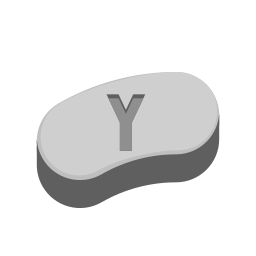 , or highlighting the Pokémon. In Brawl, a random starting Pokémon would be chosen by default if the player did not choose a Pokémon on the character select. If an amiibo of the Pokémon Trainer's Pokémon is used, the default starting Pokémon will be locked into this Pokémon.
Special moves[edit]
- Pokémon Change:
- Pokémon Change executes much faster, and no longer requires the game to load the next Pokémon with every switch. This significantly increases its safety, and allows it to potentially string into another Pokémon's moves.
- It can now be used in the air. This allows the player to mix up their recovery between different Pokémon, and to utilize its intangibility frames as a pseudo-air dodge, with the notable advantage of coming out on frame 1. As a result, it poses much less of a risk than in Brawl as a defensive option.
- It has a cooldown of around two seconds after the Pokémon switch is executed. However, it can be skipped by using another special move.
- It no longer resets stale-move negation, effectively weakening the next Pokémon when the current Pokémon switches.
- It can no longer skip the ending lag of the switch if performed near the edge of a moving platform, although it still grants Ivysaur an extra midair jump.
- Triple Finish:
- Triple Finish deals less total damage (58% → 44.3%).
Update history[edit]
Unlike his Pokémon, Pokémon Trainer did not receive any buffs or nerfs via game updates due to not being a directly playable character. Instead, he received only a number of fixes to both minor and major glitches.

 Fixed a glitch where button mashing Pokémon Change canceled Monkey Flip's knockback.[1]
- Fixed a glitch where Pokémon Change would not properly switch Pokémon during Special Smash.
- Fixed a Ditto-related glitch where Pokémon Trainer would enter on-stage in Training Mode.
- The duration of ledge invincibility is no longer shortened when using Pokémon Change in the air before grabbing the ledge.
- The Unlimited Rebellion Gauge glitch has been fixed.
- Fixed a bug in Garden of Hope that caused the Pokémon to remain tiny after escaping the fully constructed pot if they used Pokémon Change at the top of the pot.
Moveset[edit]

Although Pokémon Trainer is technically a fighter, he stays in the background and does not directly participate in a battle. Instead, he has a team of three Pokémon (Squirtle, Ivysaur, and Charizard) that he instructs to fight in a battle. Only one Pokémon is active at once, and all three of them have different movesets and abilities.
It is possible to change which Pokémon the Pokémon Trainer starts with at the beginning of a battle. On the character select screen, Pokémon Trainer has the starting Pokémon's portrait to the upper-right of the portrait. If the Y button is pressed, or if the Pokémon's portrait is hovered over and selected, the starting Pokémon is toggled to the next one. The default Pokémon is Squirtle, which can be toggled to Ivysaur, then Charizard, and then back to Squirtle.
The three Pokémon have separate movesets and attributes. The only moves shared by the Pokémon are their down special move (Pokémon Change) and their Final Smash (Triple Finish). Pokémon Change involves the Pokémon Trainer recalling the currently active Pokémon and sending out the next one to replace it. The order that the Pokémon are changed in is the same as toggling on the character select screen: Squirtle switches to Ivysaur, Ivysaur to Charizard, and Charizard to Squirtle. Triple Finish is a combination attack in which the Pokémon Trainer temporarily brings out all three of his Pokémon to attack simultaneously. The attack boasts a large range and inflicts damage to any opponents caught in it. Once it concludes, the two inactive Pokémon are recalled.
Although he is not directly controllable, the Pokémon Trainer can be seen standing in the background of the stage, commanding the Pokémon and reacting to the Pokémon's situation. Various animations and voice lines differ for the Pokémon Trainer and his female counterpart. The Pokémon Trainer can move around somewhat on most stages, running toward his current Pokémon if it is far enough away, and will also turn to face the position of his Pokémon at most times. On some stages, the Pokémon Trainer stands on a special platform in the background instead of standing on a portion of the stage's background. On these stages, the Pokémon Trainer can not move around, but will still turn to face his Pokémon.
Pokémon Trainer does not appear in the background during battles with five or more players, in Squad Strike's Tag Team mode, or on Custom Stages. However, he can still be heard giving commands, and the Poké Ball and its energy effects can be seen traveling towards the foreground, implying that the Pokémon Trainer is in the foreground and outside of the camera's view. This also happens in certain single-player and co-op modes.
The Pokémon Trainer reacts to various situations and inputs:
- When the active Pokémon performs a special move, the Pokémon Trainer gestures with one arm, pointing in a specific direction based on the input or direction the Pokémon is facing:
- Neutral special move: Points left or right, based on the direction the Pokémon is facing.
- Side special move: Points left or right, based on the direction the move was used in.
- Up special move: Points towards the direction the Pokémon is facing, or upwards if the Pokémon is above.
- When using the Pokémon's down special move, Pokémon Change, the Pokémon Trainer throws the next Pokémon's Poké Ball toward the Pokémon's position, then holds up the previous Pokémon's Poké Ball as it is recalled in energy form. The Pokémon Trainer then puts the Poké Ball away in his backpack (male) or her purse (female) and pulls out the next Pokémon's Poké Ball. The Pokémon Trainer also says a voice line, either encouraging the next Pokémon or praising the previous Pokémon.
- Pokémon Change cannot be used again until this animation completes or is interrupted by using another special move.
- When using the Final Smash, Triple Finish, the Pokémon Trainer throws the other two Pokémon's Poké Balls out and points toward the direction the move was used in for the duration of the attack while saying a voice line including the name of the move. Once the attack is over, the Pokémon Trainer recalls the other two Pokémon and puts the Poké Ball away in his backpack or her purse.
- Pokémon Change cannot be used until this animation completes or is interrupted by using another special move.
- When the active Pokémon lands a hit, the Pokémon Trainer does a small fist pump with a happy expression.
- When the active Pokémon scores a KO:
- The male Trainer raises his left fist and fist pumps, while nodding and winking, with a happy expression.
- The female Trainer jumps into the air with her right arm raised, doing a full spin mid-jump, and does a double fist pump as she lands.
- When the active Pokémon is hit:
- The male Trainer throws his left fist downwards with a distressed expression.
- The female Trainer winces with a distressed expression.
- When the active Pokémon has changed into a different active Pokémon type:
- The male Trainer might say "Come back!" during a fight.
- The female Trainer might say "Return!" during a fight.
- When the active Pokémon is KO'd:
- Both Trainers shake their heads while covering their faces with their left hand. They may say "Ah!" or "Dang it!" (the latter for their alternate KO line)
- When the active Pokémon is stunned (including from a shield break) or buried:
- The male Trainer puts his left hand on the back of his head (or in the female Trainer's case, on the side of her head) and looks downward with a distressed expression. He will say one of three lines: the Pokémon's name in a distressed tone, "Wake up!", or "Get a hold of yourself...!" (male) and "You got this." (female)
Announcer call[edit]

Unlike in Brawl, Squirtle, Ivysaur, and Charizard do not have unique announcer calls.
- English/Japanese/Chinese
- French
On-screen appearance[edit]
Pokémon Trainer sends out the starting Pokémon from its Poké Ball while saying "Go!" and the Pokémon's name; the female Trainer winks and smiles while doing so.
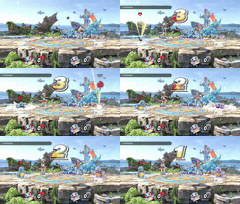 Squirtle's on-screen appearance
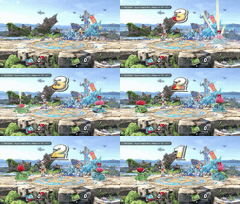 Ivysaur's on-screen appearance
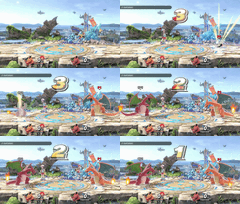 Charizard's on-screen appearance


Taunts[edit]
Male[edit]
- Up taunt: Triumphantly raises his Poké Ball into the air, saying, "All right!"
- Side taunt: Fist pumps with his left hand.
- Down taunt: Fist pumps with his left hand while posing triumphantly, saying "Yay!"
 Male Pokémon Trainer's up taunt.
 Male Pokémon Trainer's side taunt.
 Male Pokémon Trainer's down taunt.


Female[edit]
- Up taunt: Fist pumps with her left hand while triumphantly raising her Poké Ball into the air, saying "All right!"
- Side taunt: Fist pumps with her left hand.
- Down taunt: Jumps slightly off the ground while doing a double fist pump, saying "Yay!"
 Female Pokémon Trainer's up taunt.
 Female Pokémon Trainer's side taunt.
 Female Pokémon Trainer's down taunt.


Pokémon Trainer's taunt quotes in each language are:
| Up | Down | |
|---|---|---|
| English | "All right!" | "Yay!" |
| German | "Nicht schlecht!" | "Klasse!" |
| Italian | "Diamoci dentro!" | "Sì!" |
| Japanese | "よし。" (Alright.) |
うん!" (Yeah!) |
| Spanish | "¡Tu puedes!" | "¡Ja!" |
Idle poses[edit]
Male[edit]
- Rubs his left leg with his left hand.
- Jumps gently on the spot twice.
 Male Pokémon Trainer's first idle pose.
 Male Pokémon Trainer's second idle pose.


Female[edit]
- Wipes her brow with her left hand.
- Stretches her right arm, holding her elbow with her left hand.
 Female Pokémon Trainer's first idle pose.
 Female Pokémon Trainer's second idle pose.


Crowd cheer[edit]
| Cheer (English) | Cheer (Japanese/Chinese) | Cheer (Italian) | Cheer (Dutch) | Cheer (French) | |
|---|---|---|---|---|---|
| Cheer | (♂) (♀) |
(♂) (♀) | |||
| Description | I choose you! | Pokémon Trai - ner! | A - llena - to - re di Po - ké - mon! (♂) A - llena - tri - ce di Po - ké - mon! (♀) |
Pokémon Trai - ner! | Dre - sseur de Poké - mon! (♂) Dre - sseuse de Poké - mon! (♀) |
| Cheer (German) | Cheer (Spanish) | Cheer (Russian) | Cheer (Korean) | |
|---|---|---|---|---|
| Cheer | (♂) (♀) |
(♂) (♀) |
||
| Description | Po - ké - mon Trai - ner! (♂) Po - ké - mon Trai - ner - in! (♀) |
En - trenador! Po - ké - mon! (♂) En - trenadora! Po - ké - mon! (♀) |
Trener! Pokemonov! | Pokémon Trai - ner! |
Victory poses[edit]
The male Trainer can say "You all did great!" (みんな、よくがんばったな!, Everyone, you did great!), while the female Trainer can say "Everyone did great!" (みんな、最高だね!, Everyone, you're the best!). They will either say a non-specific line, or a Pokémon-specific line. In Team Battles, if there are more than two players on the winning team, the Pokémon will not be present, but this does not affect the Trainer's lines. The male and female Trainers also have variations in their own poses depending on the gender of the Trainer, similarly to the Inklings.
- Left: The Trainer throws a Poké Ball up. The male Trainer poses before catching the Poké Ball and holding it in front of him, while the female Trainer performs a twirl, catches it, and holds it out in front of her. The only animation the Pokémon Trainers use during team victories.
- Up: The Pokémon does one of its moves, and the Trainer cheers it on. The male trainer ends his pose by raisin