
Gameplay modification

Gameplay modification, often shortened to mod, is a blanket term for unofficial hacks and code alterations that change one or more aspects of the original, or "vanilla" version of a game. Mods range from simple cosmetic changes to total engine and gameplay overhauls that result in the game functioning completely differently, functionally making them fan games.
Overview[edit]
Specific changes to the game depend on the preferences of the developers, as well as their ultimate goal. There are a few different categories most mods fall into:
- Balance mods usually do not significantly change the core gameplay and apply buffs and nerfs to characters to reduce competitive inequality between characters.
- Overpowered mods are a variant of Balanced mods, giving every character absurd buffs so that they are all equally overpowered.
- Melee-inspired mods change the gameplay and movesets to be more fast-paced and technical like in Melee, sometimes adding mechanics such as wavedashing.
- Competitive mods do not change anything gameplay-wise, but add features for players to practice their skill and/or improvements for tournament play, such as improved training modes.
- New character mods introduce new characters into the game with new 3D models, animations and movesets, either replacing another character or being a new addition.
- Skin mods add new alternate costumes to characters using file replacement.
- Silly mods change characters or game mechanics in certain ways to result in humorous outcomes, such as modifying characters such as Ganondorf to have their moves stretch to absurd proportions, or having hitboxes from powerful moves such as Rest or Falcon Punch be active at all times, turning a character into a walking hazard. Silly mods often times have overlap with Overpowered mods.
The first attempts at modding involved Super Smash Bros. Brawl, with such projects generally being viewed as novelties, such as palette swaps for characters and UI changes. Outside of this, forcing the Wii to load such mods was considered difficult, requiring use of the now-inoperable Twilight hack. The increasing complexity of game play mods and the discovery of the Smash Stack exploit, however, caused mods to develop considerably more attention with observers.
Brawl remains the most commonly modded game in the series, primarily utilizing either The Homebrew Channel or the Smash Stack exploit. Mods for Super Smash Bros. Melee often also require the use of applications available for the Homebrew Channel. Gameplay mods for Super Smash Bros. require patching a ROM image of the game. Mods for both versions of Super Smash Bros. 4 involve the use of kernel exploit chains on their respective consoles primarily using Layered File System (LayeredFS) patchers to overwrite parts of the game's filesystem. Mods for Ultimate require a Nintendo Switch console released before July 2018 to utilize a recovery mode exploit left over from the development phase of the console, enabling the use of code hooking and file replacement via the Skyline executable patch.
Given the nature of gameplay modifications, it is possible for them to be created for nefarious purposes, such as cheating in tournaments. One notable case is the "Super Pichu" scandal in the Ohio Melee scene, where a smasher named Chaos won cash prizes in tournaments using a secretly modded setup that heavily buffed Pichu to win against top-tier characters. However, outside of this case, cheating through gameplay modifications in tournaments is extremely rare, mainly because of the difficulty in installing them onto consoles, and the logistics in having to play on the same modded setup in every round, a difficulty Chaos faced in his own tournament runs.
Since online play was introduced in Brawl, gameplay modifications have been used for cheating online as well. Hacking Giga Bowser to be normally playable is a common method across all online games, using his near-invulnerability to knockback to trivialize beating even highly skilled players. While Brawl did not issue bans for such behavior, as of Ultimate, while possible, bans are issued. For a period of time, Giga Bowser could even be hacked into playable form on Project Slippi for play in Melee, though this has since been patched. Regardless, cheating does continue to occur on the platform, namely through the use of macros to make advanced techniques easier.[1] Thanks to improvements in moderation, though, they typically get banned quickly.
Stages[edit]
In addition to raw gameplay, other portions of the game may be overhauled by developers to further change gameplay. The changing of stages is among the more common ways to do this:
In Super Smash Bros.[edit]
19XX modifies the stage selection screen to contain Battlefield, Final Destination, and Meta Crystal, stages otherwise unplayable in Versus mode. 19XXTE's selection screen contains 11 instead of the original 9 slots for stages, and 19XXCE has 16 slots.
In 2018, modders found a way to change stages. At first only Hyrule Castle could be replaced, but later it became possible to replace all stages. The mod SSBMSE replaces most stages in the game with more competitive stages modeled after their appearance in other Smash games.
Smash Remix is the most popular mod for the game. It includes five pages of stages, including stages from newer Smash games and brand new custom stages, as well as multiple "Remix" variants for stages.
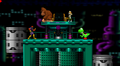 A completely original Smash Remix stage, Metallic Madness from Sonic CD.
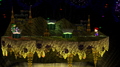 An Ω form for Planet Zebes in Smash Remix


In Super Smash Bros. Melee[edit]
While one of the less popular entries in the series for mods, some have been created over the years. SD Remix, released in 2015, features 3 pages of stages: one for the vanilla stages, one with 1-player mode-only stages, and one for newly created stages, with some inspired from other games.
Adding stages to Melee quickly escalated after the m-ex engine added the possibility to import custom stage models with separate slots, as well as custom high poly models over existing ones.
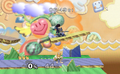 A mod for Melee that gives Yoshi's Island (64) a more neutral layout, with a flat base platform and the disintegrating cloud relocated to a space where it cannot be used for camping.
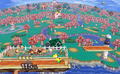 A backport of Smashville into Melee - to play into a "what-if" scenario of if Animal Crossing actually received major representation in Melee, small aesthetic changes have been made to more closely resemble the Nintendo 64 and Nintendo GameCube Animal Crossing games instead of Wild World.


In Super Smash Bros. Brawl[edit]
Brawl is the most commonly modded game in the series due to Smash Stack exploit, which makes modding the game much easier to the average player. In these mods, it is common to new stages, often replacing others, that have been made by fans. It is also possible to use newly created slots on the stage selection screen or alternative stages that load when holding a specific button when selecting a stage.
Brawl- and Project M, for instance, replace the ordinarily over-sized Temple with a smaller, more condensed version. Stages with transformations like Castle Siege or Pokémon Stadium are often changed to stay at the most competitive form of the stage. Outside of this, unpopular stages might be entirely replaced with others, such as how Project M replaces the highly non-standard Mario Bros. with a rendition of Fountain of Dreams from Melee.
Legacy TE added stages with the design of stages used for competitive play for each stage, using their theme in background models and textures and playing the same background music, that load when holding the Start, L, or Z button. Legacy XP added over 700 new stages into the game using new slots on the selection screen, as well as variants when holding down specific buttons. Button Shortcuts to quickly select popular Project M stages have also been added. Smash 2 added all stages that were in Melee back into the game.
Outside of stage layout changes, some textures and tracks may be replaced, particularly in the case of original stages.
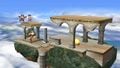 In Brawl-, the stage Temple has been significantly condensed compared to its vanilla counterpart.
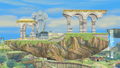 In Project M, the same stage layout was used to make the Skyloft stage.
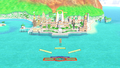 The Brawl stage Delfino Plaza remade with BrawlBox, adding many setpieces from Super Mario Sunshine usually absent from the stage such as the Grand Pianta Statue, and the red cannon to Pinna Park.
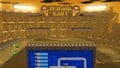 "1-to-1" stages, which replace the aesthetics of a competitive stage, but keep all geometry perfectly intact, are very popular in Project M and Project + modding - this stage skin changes WarioWare, Inc. to resemble Waluigi Stadium from Mario Kart: Double Dash


In Super Smash Bros. 4[edit]
Creating new stages is possible in Smash 4, but they will need to replace an existing stage or a stage's Ω form.
In Super Smash Bros. Ultimate[edit]
Creating new stages is possible in Ultimate, though stage collisions have new properties that cannot currently be edited by the Smash 4 stage collision editor.
Any use of new stages in Ultimate will result in disconnection, or a possible ban depending on the user and how often attempts to go online happen.
As of 2023 it is now possible to add stage alts to the game, with a recent mod for Ultimate making a plugin that allows stages to be added to the game without having to replace anything.[2]
As of late 2025 the CSK Collection plugin supports stage cloning which allows stages to be added similar to Melee and Brawl. This new editor gives a cloned stage an added slot on the stage selection screen.
 A mod for Ultimate that adds the "Sweet Dream" stage from Nickelodeon All-Star Brawl 2.
 A texture edit for Mushroomy Kingdom that removes the often-criticized "fallen empire" theming.
 A layout edit for Tomodachi Life to make it suited for competitive play.


Gameplay adjustments[edit]

Gameplay adjustments are changes to the engine, character movesets, and various other aspects of the game that are intended to be changed to a different vision for the game in question.
In Super Smash Bros. [edit]
Smash Remix is one of the few mods for Smash 64 that would count as a gameplay adjustment. The original 12 characters and the mechanics of the game are unchanged, however, it adds 18 new fighters (alongside multiple new bonus characters), over 80 new stages (with about half of them being original), and many new gamemodes, like All Star, Multi-Man Mode, Cruel Multi-Man Mode and Home-Run Contest. Additionally, there are optional selections to change the gameplay significantly by adding elements such as footstooling, air dodging, air dashing, tripping, perfect shielding and ledge trumping.
In Super Smash Bros. Melee[edit]
Gameplay adjustments are rare for Melee, and typically take the form of balance changes, improving lower tier characters or nerfing higher tier characters to remedy the game's notoriously large tier gap. SD Remix was the first balance mod to attempt to balance the entire game as opposed to experimental single-character mods, improving every character lower on the tier list than Peach, though it makes no changes to the base gameplay.
Beyond Melee is also one of the few mods for Melee that change the basic gameplay. Beyond Melee changes mechanics of the game, changes the balancing of characters to try and rebalance them, alongside adding new fighters. Characters like Bowser and Zelda, notable for being nigh unusable in the base game, were given many buffs in order to make them more viable, with some like Zelda and Ness receiving complete overhauls. There are also 7 newcomers to the mod, being Skull Kid, Fay, Wolf, Raichu, Shadow Mewtwo, Sonic, and Meta Knight.
In Super Smash Bros. Brawl[edit]

Project M is one of the many modifications made to Brawl, due to the Wii's accessibility for modding. It's also the most popular modification for the game, due to it changing Brawl's engine to be more like that of Melee, alongside extensive rebalancing of the cast. Many fighters got new moves and overhauls, such as Samus gaining the Ice Beam and Wario gaining a side special based on the Dash Attack from the Wario Land series.
In Super Smash Bros. 4[edit]

Super Smash Bros. for Wii U has had its gameplay modded relatively extensively, but not to the degree that Brawl and Ultimate have, with multiple large mods attempting to replicate the appeal of Project M, though none were as successful as said mod or the eventual HewDraw Remix for Ultimate.
Super Smash Bros. for Nintendo 3DS has been even less explored - while character and mechanical changes have been made, they have been limited, to the point where not even a Melee mechanics mod is known to exist.
In Super Smash Bros. Ultimate[edit]

Gameplay mods for Ultimate first appeared in 2019, a year after the game's launch, with the cancelled and unreleased ProjectNX, which added techniques from Melee. Since then, Melee adjacent Ultimate mods have increased in popularity and accessibility, alongside mods that decrease the game's much-derided offline input lag. Character movesets can also be modified. HewDraw Remix has an improved netcode toggle, though the team behind the mod refrained from releasing it for vanilla Ultimate as using it against someone without the mod would be considered cheating, which could cause legal issues with Nintendo.[3]
Animations/models[edit]
In Super Smash Bros.[edit]
For Smash 64, editing animations or models was once very limited. In 2019, Smash Remix became the first mod with such features: A Ganondorf model replacing Captain Falcon got newly created animations for his smash attacks, where he uses a trident weapon. Since then Smash Remix has added multiple other characters, some of which are completely original.
In Super Smash Bros. Melee[edit]

For Melee, editing animations or models was limited and rarely done, although the m-ex engine for Melee did make the process much easier.
In 2017, the Smash 4 modding tool Smash Forge became compatible with Melee, making it possible import new models over Melee characters.[4] Some small mods that replace a costume of a character have been created, for example, a Ryu model import over Captain Falcon.[5]
In March 2019, the first custom animation on a Melee character was released: Falco got his Forward Air imported from Ultimate[6]
In SD Remix, a few characters got different animations for some moves, though this was done through recycling animations from different moves; for example, Pichu used its roll animation for its dash attack,[7] and Bowser used his aerial item down-throw for his down aerial.[8]
Beyond Melee would later add fully original animations for some characters, such as giving Dr. Mario his down aerial from Ultimate, Donkey Kong getting his dash attack from later Smash games, and Pichu getting a shine.
In Super Smash Bros. Brawl[edit]
For Brawl, the tool BrawlBox easily allows modders to replace models and animations. Brawl mods usually feature a lot of new custom models and animations. A popular form of modding introduced with Brawl that would only become possible for earlier games much later is "model swaps", which outright replace an alternate costume with a model from another game, such as another character not yet in or outright ineligible for Smash, or an alternate model for the existing character from a game with a different art style, but without making any modifications to a character's animations or attacks.
In Super Smash Bros. 4[edit]
For Smash 4, there is a tool called Smash Forge for changing models and animations.[9] Mods that replace Fox with Wolf[10] and Dr. Mario with Popo,[11] both using animations and attacks from Brawl, have been created. Additionally, those same two mods also exist for the 3DS game, alongside a port of Project +'s Knuckles.
In Super Smash Bros. Ultimate[edit]

For Ultimate, there is a tool called StudioSB, which allows for model imports and animation imports. Add-ons for Blender were also made to edit some animation/model files. Material edits are done via ParamXML or CrossMod, to change properties like how metallic or bright an object appears. BrawlBox is also compatible with Ultimate animations and models.
Adding new characters[edit]
In Super Smash Bros.[edit]

The first few public versions of Smash Remix added Ganondorf, Young Link, Falco and Dr. Mario to the game, working however as replacements for Captain Falcon, Link, Fox and Mario respectively. In version "0.9" released in October 2019, the dev team of Smash Remix managed to give those characters their own roster slots, restoring the full original cast.
As of version 2.0.1 of Smash Remix, several characters have been added in addition to the original 12, with backports from future entries including Ganondorf, Young Link, Falco, Dr. Mario, Wario, Peach, Bowser, Wolf, Mewtwo, Marth, Sonic, Sheik, King Dedede, and Banjo & Kazooie, as well as brand new characters like Conker (from Conker), Marina (from Mischief Makers), Goemon, and Crash (from Crash Bandicoot). Some characters, including Metal Mario, Giga Bowser, Mad Piano, Super Sonic, Peppy, Slippy, Ebisumaru, Dragon King, Metal Luigi, Dark Samus, Lucas, Dr. Luigi, Roy, and Lanky Kong, have also been added as bonus playable characters, and balance-changed versions of characters from between the different regional versions of 64 are available, as well as Fighting Polygon Team variants for all new non-boss characters.
In Super Smash Bros. Melee[edit]

As of 2021, Melee also had mods created for it using the m-ex engine. This has been shown off in the Akaneia Build adding Wolf on December 25, 2021, followed later by Diddy Kong, Charizard, Lucas, Sonic, King Dedede, and Tails.
Another mod, Beyond Melee, also added new characters to Melee, including Wolf, Fay, Raichu, Shadow Mewtwo, Skull Kid, Meta Knight and Sonic.
In Super Smash Bros. Brawl[edit]

In 2013, the addition of characters has become a possibility for Brawl mods. Project M notably added Roy and Mewtwo as playable characters in version 3.0 after the absence of the duo in Brawl.
In 2015, a build called Project M Ex was created, mainly by hacker PyotrLuzhin/Петр Лужин, that works as a template for builds to easily add new character slots. It included all characters present in Project M, as well as Ridley. All future builds that were based on Project M and added new characters are based on this template, and mods like Brawl- switched to this template reimplementing their changes.
Brawl- added Pichu, Roy, Mewtwo, and newcomers Ridley and Waluigi to the game. Newer mods based on Project M like Legacy XP add even more characters into the game with new movesets, including backports of characters from later Smash games like Cloud and Banjo & Kazooie.
In Super Smash Bros. 4[edit]
There are currently no known means to add playable characters to either version of Smash 4 without replacing another character. A mod called 4XM added Chrom by giving Lucina extra costumes, but they both share the same slot.[12] Another method is to replace a Fighting Mii Team slot with an existing character and then replace that character's slot with a modded character, though this method tends to have more limitations and bugs.[13]
In Super Smash Bros. Ultimate[edit]
Adding new characters to Ultimate in the same manner that Smash 64, Melee, and Brawl did is not currently possible due to a lack of information on how the vanilla game registers new characters. There are however a variety of means to work around this limitation that allow what is effectively a wholly new character.
The first added character was Akuma from the mod Super Smash Bros. Ultimate: Championship Edition, which was released in 2021, who had a fully unique kit. Due to present limitations at the time, the method to implement the character involved stacking Akuma's assets on top of Ryu, which could then be loaded depending on certain conditions.
Developments towards Arcropolis (the main mod loader for current Ultimate modding) led to the implementation of being able to add fully new files and directories to the game, which permits increasing characters costume slots past slot 8 and up to 255 (which is due to the undefined8 limit). Various further development plugins, such as One Slot Effects and CSK Collection, enabled the unsharring of character costume slots. The unsharring of these slots would permit them to have unique character UI, names, sound effects and voice clips, animations, and classic mode routes. Furthermore, the creation of Smashline 2, a plugin that assists with loading custom code for the game, enabled custom code for individual character slots. With all of these additions and developments happening, the vast majority of hurdles for implementing characters have been overcome, and de facto newcomers for Ultimate would become a possibility.
Further developments to Smashline 2 in 2025 would enable added characters to receive their own articles (internal terminology for things like projectiles or character external assets like Sonic's Chaos Emerald), and allow multiple added characters to exist on the CSS without the need to expand the slot (as the game has a default limit of 91 slots on the CSS, and trying to normally bypass it would cause a crash).
In August 15th, 2026 PropaSmike got to release a Clone Engine plugin Super Smash Bros. Ultimate, that can add slotted fighters as data was copy from base fighter instead of replacing base alt costumes started.
Notable gameplay mods[edit]
Super Smash Bros.[edit]
19XX[edit]

19XXTE (Tournament edition) is the first and most notable of gameplay mods involving Smash 64. Similar to the concurrently developed 20XX, 19XXTE is intended to assist players in training their skills for professional play in 64, as well as adding various improvements for tournament play, such as a match timer, and allowing for access to the ordinarily unplayable stages Duel Zone, Final Destination, Meta Crystal and cloudless Yoshi's Island. The mod has notably seen use in most Smash 64 tournaments since Hitstun 3 in late 2015, including GENESIS 3, the first tournament with over 200 participants.
19XXGE (Genesis edition) is more or less identical to 19XXTE and got its name from being designed for the GENESIS series.
19XXCE (Complete edition) has more content, such as a bigger stage selection screen including all 1P only and unplayable test stages, and an enhanced training mode with options for hitbox display, color overlays, flashes on Z-cancel, the option to set the percentages, and more.
SSBMSE[edit]

SSBMSE (Super Smash Bros: More Stages Edition) is a modification with the aim to increase the number of tournament-viable stages in Super Smash Bros., done by replacing non-viable ones from the stage selection. As of the last version, the mod features imported versions of Ultimate's Battlefield, static versions of Kalos Pokémon League, Pokémon Stadium 2, WarioWare, Inc. and Skyloft, and Smashville, with How to Play and Final Destination being made selectable, leaving only Dream Land from the base game stage roster (though with the wind hazard removed). Other features include custom music, time on stock battles, a preset tournament ruleset and an easily accessible Debug menu.
Earlier versions of the mod included Small, Duel Zone, Meta Crystal, Melee Final Destination and 1P Yoshi's Island in the stage selection before being replaced by other stages.
The first version was released on February 11, 2019, with the latest version, 0.5.1, released on September 2, 2019. While a 1.0 version was planned with an outlined "TO DO" list including an undisclosed seventh custom stage related to Kirby, the mod's efforts were merged into Smash Remix, which has effectively superseded it, and further development of the mod has ceased.
Smash Remix[edit]


Smash Remix is a mod with the goal to expand Smash 64 with new characters, stages, etc. while staying true to its core gameplay. New mechanics from the other Smash games, like wavedashing, are added as optional bonuses. The vision involves having tournaments where the new characters are pitched against the old ones, with most of the newcomers being viable against the originals, alongside a set of more powerful boss characters.
Incorporating every feature from 19XXCE and SSBMSE, the mod adds 18 regular characters (returning and newcomers) as well as more than 60 stages. It also adds many new game modes, as well as a plethora of customisation options for those modes, making the mod a robust single-player experience and multiplayer competition game alike.
Smash Remix +EXTRA[edit]

Smash Remix +EXTRA is an unofficial build of Smash Remix primarily designed to automate and simplify the process of implementing additional mods on top of Remix's base. While not an official Remix update, members of the Remix development team such as Shino and Maafia did contribute to the mod. +EXTRA adds 14 bonus characters (Birdo, Ultimate DK, Young Zelda, Meta Knight, Mr. Game & Watch, Snake, Knuckles, Ryu, Ken, Cloud, Terry, Kazuya, Spider-Man, and Maafia channel mascot Rebecca), 13 stages plus variants, and other optional toggles such as Ultimate style knockback and run cancels, input buffering, and tap jump.
The first public version, v0.5.0, was released on July 25, 2026. Unlike Remix, +EXTRA is not compatible with most N64 flash carts due to exceeding the 64MB filesize limit.
Project Galleon[edit]


Project Galleon is a modified version of Smash Remix, first released on April 21, 2026. While Remix largely adheres to characters and settings from the N64 era, Project Galleon brings together content from other mods, along with its own additions, leading it to feature content from outside of that scope, including fan characters and characters from other forms of media. In addition to rebalancing the existing Remix roster, it adds six of +EXTRA's characters (Ryu, Ken, Cloud, Kazuya, Spider-Man, and Rebecca) and three more of its own (Shovel Knight, Uzi Doorman, and original character Lucia Parsec), along with other stages and options.
Super Smash Bros. Melee[edit]
Melee: SD Remix[edit]

Melee: SD Remix is considered the first notable modification of Melee. Based off version 1.0, SD Remix is designed to improve the balance of Melee through character buffs only, addressing the weaknesses of weaker members of the cast to put them closer in line with the stronger fighters while also maintaining their playstyle. Following the mod's philosophy, no nerf has been applied to any character, with the top-tier characters remaining identical to the base game. Additionally, the stage selection was expanded, now featuring a second page composed of edits of base Melee stages, ranging from disabled stage hazards to brand new layouts reusing assets from the base stage (e.g. Smashville Fourside, a version of Fourside with a layout similar to Smashville).
The SD Remix project started in mid 2012, its latest version, 3.3, was released in mid 2020. An alternate version of version 3.2.1 named SD Remix Lite was released on July 5, 2015 and allows the mod to be loaded from a memory card and thus played on console without any hardware modifications and on any version of Melee (NTSC/NTSC-J 1.0, 1.01, 1.02, and PAL). Some secondary features are missing from this version due to limitation, but core features such as balance changes, custom stages, and some new features are intact.
20XX[edit]

The 20XX Melee Training Hack Pack does not feature any true modifications to Melee's gameplay; rather, as its name suggests, it modifies Melee's overall user interface to allow players to train their skills for professional Melee tournaments. Hacks, for instance, can allow players to flash differing colors to allow for practicing of