
Donkey Kong (SSB4)
| Donkey Kong in Super Smash Bros. 4 | |
|---|---|
 
| |
| Universe | Donkey Kong |
| Other playable appearances | in SSB in Melee in Brawl in Ultimate |
| Availability | Starter |
| Final Smash | Konga Beat |
| Tier | C (22) |

Donkey Kong (ドンキーコング, Donkey Kong) is a playable character in Super Smash Bros. 4. His return to the series was announced during the E3 Nintendo Direct on June 11th, 2013.[1] Instead of being voiced by Takashi Nagasako, Donkey Kong retains the realistic gorilla grunts and roars (derived from tiger growl sound effects) that served as his voice in Super Smash Bros. Brawl, although they have been heavily altered.
Donkey Kong ranks 22nd out of 54 on the tier list, placing him in the C tier; this is a noticeable improvement from his placement in Brawl, where he was ranked 21st out of 38, and his best placement in the series. Donkey Kong retains his outstanding power, deceptively fast mobility, and great spacing options, but has also been improved both directly and indirectly. The removal of both chain grabbing and edge-hogging drastically improves his endurance and recovery, allowing him to take full advantage of the introduction of rage. Donkey Kong's gameplan is infamously reliant on his grab game, boasting a far-reaching grab and useful throws, most notably his "cargo up throw", which reliably starts easy and extremely damaging combos alongside KO confirms at relatively low percents.
However, not every change to the engine was beneficial. Donkey Kong retains many of his flaws from Brawl, including his awful defensive game. His already huge hurtbox (which includes a tie hurtbox) has become even larger, which alongside the removal of hitstun canceling and momentum canceling offsets the improvements to his survivability and makes him even more susceptible to combos than before. In addition, he remains vulnerable to edge-guarding because of his recovery's poor vertical distance and lack of overhead protection, alongside his ineffective ledge options. Furthermore, Donkey Kong has major issues dealing with close-quarters pressure due to his slow out of shield options, and a surprising amount of moves being unsafe on hit. Finally, Donkey Kong lacks any sort of projectile, often being forced to approach as a result.
Nevertheless, Donkey Kong's strengths generally outweigh his weaknesses, to the point that he has achieved above-average results in competitive play, largely thanks to HIKARU, Tweek, Konga and DKwill.
Attributes[edit]
As the second-heaviest character in the game, Donkey Kong is a super heavyweight, as expected. However, despite his weight, he sports surprisingly excellent mobility and frame data, making him a non-traditional heavy character. He has the ninth-fastest walking and air speeds, the 22nd-fastest dashing speed, and above-average falling speed, but in contrast he has below-average gravity and traction, as well as moderately slow air acceleration. His large size also gives his attacks a respectable amount of physical range, but at the expense of making him easier to hit and combo.
As expected, Donkey Kong's greatest asset is his power. In typical heavyweight fashion, Donkey Kong has a plethora of reliable kill moves (his sweetspotted up tilt, smash attacks and aerials, regular back throw, Giant Punch, and grounded Spinning Kong being the best examples) and excellent endurance thanks to his extremely high weight and above average falling speed. However, his fast mobility and frame data give him an effective approach and make it easier to land his attacks, which is further complemented by his above-average reach. Conversely, his moves that lack KO potential are effective for set-ups, thanks to their high speed, low knockback, and favorable launch angles. Thanks to these attributes, Donkey Kong can rack up damage and KO his opponents not only quickly, but safely compared to most heavyweights. Donkey Kong also has the second-best vertical and horizontal endurance in the game, being surpassed by only King Dedede vertically and Bowser horizontally.
Donkey Kong's grounded moveset is very useful; his neutral attack can be jab canceled for follow-ups, and can jab lock, as well as being able to set up into grab, his forward tilt is great for spacing, as it has long range and is intangible, his up tilt is a decent combo starter at low percentages, and his down tilt has incredible speed and can trip opponents, making it ideal for starting or extending combos. All of his smash attacks pack incredible power and have very long ranges, while not being particularly slow either. To complement his ground game, Donkey Kong's aerial game is extremely effective. His forward and down aerials can meteor smash and can effectively finish off his combos or his opponents, thanks to their high power. His neutral aerial is very quick and can lead into follow-ups, or it can be used to give Donkey Kong some space. His up aerial launches opponents upwards, making it great for combos and KOing. His back aerial is long-ranged, has a long-lasting hitbox, and can be used to edge-guard opponents. The last three aerials can also auto-cancel in a short hop, further demonstrating their utility. Finally, Donkey Kong's fast air speed allows him to easily pursue opponents in the air.
In addition, the aforementioned combo abilities pair well with his grab game. Donkey Kong's grab range is the second largest non-tether grab in the game (being surpassed only by Greninja's), while his grabs are decently fast, making them very easy to land. His pummel is fairly fast, making it great for racking up damage. While his up and down throws are rarely used because of their limited utility, his forward and back throws make up for that. His back throw is the tenth strongest in the game, making it a viable KO option.
Donkey Kong's forward throw is an all-purpose throw, as well as an excellent damage racker. Using it will open up four different throws, commonly known as the "cargo throws". Cargo down throw is a semi-spike and is great for edge-guarding. Cargo back throw deals 12% and can KO at very high percentages near the upper blast line. His most notable throw, however, is his cargo up throw, which can lead to any aerial at lower percents. Since it connects directly into his powerful up aerial at most percentages, this combo can be used to KO opponents at specific percentages, and has since been nicknamed the "Ding Dong".
Donkey Kong's special moveset has a lot of utility. Giant Punch is a deadly KO move, and a fully charged one has super armor, making it difficult to interrupt. Headbutt can bury opponents, leaving them exposed to any move. It also does strong shield damage, threatening attempts to block the move. Hand Slap has a very long range and allows for stage control, but since it is a quake move, it does not affect aerial opponents when it is performed on the ground. However, an aerial Hand Slap is now capable of meteor smashing and is not only fairly easy to land, but it is an effective one as well.
Finally, Spinning Kong can be used as an out of shield option, thanks to its super armor and serious damage output. As a recovery, it lets Donkey Kong move horizontally quickly and for a long time, giving him a very long horizontal recovery. Spinning Kong also retains its ability from Brawl to completely negate all momentum, against both horizontal and vertical knockback; however, this is considered impractical and nearly impossible to utilize due to the changes to hitstun canceling.
Despite these advantages, Donkey Kong has noticeable flaws. His most notable flaw is his poor defensive game. Although his large size gives him high reach, it also makes him very easy to hit, which is further exacerbated by the fact that he has a tie hurtbox. While his out of shield game is strong, Donkey Kong's shield itself is rather poor, due to it being unusually small for a character of his size (like Ganondorf), making him heavily vulnerable to shield stabbing. His rolls and edge recovery options are also very slow. With all of this working against him, Donkey Kong is heavily vulnerable to combos and juggling, worsened by his lack of combo breakers (due to his polarizing aerials) and lack of good dodging options outside of aerial maneuvering.
Despite being very fast in terms of start-up, Donkey Kong's moveset is slow regarding ending lag, making him susceptible to punishment without careful spacing. Finally, his vertical recovery is almost nonexistent, due to Spinning Kong's vertical distance being considerably low. This also makes it extremely difficult for him to survive even the weakest meteor smashes.
Custom moves can give Donkey Kong considerable benefits, more so than most other characters. Kong Cyclone is often considered to be Donkey Kong's most valuable move, as well as the best custom in the game: it grants super armor, has a suction effect, can be auto-canceled, and possesses greater power, maneuverability, and speed compared to Spinning Kong. Altogether, these traits enable Kong Cyclone to significantly improve DK's neutral game.
Chopper Kong does no damage and grants less horizontal distance, but covers more vertical distance, enabling Donkey Kong to survive meteor smashes more effectively. Storm Punch has a push effect and is very effective for edge-guarding and spacing. Lightning Punch charges much faster, giving Donkey Kong a more readily available KO option in case his moveset can't get the job done. However, it deals less damage, more so than Storm Punch. Jumping Headbutt has more vertical range and a hitbox during most of its descent, making it a good alternative to fast falling, but at the cost of being unable to properly bury opponents. Stubborn Headbutt eschews its role as a pressure move due to its slower start-up. However, it has higher power and grants him super armor throughout its duration, protecting Donkey Kong from any attack. Focused Slap and Hot Slap sacrifice range for paralysis and vertical range, respectively. Both are also potent KOing options, with the latter having high diagonal knockback, and the former having extremely high vertical knockback.
Overall, Donkey Kong is a potent character; with speed, power, range, endurance, and easy-to-use combos, there are very few matchups he cannot overcome. As a result, DK is, alongside Bowser, one of the two most effective super heavyweights in the game. This, in turn, is reflected in his presence in the competitive scene, as he has average tournament representation and above average results, the latter of which has been thanks to the likes of HIKARU, Tweek, Konga, and DKwill.
Changes from Super Smash Bros. Brawl[edit]
Donkey Kong has seen a mix of buffs and nerfs in the transition from Brawl to SSB4, but was noticeably buffed overall. As for his buffs, the most noticeable improvement has been to his overall speed. His already solid movement speed has also been greatly increased, although this is the case for a majority of returning veterans. Donkey Kong has received some new attacks which help him out overall, including a new dash attack which covers much more distance and has much less ending lag, and an aerial variant of Hand Slap which gives him a new landing option and edgeguarding tool. He also has additional intangibility on a variety of his moves. His grab game is significantly more effective as his grabs have more range, and his dash grab is less laggy. All variants of his Cargo Throw have been altered and improved, but the most significant variant of Cargo Throw, which was improved, was his up throw. His Cargo up throw has altered knockback, which, when combined with the removal of hitstun canceling and the changes to DI, gives it much better combo potential, and at certain percents, it can lead into an up aerial for a guaranteed kill at very low percents, especially with rage. Donkey Kong has received many benefits from the game's new mechanics. Donkey Kong heavily benefits from the introduction of rage as his increased weight enables him to live for a long period of time and build up rage, which makes his already solid power become even more effective and allows his "Ding Dong" (Cargo up throw up aerial) to kill opponents at obscenely early percents. Donkey Kong also benefits from the removal of chain grabbing as it improves his endurance against certain characters, although he lost a couple of chain grabs of his own. Finally, DK benefits considerably from the removal of edge hogging and the introduction of edge stealing, which prevents his poor vertical recovery from being edge-hogged.
Donkey Kong did receive a few noticeable nerfs, both direct and indirect. As for indirect nerfs, the weakening of hitstun canceling does not benefit him as much as other characters. It does not grant him much better combo ability, and it makes him much easier to combo combined with his higher weight, falling speed and gravity and it significantly hinders his endurance, especially horizontally although it combined with his altered Cargo up throw gives him incredible followup potential including his "Ding Dong" (which greatly makes up for the removal of hitstun canceling). The removal of glide tossing and edge momentum shifting also hinders his mobility in certain situations. As for his direct nerfs, his overall damage output and KO power outside of his "Ding Dong" and rage have been reduced, and he has less range, especially when compared to the cast hindering his ability to wall out opponents and making it easier for his opponents to approach him.
Overall, the general changes to Smash 4's mechanics benefit him more than they hinder, and some of his buffs benefit him quite a bit, resulting in him being considered to be more viable than he was in Brawl despite the various downgrades his ground moves and aerials received. He was initially considered to be much worse in earlier versions of the game, although update 1.1.0 gave him multiple beneficial changes, most notably his "Ding Dong", resulting in players having a much higher opinion of him, with most professionals considering him to be a high-tier character.
Aesthetics[edit]
 Due to the aesthetic used in Smash 4, Donkey Kong's skin is sleeker, his tie is more vibrant, and his fur is of a significantly higher visual quality than in Brawl. His teeth are also white instead of straw yellow. Altogether, these changes make Donkey Kong appear virtually identical to his appearance as of Donkey Kong Country Returns.
- Donkey Kong has received two new alternate costumes.
- Donkey Kong is significantly more expressive. He now scowls during certain attacks, his up taunt, and while hanging from an edge; he appears confused during his down taunt and while teetering; his irises shrink when he is hit, grabbed, screen KO'd, and when an opponent escapes his grab; his eyes comically bulge outward when he is launched;[2] he sports a toothy grin during his side taunt, backflipping and chest-beating victory poses, and standing and pivot grabs; and he
 smiles with his lips pursed during his self-congratulatory victory pose. The majority of Donkey Kong's animations are also more fluid.
 - Idle pose's animation has slightly changed. Donkey Kong now purses his lips, instead of slightly baring his teeth.
- Aside from his down taunt's voice clip, Donkey Kong's other voice clips have been updated yet again.
Attributes[edit]
 Donkey Kong walks slightly faster (1.2 → 1.3).
- Donkey Kong dashes slightly faster (1.622 → 1.7031).
- Donkey Kong is considerably heavier (116 → 122), improving his endurance.
- Donkey Kong's air speed is faster (1.081 → 1.15).
- Donkey Kong falls slightly faster (1.58 → 1.63), although relative to the cast, it has gone from the 10th highest out of 39 characters to the 22nd highest out of 58. This slightly improves his vertical endurance, but makes him more susceptible to combos, compounded by his higher weight and gravity.
- Donkey Kong's gravity is slightly higher (0.081 → 0.08505).
- Donkey Kong's fast falling speed is higher (2.212 → 2.608).
 Donkey Kong jumps lower (35.83759414 → 34), going from the 10th highest out of 39 characters to the 25th highest out of 58.
- Donkey Kong's shield is larger (11.6u → 12.9u), with it now fully covering Donkey Kong while it is at full health.
- Donkey Kong's ground release animation is considerably longer (FAF 21 → 30), now matching the rest of the cast. This means that Donkey Kong can no longer get a guaranteed punish on his opponent if he breaks out of their grab.
- The changes to hitstun canceling both help and hinder Donkey Kong. They significantly improve his own combo potential, but drastically worsen his survivability (considering his strong momentum canceling previously) and make him more susceptible to combos.
- The removal of chain grabbing significantly improves Donkey Kong's endurance in certain matchups, while not significantly impacting his own grab game.
- The removal of meteor canceling serves as a double-edged sword for Donkey Kong. It significantly improves the reliability of his own meteor smash moves, but makes him significantly more vulnerable to opposing meteor smashes, considering his large size and poor vertical recovery.
- The removal of glide tossing significantly hinders Donkey Kong's approach with items.
- Rolls have less landing lag (FAF 32 → 30).
- Rolls have a shorter duration (frames 4-19 → 4-16).
- Air dodge has less ending lag (FAF 50 → 35), although it is still slower compared to other air dodges.
- Spot dodge has less ending lag (FAF 31 → 29), although it is still one of the slowest in the game.
- Spot dodge has more startup lag with a shorter duration (frames 2-23 → 4-19).
Ground attacks[edit]
- Neutral attack:
- One of neutral attack's first hit's body hitboxes has altered knockback (0 (base), 100 (scaling) → 35/25) and its angle has been altered (361° → 110°). This makes it connect better with its second hit, but removes its ability to lock.
- The far hit's knockback (0 (base), 100 (scaling) → 45/25) and angle (140° → 130°) have also been altered.
- This makes it connect better with the second hit and improves its jab canceling potential at lower percents.
- However, this hinders its jab canceling potential at higher percents, no longer being able to reliably lead into a down smash at realistic percents.
- Neutral attack's first and second hit have shorter durations (frames 5-7 → 5-6 (first hit), frames 6-11 → 6-7 (second hit)).
- Neutral attack's animation has slightly changed. Donkey Kong now turns farther inward when throwing the hook.
- Forward tilt:
- Forward tilt has increased intangibility on its non-angled and angled down versions (frames 8-11→ 1-25). The up-angled version also gains intangibility earlier (frame 8 → 7).
- Upward angled forward tilt deals 1% less damage (12% → 11%) and has less intangibility (frames 8-37 → 7-11).
- All variants have more startup lag with a shorter duration (frames 8-11 → 9-11), more ending lag (FAF 34 → 38), and have smaller hitboxes (5.5u/5u/4u/3.5u → 5u/4.5u/3.2u).
- Up tilt:
- Up tilt has increased intangibility (frames 5-11 → 5-25) and its sourspot is larger (5u → 5.3u).
- Down tilt:
- Donkey Kong's arm is now intangible when performing down tilt.
- Down tilt deals less damage (8% → 7% (arm)/6% (hand)). This allows it to lock and trip for longer, but hinders its damage racking and spacing potential.
- Down tilt has more startup lag with a shorter duration (frames 6-9 → 7-9). It also has smaller hitboxes (4.8u/4.8u/5.28u/6.4u → 4.4u/4.4u/5.5u).
- Dash attack:
- Donkey Kong has a new dash attack, the Roll Attack based on his main attack from "Donkey Kong Country". Compared to the previous dash attack, it covers much more distance, has a longer duration (frames 9-20 → 9-24), and less ending lag (FAF 55 → 42), making it safer and greatly improving its approach potential. The clean hit also deals more knockback (100 (base), 20 (scaling) → 85/53), and the late hit no longer has set knockback (120 (set), 100 (scaling) → 60 (base)/65).
- Dash attack deals 1% less damage (11% (clean)/9% (late) → 10%/8%).
- All smash attacks now have transcendent priority, improving their reliability.
- However, this also prevents them from cancelling out projectiles.
- The 19% damage increase to shields and the increase to shieldstun significantly improve sweetspotted forward and down smash's shield pressuring potentials.
- Forward smash:
- Forward smash now grants intangibility to Donkey Kong's head and arms on frames 20-26.
- Forward smash's hitboxes deal consistent damage (21%/20% → 20% (hands), 19%/18% → 19% (body)) and have decreased knockback (30 (base), 94 (scaling) → 30/91 (hands), 18/100 → 25/91 (body)), hindering its KO potential. It also has smaller hitboxes (6.4u/6.8u/4.3u/3u → 5.7u/3.7u).
- Sweetspotted forward smash sends opponents at a less favorable angle (361° → 46°).
- Up smash:
- Up smash has decreased knockback (40 (base), 93 (scaling) → 30/83), hindering its KO potential. Its hitbox is also smaller (9.5u → 8.8u/7u).
- Down smash:
- Down smash has received hitboxes at the tips of Donkey Kong's fists that deal 18%, improving its saftey.
- Down smash has more startup and a shorter duration (frames 10-14 → 11-14).
- Its higher startup makes the hitbox start on a lower position, decreasing its vertical range.
- Down smash has decreased knockback scaling (100 → 88) and the new sweetspots also have lower base knockback (35 → 30), hindering its KO potential. Its arms and fists' hitboxes are smaller (7u → 4u/6u).
- Down smash's angles have been altered (115°/98° → 70°, 55°/82°).
Aerial attacks[edit]
- Neutral aerial:
- Neutral aerial auto-cancels earlier (frame 39 → 27).
- It has increased landing lag (15 frames → 17).
- Forward aerial:
- Forward aerial has a new animation which decreases its start-up lag (frame 25 → 18), ending lag (FAF 60 → 56), and makes it auto-cancel/grab ledges earlier (frame 60 → 56).
- It has slightly decreased landing lag (30 frames → 29).
- The late sweetspot has higher knockback scaling (85 → 100) improving its KO potential.
- The early hit has a longer duration (frames 25-26 → 18-20), but the late hit has a shorter duration (frames 27-29 → 21-22).
- Its late hit deals less damage (16% → 15% (clean)/13% (late)), and the early hit and late sourspot deal less knockback (30 (base), 100 (scaling) → 30/85 (early), 50/85 → 30/100 (late)).
- It has smaller hitboxes (6u/6u/4u/4u → 5.5u/4.5u (early), 7u/7u/4u/4u → 6u/5u (late)).
- It no longer has hitboxes which deal extra shield damage (0 (hand/arm)/1 (shoulder) → 0 (all)).
- Back aerial:
- Back aerial has decreased knockback scaling (100 → 97) and has smaller hitboxes (7.6u/6u/6u → 7u/5u/5u (clean), 7u/5u/5u → 6u/4u/4u (late)), hindering its KO and spacing potential.
- It has has increased landing lag (15 frames → 18).
- Up aerial:
- Donkey Kong's head is now intangible while performing up aerial.
- Up aerial has more duration. (frame 6-9 → frame 6-10)
- It deals 1% less damage (14% → 13%), hindering its KO potential.
- It has a smaller hitbox (8u → 7.5u).
- It has increased landing lag (22 frames → 25).
- Down aerial:
- Down aerial has decreased start-up lag (frame 18 → 14) and landing lag (31 frames → 24).
- Due to its angle being altered (270° → 361°), the sourspot is no longer a meteor smash.
- It has a shorter duration (frames 18-23 → 14-16) and has smaller hitboxes (8.5u/7.7u/5.7u → 7u/5.8u).
- The sweetspot has decreased base knockback (38 → 30).
Throws/other attacks[edit]
- Grabs have new animations. Instead of clenching both of his hands to grab his opponent, Donkey Kong now reaches out with one hand and grabs.
- In the case of pivot grab, this results in it losing its disjoint, despite having more lateral range.
- Standing grab has more ending lag (FAF 30 → 31).
- Dash grab has less ending lag (FAF 50 → 39).
- Pivot grab has more startup lag (frame 10 → 11) with its total duration subsequently increased (FAF 36 → 37).
- Grabs have smaller grabboxes (6.24u/5.376u → 5.8u (standing/pivot), 6.24u/5.28u/4.32u → 4.6u (dash)),
- Standing grab does not extend as far away from Donkey Kong (z offset: 15u → 13.7u), which, along with its smaller size, gives it less range.
- However, it does overall have slightly more range close to Donkey Kong due to its larger size in comparison to its previous near grabbox.
- Dash and Pivot grab extend further away from Donkey Kong (z offset: 9 (dash)/-19 (pivot) → z stretch: 17/-24.5), giving them significantly more range.
- Standing and Pivot grabs extend further close to Donkey Kong (z offset: 7 (standing)/-8 (pivot) → 4/-4), giving them more range inside of him.
- Dash grab does not extend as far close to Donkey Kong (z offset: -1.6 → 4), giving it less range inside of him.
- Pummel:
- Pummel deals 1% less damage (3% → 2%).
- Forward throw:
- All variants of Cargo throw have new animations.
- Cargo throws ignore the new 1-second timer to prevent grabbed opponents from being regrabbed. Because of this, cargo down throw is now the only throw in the game that can still chain grab opponents.
- The knockback-based armor while holding an opponent with Kong Karry has been significantly reduced (80 KB → 16 KB).
- Cargo forward throw:
- Cargo forward throw deals 2% more damage (8% → 10%).
- Donkey Kong releases opponents from cargo forward throw later (frame 13 → 15), but it has more ending lag (FAF 40 → 46).
- Cargo back throw:
- Cargo back throw deals 4% more damage (8% → 12%), and has increased knockback (80 (base), 50 (scaling) → 70/80).
- Cargo back throw's angle has been altered (55° → 72°). This improves its KO potential near the upper blast line, but significantly hinders its stage spike potential.
- Donkey Kong releases opponents from cargo back throw later (frame 15 → 16), but it has more ending lag (FAF 40 → 43).
- Cargo up throw:
- Cargo up throw deals 3% more damage (7% → 10%), with altered knockback (90 (base), 30 (scaling) → 58/52) and Donkey releases opponents slightly later (frame 14 → 15). These changes, combined with the removal of hitstun canceling, grant it combo potential at low to high percentages, with it leading into an up aerial at certain percentages for a kill confirm.
- Cargo down throw:
- Cargo down throw deals 1% more damage (6% → 7%), and knockback (65 (base), 26 (scaling) → 50/80), improving its KO and stage spike potential.
- Cargo down throw's angle has also been altered (28° → 48°).
- This allows it to chain grab opponents on moving platforms.
- However, this hinders its edgeguarding potential.
- Donkey Kong releases opponents from cargo down throw later (frame 16 → 17), but it has more ending lag (FAF 40 → 45). When combined with its increased knockback, this significantly hinders its chain-grabbing potential at a wall.
- Down throw:
- Down throw's animation has changed.
- Down throw releases the opponent much sooner (frame 41 → 24) without compensation on its interruptibility. While this makes down throw harder to DI at higher percents, this significantly hinders its follow-up potential at lower percents, which is further exacerbated by the removal of chain grabbing, hindering down throw's damage-racking potential.
- Floor attack:
- Front and back floor attacks deal 1% more damage (6% → 7%) and have less ending lag (FAF 50 (front), 52 (back) → 46 (both)).
- Front floor attack has less startup lag (frame 20 → 18).
- Back floor attack has more intangibility (frames 1-21 → 1-24).
- Front floor attack has less intangibility (frames 1-25 → 1-24).
- Back floor attack has more startup lag (frame 9 → 18).
- Edge attack:
- Donkey Kong has a new edge attack, a forearm club. Compared to the previous fast edge attack, it has much more startup lag with a shorter duration (frames 9-16 → 23-25) and has less range.
- However, its total duration was only increased by one frame (FAF 55 → 56), giving it less ending lag.
Special moves[edit]
- Giant Punch:
- Grounded fully charged Giant Punch has increased super armor frames (frames 17-20 → 11-20).
- Giant Punch now has transcendent priority, improving its reliability.
- However, this also removes its ability to cancel out projectiles.
- The 19% damage increase to shields and the increase to shieldstun significantly improve fully charged Giant Punch's shield pressuring potential despite no longer dealing extra shield damage (2 → 0).
- Giant Punch takes longer to fully charge (127 frames → 144) and has increased ending lag (FAF 53 (ground), 46 (air) → 63 (both) (uncharged), FAF 46 (both) → 48 (ground), 63 (aerial) (fully charged)).
- The early hit was removed for grounded fully charged Giant Punch, increasing its startup lag (frame 18 → 19).
- Giant Punch has a shorter duration (frames 18-22 → 18-20 (uncharged/aerial fully charged), 19-20 (grounded fully charged)).
- Giant Punch grants less intangibility to DK's arm (frames 4-22 → 4-20).
- Giant Punch's wind-up is lower-pitched.
- Headbutt:
- Grounded Headbutt has increased range.
- The 19% damage increase to shields and the increase to shieldstun significantly improve Headbutt's shield pressuring potential despite its reduced shield damage (30 → 25).
- Aerial clean Headbutt deals 4% less damage (14% → 10%), its meteor smash hitbox is more difficult to land, and it barely stalls Donkey Kong's descent, significantly hindering its recovery potential. The removal of edge momentum shifting also hinders its utility.
- Headbutt has increased ending lag (FAF 60 → 64).
- Spinning Kong:
- Grounded Spinning Kong's first hit deals more damage (5% (arms)/4% (body) → 7%). Additionally, due to their angles being altered (361° → 20°/180°), its loop hits connect better. Lastly, it has increased super armor frames (frames 10-16 → 8-17).
- The weakening of SDI makes Spinning Kong significantly more difficult to escape from.
- Aerial Spinning Kong has increased intangibility (frames 4-6 → 3-6).
- Grounded Spinning Kong's loop hits deal 1.7% less damage (3% → 1.3%), significantly reducing its maximum damage potential (35% → 18%).
- Donkey Kong's "Invincicopter" can now only be performed by transitioning from the aerial version to the grounded version on frame 6.
- If DK lands with aerial Spinning Kong before he goes into free fall, it will no longer auto-cancel on landing, but instead, DK will go through his grounded Spinning Kong ending lag animation, making it significantly easier to punish on landing.
- While aerial Spinning Kong can still be used for momentum canceling, its effect is significantly weaker as Donkey Kong can no longer use hitstun canceling to reduce his launch speed and make greater use of Spinning Kong.
- Grounded Spinning Kong's animation has changed. Donkey Kong now performs a series of discus clotheslines and spinning backfists before striking a flexing pose upon finishing.
- This new animation lengthens its duration (frames 19-56 → 19-62) and improves its vertical range.
- However, the new animation is longer without full compensation on its interruptibility (FAF 85 → 93). The move's longer duration also fails to compensate for its increased ending lag.
- Hand Slap:
- Hand Slap can now be used in midair, with its second hit being a meteor smash. These changes grant it edge-guarding potential and give Donkey Kong an extra aerial attack.
- The 19% damage increase to shields and the increase to shieldstun significantly improve Hand Slap's shield pressuring potential.
- Hand Slap has increased ending lag (21 frames → 35) hindering its use as a spacing tool.
- Konga Beat:
- Konga Beat's visual effects have changed. It is now accompanied by a bar that indicates when to press the special button in rhythm with the beat, similarly to the display in Donkey Konga. This significantly improves its reliability.
- Konga Beat's animation has slightly changed. If Donkey Kong performs all of the button presses with the correct timing, he will strike a thumbs-up pose at its conclusion.
Update history[edit]
Donkey Kong has been significantly buffed overall via game updates. Update 1.0.6 saw Giant Punch's charging time decreased, whereas update 1.0.8 buffed the damage outputs of all variations of his cargo throw, which helped his initially weakened grab game. Update 1.1.0 gave DK his most useful buff, however, by altering cargo up throw's knockback to the point of effectively being re-purposing into a very useful combo starter into his aerials, most notably up aerial. Thanks to this new combo, which has been nicknamed the "Ding Dong", Donkey Kong now boasts as a potential KO confirm, much like how Diddy Kong did with his "Hoo Hah" combo. Outside of this, update 1.1.0 also made his dash attack faster and increased its duration.
Although update 1.1.1 reduced the shield damage dealt by Giant Punch and Headbutt, this was compensated by the increased shieldstun brought about by the same update, which significantly benefits Donkey Kong's powerful, high hitlag attacks by making them safer on shield. While the changes to shield mechanics also inhibit his effective out of shield options and his already unimpressive shield, these nerfs are largely negligible.
Overall, Donkey Kong's buffs outweigh his nerfs, to the point that he is considered to be significantly better than he was during SSB4's initial release.

- Neutral attack's first hit's angle altered: 361°/140° → 361°/110°/361°/130°.
- Giant Punch's charge time decreased: 172 frames → 144.
- Headbutt no longer stalls Donkey Kong in midair, removing its recovery potential.
- Cargo forward throw deals 2% more damage: 8% → 10%.
- Cargo back throw deals 4% more damage: 8% → 12% and its knockback growth increased: 38 → 80.
- Cargo back throw's angle altered: 55° → 72°. This improves its KO potential near the upper blast line, but significantly hinders its stage spike potential.
- Cargo up throw deals 3% more damage: 7% → 10%.
- Cargo down throw deals 1% more damage: 6% → 7%.
- Cargo down throw's animation slightly changed. Donkey Kong now hops while performing it, stalling him in the air. This new animation allows Donkey Kong to go off-stage, use it and then more safely recover back to the stage, regardless of whether or not it was used to stage spike an opponent.
- Dash attack's start-up: frame 10 → 9 and ending lag decreased: frame 49 → 42, and its duration increased: frames 10-21 → 9-24.
- Forward smash's hitbox size increased: 5u → 5.7u and its bone intangibility on Donkey Kong's head and arms have received additional frames: 20-26.
- Up smash's hitbox sizes increased: 7.5u/6u → 8.8u/7u.
- Cargo up throw's knockback altered: 90 (base)/50 (growth) → 58/52, granting it combo potential at low to high percentages.
- All variations of Giant Punch deal less shield damage: 2 → 0.
- All variations of Headbutt deal less shield damage: 30 → 25.
Moveset[edit]
For a gallery of Donkey Kong's hitboxes, see here.
| Name | Damage | Description | ||
|---|---|---|---|---|
| Neutral attack | Jab (ジャブ) Upper (アッパー) |
4% | A hook followed by an uppercut. At very low percentages, it can combo into itself or work as a fairly reliable set-up for a fully charged Giant Punch. However, its first hit can also be jab canceled into forward tilt, down tilt or a grab, which is further supplemented by the first hit's tip launching the opponent towards Donkey Kong instead of away from him. | |
| 6% | ||||
| Forward tilt | ↗ | Kongo Backhand (コンゴバックハンド) | 11% | A backhanded slap. Can be angled, with the upward angle dealing the most amount of damage and the downward angle dealing the least. |
| → | 10% | |||
| ↘ | 9% | |||
| Up tilt | Spiderweb Clearing (くもの巣はらい) | 11% (arm), 10% (elbow), 9% (hand) | An overhead arcing swipe. It has a very reliable range and deals more damage and knockback if the target is hit near DK's shoulder. | |
| Down tilt | Slouch Slap (ロースラップ, Low Slap) | 7% (arm), 6% (hand) | A crouching swat. Slightly less powerful around his fingers. In addition to its great speed and range, it has a chance to trip opponents, allowing for guaranteed follow-ups such as itself, a pivoted up tilt, forward smash, Giant Punch, Headbutt, Hand Slap or a grab. | |
| Dash attack | Rolling Attack (ローリングアタック) | 10% (clean), 8% (late) | The Roll Attack, his signature attack from Donkey Kong Country. It deals less damage towards its end. | |
| Forward smash | Dyna Clap (ダイナクラップ) | 20% (hands), 19% (arms) | A frontward clap. It deals slightly less damage if it hits with Donkey Kong's arms. KOs at 92% uncharged and at 54% fully charged without rage. | |
| Up smash | Jumbo Press (ジャンボプレス) | 18% | An overhead clap. Unlike other up smashes, it does not launch opponents into the main hitbox, making it somewhat problematic to land if the opponent is not airborne or incredibly close to him. However, it can be effective if used beneath a platform. KOs at 102% and 63% uncharged. At full rage, it is slightly more powerful than his Brawl up smash. Donkey Kong's head and arms are intangible while the hitboxes are out. | |
| Down smash | Twin Beat (ツインビート) | 14% (arms), 17% (early, fists), 18% (late, fists) | Raises his arms overhead and then quickly swings them downward to perform forearm clubs. It has decent range, fast start-up for a smash attack, and deals great vertical knockback. It KOs starting at 101% when sweetspotted, it is especially good for punishing rolls and laggy attacks, and is a reliable out of shield option. It could arguably be considered one of the best down smashes in the game, despite its fair amount of ending lag. | |
| Neutral aerial | Donkey Lariat (ドンキーラリアット) | 11% (clean), 8% (late) | Quickly spins around to perform discus clotheslines with both arms, similarly to Spinning Kong. It is not the fastest of DK's aerials, but has the longest lasting hitbox and the lowest amount of ending lag. Additionally, its late hit has excellent combo potential when SHFF'd, but it requires good timing due to its hitbox not being optimally positioned compared to his other aerials. | |
| Forward aerial | Hammer Knuckle (ハンマーナックル) | 16% (early), 15% (meteor smash), 13% (late) | A double axe handle. If sweetspotted, the opponent is meteor smashed. Like many other moves, its early hitbox is weaker than its meteor smash hitbox, to the point that it is even weaker than the late sourspot despite dealing more damage. However, the early hitbox launches opponents away by dealing extreme horizontal knockback, making it more effective for KOing horizontally. It appears similar to his midair attack from Donkey Kong 64, which itself was inspired by this attack due to SSB debuting before Donkey Kong 64. | |
| Back aerial | Kong Rocket (コングロケット) | 13% (clean), 8% (late) | A back kick. A useful move courtesy of its decent power, large, lingering hitbox and minimal start-up, ending and landing lag. Its low ending lag allows it to initiate a wall of pain. | |
| Up aerial | Air Headbutt (エアヘッドバット) | 13% | An upward headbutt. DK's head is intangible as soon as the attack begins. Its high damage output and knockback make it a viable KOing option and the most potent follow-up from "cargo up throw". It also autocancels in a SHFF, making for an excellent juggling option and frame traps landing air dodges with ease. | |
| Down aerial | Air Stampede (エアスタンピード) | 16% (sweetspot), 13% (sourspot) | A stomp. Its sweetspot is a strong meteor smash, while its sourspot, which is close to Donkey Kong's chest, deals diagonal knockback. However, it is a rather laggy attack despite its fairly quick start-up. | |
| Grab | Grab (つかみ) | — | Reaches out. Donkey Kong's overall grab range is the second longest in the game, being surpassed only by Greninja's. | |
| Pummel | Grab Chop (つかみチョップ) | 2.1% | A slap. A fairly fast pummel. | |
| Forward throw | Kong Karry (リフティング, Lifting) | 10% (forward), 12% (backward), 10% (upward), 7% (downward) | Cradles the opponent on his back, allowing him to move and jump around while still holding the opponent. This gives him access to forward, back, up, and down throws that are distinct from his normal grabs.
Forward: Launches foes away from DK at a high angle. High base knockback allows DK to KO opponents in rare situations, such as a grab on the Smashville / T & C platforms. Also makes for a powerful, yet risky stage spike. Back: Heaves the opponent backward using both hands, launching them at a slightly higher trajectory. Can be performed easily by tilting the C stick (attack / smash) backwards. Can be used to KO opponents at ~150%. Up: Heaves the opponent upward. Its very low base knockback allows for follow-ups, especially when preceded by a jump, such as his up aerial (which can be performed twice in a row), his back aerial (also capable of comboing into itself), his forward aerial for significant damage, or Charged Giant Punch (VS fastfallers). At medium to high percentages, its up aerial combo can set up an early KO with his up aerial when preceded by a jump, making it reminiscent of Diddy Kong's "Hoo-Hah" combo. This combo is referred to by players as the "Ding Dong" combo. Down: A gorilla press slam. It launches the opponent horizontally, which allows it to be used off-stage as a surprise KO option against opponents with poor recoveries, such as Little Mac. DK performs a little hop during the animation, allowing him to maintain his height through the animation of the throw while airborne. When the opponent is too damaged to escape in time, all of these throws allow for easy stage spikes. Donkey Kong can simply walk off the edge, pull back and throw them against the underside. However, this carries significant risk, as the opponent can tech it and thus result in DK ending up too far below the edge to recover if his timing is off. | |
| Back throw | Reverse Throw (反転投げ, Inversion Throw) | 11% | Flings the opponent backward. DK's most damaging throw, it KOs even the heaviest characters in the game below 170% near the edge without rage. | |
| Up throw | Coconut Toss (ココナッツトス) | 9% | Heaves the opponent upward with one arm. | |
| Down throw | Bottom Shoot (ボトムシュート) | 7% | Shoves the opponent into the ground with one arm. It has rather weak knockback and launches opponents horizontally in front of DK. | |
| Forward roll Back roll Spot dodge Air dodge |
— | — | ||
| Techs | — | — | ||
| Floor attack (front) Floor getups (front) |
7% | Performs a swat before getting up. | ||
| Floor attack (back) Floor getups (back) |
7% | Claps behind himself and then in front of himself before getting up. | ||
| Floor attack (trip) Floor getups (trip) |
5% | Throws a spinning, wind-up punch while getting up. | ||
| Edge attack Edge getups |
8% | Performs a forearm club while climbing up. | ||
| Neutral special | Default | Giant Punch | 10% (uncharged/one wind-up), +2% (per wind-up), 28% (tenth wind-up/fully charged grounded), 25% (tenth wind-up/fully charged aerial) | A wind-up punch which fully charges after ten wind-ups, with an eleventh wind-up letting DK store the maxed charge. A fully-charged punch deals excellent damage, grants super armor, and is overall faster than if used uncharged. Its charge can charge canceled and saved sooner, and chosen when to be released. DK will be rendered helpless if he uses it in midair. |
| Custom 1 | Lightning Punch | 12% (uncharged), 16% (five wind-ups), 15% (fully charged, six wind-ups), 8% (uncharged aerial) (all punches become 2% weaker from farther away) | An electrical version that takes less time to fully charge (six wind-ups at significantly increased speed), but deals much less damage and lacks super armor at full wind-ups. | |
| Custom 2 | Storm Punch | 8% (uncharged), +2% (per wind-up), 18% (fully charged) | Deals less damage, but produces a powerful windbox that will push back opponents and takes less time to charge. Higher ending lag and lacks super armor but takes less time to fully charge than Giant Punch. | |
| Side special | Default | Headbutt | 10% (grounded/sweetspot aerial), 8% (sourspot aerial) | A headbutt. The move buries the opponent, who will remain submerged longer the more damage they’ve taken. The aerial version will meteor smash the opponent if they are hit by its sweetspot. Unlike in Brawl, it will not stall DK in the air. It has a deceptively large range and high shield damage, so full power shields will barely manage to avoid breaking against this move. |
| Custom 1 | Jumping Headbutt | 5% (aerial), 10% (grounded) | A jumping headbutt, which is slightly faster and possesses increased vertical range. However, buried opponents can break out faster and Donkey Kong will self-destruct if he uses it off-stage outside edge grabbing distance. | |
| Custom 2 | Stubborn Headbutt | 13% | Has a significantly longer start-up, but has super armor for its entire duration. Also deals more physical and shield damage. | |
| Up special | Default | Spinning Kong | 7% (grounded hit 1), 1% (grounded hits 2-6), 4% (grounded hit 7), 18% (all grounded hits connect), 10% (aerial hit 1), 2% (aerial subsequent hits), 36% (all aerial hits connect) | Rapidly spins around, trapping opponents and damaging them with a series of discus clotheslines and spinning backfists before launching them. If used in the air, it grants invincibility from frames 3-6, and its initial hitbox deals moderate knockback, making it a good edgeguarding tool. It also serves as an excellent horizontal recovery, but it grants poor vertical recovery. If used on the ground, it grants super armor at the very start and Donkey Kong spins slower at an angle with more vertical range, making it a decent out of shield option. |
| Custom 1 | Chopper Kong | — | DK quickly rises vertically, even when used on the ground. DK has less horizontal control and the move completely lacks any hitboxes. This makes the move near useless on the ground, especially in comparison to Spinning Kong although it can be useful in the air, as it is faster than Spinning Kong and it covers more vertical distance, making it a harder move to intercept in some recovery scenarios. | |
| Custom 2 | Kong Cyclone | 4% (grounded hit 1), 3% (aerial hit 1), 15% (grounded hit 2), 12% (aerial hit 2) | Donkey performs an initial spin, pulls in opponents in with a windbox while spinning (as well as additional hitboxes in the air), then launches them upwards with its last hit. The grounded version has an initial hit, some windboxes and then a final hit with decent power. While the grounded version does possess super armor, it lacks proper hitboxes for most of its duration, making it an inferior move on the ground overall compared to Spinning Kong. The final hit also launches opponents at an unfavorable angle, making it very susceptible to DI.
The aerial version on the other hand is much more potent. The initial hitbox comes out on frame 3 (where DK is also intangible) and has fantastic range. The move does start looping later than Spinning Kong however, the loop hits consist of two weak hitboxes and two very large windboxes with set knockback, to keep the opponent inside of the move, with DK also possessing super armor throughout most of the loop hit's duration. The move then has a final hit with decent damage and vertical knockback, as well as having outstanding range. The large loop hits combined with Donkey Kong having super armor make the move very difficult to challenge, both on stage and in an edgeguarding situation. Opponents can potentially avoid the loop hits and punish DK when his super armor runs out but this will not always work and the timing is strict due to the super armor and the large final hit. The most potent aspect about the move however is that if DK lands before entering free fall (which can be done without too much trouble), the move auto-cancels. This can make the move very difficult to challenge as the move can easily be completely safe when auto-canceled. This also means that DK can potentially follow-up out of the move if it connects. This is especially exploitable on stages with platforms, such as Battlefield, where DK has more opportunities to safely auto-cancel the move. The only real downsides of aerial Kong Cyclone compared to Spinning Kong are that the loop hits have more startup lag and it covers less distance overall, but all of its other traits more than make up for it and it is still a better recovery move overall due to its super armor and potent loop hits. The move is also still quite punishable if Donkey Kong misses the auto-cancel, so the player does have to be careful when using the move. Overall, grounded Kong Cyclone is nothing spectacular but aerial Kong Cyclone is an outstanding move with incredible speed, range, safety and recovery potential. The aerial version is so strong that when Kong Cyclone is selected, the aerial version becomes a core tool in Donkey Kong's kit that the opponent has to play around. Kong Cyclone is not only considered to be Donkey Kong's best custom move but it is also considered to potentially be the best custom move in the entire game due to how potent and spammable the aerial version is. In a setting where custom moves can be used, Kong Cyclone is a clear replacement for Spinning Kong. | |
| Down special | Default | Hand Slap | 14% | Slaps the ground to cause earth-shaking vibrations. When grounded, Donkey Kong can keep pounding by repeatedly pressing the special button. The attack gives him some protection from opponents while grounded and has good range, but is unable to KO until extreme percentages due to its very low knockback growth. In midair, Donkey Kong will perform two midair slaps, the second hit being a powerful meteor smash that combos from the first slap. Originates from Donkey Kong Country. |
| Custom 1 | Focused Slap | 7% (hit 1), 14% (hit 2) | Paralyzes opponents and launches with high vertical knockback from the second hit, reliably KOing around 100% without rage, but decreased range and is unable to meteor smash. | |
| Custom 2 | Hot Slap | 4% (hit 1), 12% (hit 2), 5% (aerial hit 1), 5% (aerial hit 2) | Flaming pillars erupt in front of DK instead of earth-shaking vibrations in both directions. It only generates hitboxes in front which doesn't reach out far, but has decent vertical range, much less start-up and much more knockback growth than Hand Slap, giving it better KO potential. However, it does not meteor smash if used in the air. | |
| Final Smash | Konga Beat | 7% (initial shockwave), 1-2% (no/bad input), 7-12% (good/great input), 12-24% (great input, close) | Takes out the DK Bongos and begins to play them to the beat of "DK Island Swing", which emits shockwaves in the process. The song is accompanied by an indicative bar that will appear above DK, signaling the player when to press the attack button in sync with the beat. The attack’s range and power is determined by the player's input, with successful inputs having the greatest range and power. If the player hits all beats correctly, DK will give a thumbs up at the end of the song. | |
Stats[edit]
| Stats | Weight | Dash speed | Walk speed | Traction | Air friction | Air speed | Air acceleration | Gravity | Falling speed | Jumpsquat | Jump height | Double jump height | Empty landing lag |
|---|---|---|---|---|---|---|---|---|---|---|---|---|---|
| Value | 122 | 1.6 – Initial dash 1.7031 – Run |
1.3 | 0.0529 | 0.015 | 1.15 | 0.01 – Base 0.05 – Additional |
0.08505 | 1.63 – Base 2.608 – Fast fall |
6 | 34 - Base 17.297209 - Short hop |
35.5 | 5 |
Announcer call[edit]

- English/Japanese/Chinese
On-screen appearance[edit]
- Bursts out from a DK Barrel and strikes a flexing pose.

|
|---|
Taunts[edit]
- Up taunt: Beats his chest while scowling.
- Side taunt: Shakes himself as if he was wet, during which he will sport a toothy grin before making a humorously confused expression.
- Down taunt: Faces the camera and shrugs his shoulders while grunting and making a humorously confused expression.
| Up taunt | Side taunt | Down taunt |
|---|---|---|

|

|

|
Idle poses[edit]
- Leans forward curiously while pursing his lips.
- Punches his open palm with his fist, then performs an external shoulder rotation stretch.
 |

|
|---|
Crowd cheer[edit]
| Cheer (English) | Cheer (Japanese) | Cheer (Spanish) | |
|---|---|---|---|
| Cheer |   | ||
| Description | D - K! -- Donkey - Kong! | Don - key Kong! | Don - key Kong! |
| Cheer (French) | Cheer (German) | Cheer (Italian) | |
| Cheer | |
||
| Description | Donkey Kong ! | Don - key Kong! | Donkeeeey Kong! |
Victory poses[edit]
- Beats his chest and then faces the screen while sporting a toothy grin.
- Does a backflip and then strikes a flexing pose. It appears very similar to his "character chosen" animation in SSB.
- Clenches his hands together and shakes them overhead in a self-congratulatory manner. This is a reference to an animation he performs after winning in a Bonus Area or defeating a boss.
 |
 |

|
|---|
In competitive play[edit]
Official Custom Moveset Project[edit]
| Character | Custom sets available | ||||
|---|---|---|---|---|---|
 Donkey Kong Donkey Kong |
3233 | 3231 | 3232 | 1233 | 1231 |
| 1232 | 2233 | 2231 | 2232 | 1333 | |
Most historically significant players[edit]
See also: Category:Donkey Kong players (SSB4)
 DKwill - A prominent labber of Donkey Kong, and one of the best Donkey Kong players in United States, along with Tweek and Konga. While he never made any global rankings with Donkey Kong, he won a regional in Don't Park on the Grass, where he notably double-eliminated Konga in the ditto, and made respectable placements at majors/supermajors, such as 9th at Get On My Level 2016 and 25th at both GENESIS 3 and The Big House 6.
- False - While Donkey Kong was not one of his mains, he was one of his many secondaries he used, mainly seen at a few tournaments in 2017. He placed 3rd with solo Donkey Kong at the regional Gamer Expo Vs Edition, he placed 4th at Kawaii Kon 2017 with Donkey Kong as one of his characters, and he notably defeated MkLeo at EVO 2017, where he finished 9th.
 HIKARU - The best Donkey Kong player in Japan and one of the best Donkey Kong players in the world. An up-and-coming player in Smash 4, he often placed Top 8 at Sumabato events and placed 33rd at EVO 2016, and then had an international breakout with his 7th place at 2GGC: Civil War, upsetting VoiD, ESAM, and Mr.R in his bracket. He continued to attend occasional North American majors, including 17th at 2GGC: MkLeo Saga. These highlights placed him at 48th on the PGR 100.
- Konga - Regarded as the best solo Donkey Kong player in the United States and one of the best Donkey Kong players in the world. Placed 5th at PAX Arena at PAX West 2017, notably defeating ANTi and Tweek, and while he had lower peaks at majors in comparison to other top Donkey Kong players, he managed to place 25th at Super Smash Con 2018 and 33rd at EVO 2017. He was ranked 76th on the PGR 100.
- Larry Lurr - Although better known as the best Fox player in the world, he was also considered the one of the best Donkey Kong players in both SoCal and in the world. Despite varying success, he is notable for using Donkey Kong as a secondary throughout the entirety of his Smash 4 career, seen with placements such as 1st at 2GGT: Mexico Saga and 9th at 2GGC: ARMS Saga. He has used Donkey Kong to defeat players such as Tyrant, Tsu, and Elegant.
- Tweek - Predominantly used him as a secondary and is regarded as the best Donkey Kong player in the world. He picked up the character around 2017 as a counterpick, using him in certain matchups such as Sheik and in other crucial sets in his career, including placing 2nd at Shine 2017 using Donkey Kong to eliminate MkLeo and Nairo.


Tier placement and history[edit]
Upon SSB4's release, Donkey Kong was considered a bottom-tier character, despite the good buffs he had received in his transition from Brawl, mostly as a result of his pronounced weaknesses and his strengths not fully compensating for them. Opinions of Donkey Kong would slowly start to improve, as players later noticed he had indeed gained more than what he lost in the transition to SSB4, leading him to be seen as a low-tier character instead of a bottom-tier character in most eyes.
While he would gain dedicated mains like DKwill and buffs via game updates, it was not until update 1.1.0 that Donkey Kong's reputation would improve considerably. This was due to said update granting him a massive buff for his grab game in the form of his now-notable "cargo up throw", which allows for what is known as the "Ding Dong" combo, which is reminiscent of Diddy Kong's "Hoo Hah" combo, albeit not to the same extreme degree. Because of the huge benefits as well as the true combos that can be performed with this throw, Donkey Kong's popularity started to increase at all levels of play, with professionals such as DKwill, Average Joe, HIKARU and Mew2King making a larger impact in tournaments.
As a result, Donkey Kong was ranked 27th on the first 4BR tier list, then rose to 25th on the second tier list, and then dropped to 28th on the third tier list, losing his title of the best super-heavyweight character to Bowser. Even so, the improved results of players like HIKARU, Konga and Tweek have allowed Donkey Kong to rise to 22nd on the fourth and current tier list; since the tiers were expanded, Donkey Kong has now become a high-tier character, in addition to recovering his status as the best super heavyweight once again from Bowser. As such, despite him remaining slightly rare in competitive play, his results by the players who use him have been sufficiently high enough to secure his current tier placement, with some smashers claiming that he and Bowser should rise up the tier list even more; ZeRo has ranked both characters among the top 15 characters in the game, also claiming that "they have top-tier potential", while other smashers like Dabuz believe that they cannot be ranked any higher due to their many disadvantageous matchups and poor time landing.
In Solo Modes[edit]
All-Star Mode[edit]
In All-Star Mode, Donkey Kong is fought in Stage 1 in the 3DS version or Stage 7 in the Wii U version alongside Mario, Luigi, Mr. Game & Watch, Little Mac, and Pac-Man.
Event Matches[edit]
Solo Events[edit]
- All-Star Battle: Regulars: Donkey Kong is one of the opponents fought in this event. All of the opponents are the eight starter characters of the "perfect-attendance crew" from Super Smash Bros.
- Guardian of the Jungle: Donkey Kong, aided by two Diddy Kongs, must defeat three Duck Hunts.
- The Jungle in Chaos: As Diddy Kong, the player must defeat twenty Donkey Kongs wearing Bunny Hoods.
- The Original Heavyweights: As Mario, the player must defeat Donkey Kong and Bowser.
Co-op Events[edit]
- 1988: Donkey Kong and Diddy Kong must defeat three Marios, each one larger than the last.
- Flat Fracas: Wario and Mr. Game & Watch must defeat a giant shadow Donkey Kong and a shadow Mario.
- The Ultimate Battle: Two players select a character and must defeat the entire roster.
Congratulations Screens[edit]
3DS[edit]
 Classic Mode
 All-Star Mode


Wii U[edit]
 Classic Mode
 All-Star Mode


Trophies[edit]
Donkey Kong's default trophy is obtained by clearing Classic Mode as Donkey Kong. His alternate trophy is obtained by clearing All-Star Mode as Donkey Kong in the 3DS version or purchasing it in the Trophy Shop for 1000G in the Wii U version (the latter can only appear after clearing Classic or All-Star as Donkey Kong). The Konga Beat trophy is obtained only in the Wii U version by clearing All-Star Mode as Donkey Kong.


- Donkey Kong
- This king of the jungle really, really loves bananas. His adventures usually start with people stealing his hoard of them. In Smash Bros., he's known for his incredible strength and long reach. Despite his size, he's still pretty quick. He can even jump carrying heavy items! Use this knowledge well.
 : Donkey Kong Country (11/1994)
 : Donkey Kong Country Returns (11/2010)
- With help from Diddy Kong and his Animal Friends, this banana-loving king of the jungle will take on anyone causing trouble on his turf. The best things about him in this game are his colossal strength, his speed, his long reach and the fact that he can jump while holding heavy items. Make sure you use all that to your advantage!
- : Donkey Kong Country (11/1994)
- : Donkey Kong Country Returns (12/2010)


- Donkey Kong (Alt.)
 Donkey Kong pulls no punches when it comes to fighting. Or headbutts, as it turns out. His Headbutt special move will bury anyone on the ground who gets hit, leaving them open to some serious damage. If Donkey Kong strikes an airborne foe with this move, they'll go crashing downward.
- Donkey Kong pulls no punches when it comes to fighting. Or headbutts, as it turns out. His Headbutt special move will bury those on the ground who get hit, leaving them open to some serious damage. If Donkey Kong strikes airborne foes with this move, they'll go crashing downward.
- : Donkey Kong Country (11/1994)
- : Donkey Kong Country Returns (11/2010)
- Donkey Kong's always been one to use his head. Anyone who's been on the receiving end of his Headbutt special will tell you that. If they're on the ground when it hits them, they'll get buried, leaving them open to a serious walloping. If they're in the air, though, they might find themselves being knocked down. Either way, it's going to hurt.
- : Donkey Kong Country (11/1994)
- : Donkey Kong Country Returns (12/2010)

- Konga Beat
- In this Final Smash, DK drums on a set of bongos, just like in the Donkey Konga games. Press the attack button in rhythm with the circles to boost the attack's range and power. Enemy attacks won't affect you, but you can't move, either. Auto-scrolling stages will slow down but won't stop—don't get too carried away in the beat!
- In this Final Smash, DK drums on a set of bongos, just like in the Donkey Konga games. Press the attack button in rhythm with the circles to boost the attack's range and power. Enemy attacks won't affect you, but you can't move either. Auto-scrolling stages will slow down, but be careful or you might still self-destruct!
Alternate costumes[edit]
.png)
| |||||||

|

|

|

|

|

|

|

|
Gallery[edit]
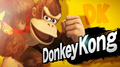 Donkey Kong in the Nintendo Direct from April 8th, 2014.
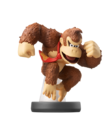 Donkey Kong's amiibo.
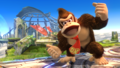 Donkey Kong's appearance during E3 2013.
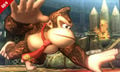 Donkey Kong's appearance in Super Smash Bros. for Nintendo 3DS.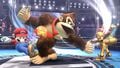
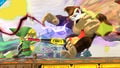 Being hit by Toon Link's Home-Run Bat.
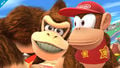 Alongside Diddy Kong.
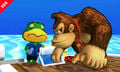 Alongside Kapp'n.
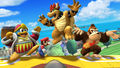 Taunting alongside King Dedede, Mario, and Bowser.
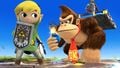 Holding Toon Link's Bomb.
 Alongside Wii Fit Trainer.
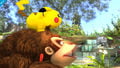 Pikachu footstool jumping on Donkey Kong.
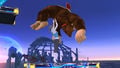 Wii Fit Trainer using her up throw on Donkey Kong.
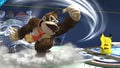 Using Spinning Kong alongside Pikachu.
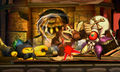 Using Spinning Kong on enemies in Smash Run.
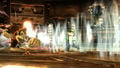 Using Storm Punch, one of his custom moves.


Trivia[edit]
- Donkey Kong's crowd chant references the DK Rap from Donkey Kong 64.
- Donkey Kong's default moveset has four meteor smashes, the most out of the entire cast.
- In Super Smash Bros. for Nintendo 3DS, Donkey Kong's mouth has a tendency to become oddly contorted if he is pummeled. However, this is merely a graphical issue.
- Donkey Kong's alt. trophy in Super Smash Bros. for Wii U resembles his Adventure Mode trophy in Melee.
References[edit]
| Fighters in Super Smash Bros. 4 | |
|---|---|
| Veterans | Bowser · Captain Falcon · Charizard · Diddy Kong · Donkey Kong · Dr. Mario · Falco · Fox · Ganondorf · Ike · Jigglypuff · King Dedede · Kirby · Link · Lucario · Lucas · Luigi · Mario · Marth · Meta Knight · Mewtwo · Mr. Game & Watch · Ness · Olimar · Peach · Pikachu · Pit · R.O.B. · Roy · Samus · Sheik · Sonic · Toon Link · Wario · Yoshi · Zelda · Zero Suit Samus |
| Newcomers | Bayonetta · Bowser Jr. · Cloud · Corrin · Dark Pit · Duck Hunt · Greninja · Little Mac · Lucina · Mega Man · Mii Fighter (Mii Brawler · Mii Gunner · Mii Swordfighter) · Pac-Man · Palutena · Robin · Rosalina & Luma · Ryu · Shulk · Villager · Wii Fit Trainer |
 Donkey Kong universe Donkey Kong universe
| |
|---|---|
| Fighters | Donkey Kong (SSB · SSBM · SSBB · SSB4 · SSBU) · Diddy Kong (SSBB · SSB4 · SSBU) · King K. Rool (SSBU) |
| Assist Trophy | Klaptrap |
| Boss | Giant Donkey Kong |
| Stages | Kongo Jungle · Kongo Falls · Jungle Japes · Rumble Falls · 75m · Jungle Hijinxs |
| Items | Hammer · Barrel Cannon · Peanut · Spring |
| Enemies | Kritter · Tiki Buzz |
| Other | Dixie Kong · DK Barrel · DK Island · Pauline · Stanley · Zinger |
| Trophies, Stickers and Spirits | Trophies (SSBM · SSBB · SSB4) · Stickers · Spirits |
| Music | Brawl · SSB4 · Ultimate |
| Masterpiece | Donkey Kong |
| Related content | Mario (universe) · Banjo · Barrel |

