


Metroid (universe)
| Metroid (universe) | |
|---|---|
 
| |
| Developer(s) | Nintendo Intelligent Systems Retro Studios Team Ninja Next Level Games MercurySteam |
| Publisher(s) | Nintendo |
| Designer(s) | Gunpei Yokoi Yoshio Sakamoto Makoto Kano Hiroji Kiyotake |
| Genre(s) | Platformer Adventure First-Person Shooter Metroidvania |
| Console/platform of origin | Nintendo Entertainment System (Famicom Disk System) |
| First installment | Metroid (1986) |
| Latest installment | Metroid Prime 4: Beyond (2025) |
| Article on Metroid Wiki | Metroid (universe) |
The Metroid universe (メトロイド, Metroid) refers to the Super Smash Bros. series' collection of characters, stages, and properties that hail from Nintendo's long-running series of science-fiction action-adventure games. Conceived and inspired by Western media, the Metroid series has garnered a notable following outside of Japan, with a large number of titles having also been developed by Western studios. The series has had twelve official games released thus far, with most of them being near-universally praised by critics and players alike. This series, along with Castlevania, were the progenitors of a subgenre of exploration-based adventure games known as "Metroidvania". The series also has a compilation (Metroid Prime: Trilogy) and two enhanced remakes (Zero Mission and Samus Returns). The main series revolves around the space-faring bounty-hunting exploits of a woman named Samus Aran trying to stop the terrors brought about by the parasitic Space Pirates and their monstrous commander, Ridley, while the Prime subseries revolves around Samus stopping the sentient mutagen substance Phazon and its avatar Dark Samus.
Franchise description[edit]
After the incredible success of Super Mario Bros. and The Legend of Zelda for the Famicom / NES, Nintendo wished to branch out and create a game with fast-paced action like the former, but with intricate exploration like the latter. Nintendo Research and Development 1 division led by Yoshio Sakamoto with producer Gunpei Yokoi were tasked with making this game a reality. The team took inspiration from Ridley Scott's 1979 sci-fi horror film Alien for both aesthetics and structure. Like The Legend of Zelda before it, the team wanted to hide permanent upgrades around the labyrinthine levels and encouraged backtracking to find new secrets with recently acquired upgrades. This game eventually released in August, 1986 as Metroid, the name being a portmanteau of "Metro" and "Android."
The game tasked bounty hunter Samus Aran with a lone mission to hunt down and kill all Metroids on planet Zebes, and taking down anyone and anything that gets in the way of the mission. While initially starting out with little more than basic weapons, Samus eventually finds a multitude of upgrades that will help find and take down any adversary. The game received praised for its inventive gameplay structure and its atmosphere, reveling in the sense of isolation and fear of what comes next. Metroid was also one of the first games to contain multiple endings, which were awarded based on how fast the game was completed; this had a hand in popularizing the concept of the "speedrun". Finally, Metroid was one of the first video games to feature a female protagonist - and this was initially presented to the gaming public as a concealed secret, even using masculine pronouns when referring to Samus in promotional material and the instruction manual, until the game was beaten in a fast-enough time. Despite this praise, the game only sold modestly in Japan, starting a trend of the franchise never performing well in that region. However, the 1987 North American release sold much better, and the game was overall considered a success. Also, in retrospect, this seminal entry has not aged particularly well, including a total lack of help over where to go and clunky feeling combat, especially compared to modern standards. Though most of these complaints are offset by its historical and cultural significance.
A sequel was then put into productions for Game Boy, which this time released in North America first in August 26, 1991 as Metroid II: Return of Samus. While very similar to the previous entry in terms of gameplay, his sequel did something that very few Nintendo series attempted to do during this time frame: directly continue the story from the previous game. Samus is now tasked with exterminating the last known population of metroids on planet SR388, including the Queen metroid and all of her eggs. However, Samus hesitated and refused to kill the last remaining metroid egg, and later handed the baby over to the Galactic Federation. Despite its important narrative influence on the series, the game was considered a step down from its predecessor, mostly due to being much more linear and was overall an easier experience. This caused sales to drop significantly, and put the series in a precarious position.

Another sequel was planned immediately after development wrapped, this time for the Super Famicom/SNES. Many members of the team that were not involved in the Game Boy entry, including Yoshio Sakamoto, returned for this entry, which would release in 1994 as Super Metroid. Immediately after the events of Return of Samus, the Galactic Federation is ambushed by Ridley and the Space pirates who steal the baby metroid and flee to planet Zebes. Samus gives chase and hunts down the Space pirates in an effort to get the baby back. With vastly refined combat, exploration mechanics, world design, and dialogue-free storytelling, the game garnered universal acclaim and is often labeled by official publications as not only one of the best games on the SNES, but also one of the best video games ever made. The greatest irony is that the American and PAL versions of Super Metroid sold well as a result of aggressive marketing by Nintendo that was spurred on by the game's poor sales in Japan. Analysts proclaim that the Japanese release of Super Metroid was poorly timed, not only because of more commercially successful games being released at the time like Donkey Kong Country, but because of the launches of the next-generation systems Sony PlayStation and Sega Saturn. This was a major contributing factor to what became a now-legendary eight-year hiatus for the series, which remained dormant despite Samus' appearance in Super Smash Bros. on the Nintendo 64, and Nintendo mentioning the possibility of an N64 installment which had never came to fruition.
The franchise would continue its presence in the Super Smash Bros. series as Samus reprised her role in Melee, but no new core entry appeared to be on the horizon. This hiatus was broken in 2002 with two brand new entries released that year. The first was Metroid Fusion for the Game Boy Advance, which continued the story after Super Metroid. The Galactic Federation realizes that metroids were natural predators to the X Parasite, which have begun invading all parts of the galaxy. Around this time, Samus gets infected by and X Parasite and nearly dies. The only way she was saved was to surgically remove her power suit and graft metroid DNA into her, which gave her the side effect of being able to consume X Parasite. Her new task is to hunt down any X Parasite before they destroy all life in the galaxy. The game was praised for its presentation and more in-depth story that ties in all previous entries, though was criticized for being more linear than any previous entry with many blatant efforts of handholding.
The second release was Metroid Prime for Nintendo GameCube, the series' inaugural transition into the third dimension as a first-person shooter. Set between Metroid and Metroid II, Samus discovers that the Space Pirates were experimenting with a dangerous substance known as Phazon, and must both learn how to harness and properly wield it, as well as defeat any creature corrupted by it. This entry was highly controversial prior to release. Not only was it being developed by a then-unknown company in the United States, the Texas-based Retro Studios, but its presentation with a first-person perspective led to accusations of being a complete departure from the Metroid fabric for the worse. The released product ultimately allayed these concerns, as Metroid Prime garnered extremely enthusiastic acclaim from critics and fans for managing the task of faithfully transplanting the classic formula into three dimensions and using the first-person viewpoint to its advantage and became one of the GameCube's best-selling titles as a result, securing the franchise's place as a Nintendo staple for the foreseeable future.

Throughout the 2000s, the Metroid franchise settled into a more regular release schedule following Prime and Fusion. On the console front, Metroid Prime would receive two direct sequels. the first was Metroid Prime 2: Echoes in 2004 for GameCube, which sees Samus fight a Phazon corrupted version of herself known as Dark Samus, as well as exploring planet Aether, and its alternate version Dark Aether, populated by the Ing, as she restores the balance of light and dark energy between the two Aethers. This game was well received, but ultimately seen as not a major step up to the formula. The second was Metroid Prime 3: Corruption in 2007 for Nintendo Wii, which sees Samus corrupted by Phazon, and thus having to team up with other bounty hunters to defeat the returning Dark Samus and keep the Phazon from corrupting other planets, ultimately travelling to planet Phaaze, the source of all Phazon, and destroying it. While the story was seen as nothing special, the brand new pointer controls were seen as revolutionary for a streamlined way to aim and shoot. The first two games games were then remastered in 2009 for Wii in Japan under the "New Play Controls" line, and these entries were then released internationally as a collection for Wii as Metroid Prime: Trilogy, with major changes being updated textures and all games sharing the pointer controls setup. Physical copies of this game are now considered rare and valuable due to their limited run.
On the handheld front, Metroid: Zero Mission released for the Game Boy Advance in February 2004. This is a full remake of the original Metroid with enhanced presentation, some gameplay improvements, and a new epilogue that would better tie this entry into the rest of the series. This entry was also the proper introduction of the Zero Suit, which would become an iconic design for Samus. In 2005, the series debuted on the Nintendo DS with Metroid Prime Pinball. While not a canon entry to the series, the game loosely retells the story of Metroid Prime in the form of a pinball game, with Samus as the ball. Then in 2006, also for the Nintendo DS, the game Metroid Prime Hunters. Set between Metroid Prime and Metroid Prime 2 the game sees Samus team up with other bounty hunters to defeat the Space Pirates. The game is essentially a first person shooter on the Nintendo DS. While praise was given for its ambition and excellent display of what the Nintendo DS is capable of, criticism was given to not all of its ideas landing.
Following the Wii compilation's original release, Retro Studios would shift its focus to revitalizing another dormant Nintendo franchise in Donkey Kong Country, leaving them preoccupied for the time being. After the conclusion of the Prime trilogy, the original visionaries like Yoshio Sakamoto would return for a console entry for the first time since Super Metroid. Sakamoto would collaborate with Team Ninja with full creative freedom to make the Metroid game he always wanted to make. This game would release as Metroid: Other M in August 2010 for the Wii Taking place between Super Metroid and Metroid Fusion, the game saw Samus team up with old friend from the Galactic Federation to figure out the cause of a distress signal, and in turn discover the horrific experiments on the ship that sent the signal that the Federation was partially responsible for and is trying to cover up. Its new third-person action-adventure gameplay aspects were generally well-received; however, some reviewers criticized its strikingly linear approach to level design, approach to characterization of Samus, the voice acting and dialogue (with the English dub directed by the non-English-speaking Yoshio Sakamoto), and the game's methods of telling a cutscene-heavy story, with these aforementioned elements causing a high degree of fan controversy and backlash. This, combined with the game's poor sales outside of Japan, dealt a critical blow to the series' success streak and marked the beginning of a second hiatus for the franchise.
After being represented exclusively in cameos and crossovers throughout the 2010s, Metroid would suddenly return at E3 2015, with a new game in the series was announced for the Nintendo 3DS, Metroid Prime: Federation Force. Developed by Next Level Games as a multiplayer based spinoff of the Metroid series, released in 2016. The game is a cooperative first-person shooter, where the player assumes the role of a faceless Galactic Federation Marine and featuring gameplay elements similar to that of Metroid Prime Hunters. The game also featured a side mode called "Blast Ball" in which two teams of four Federation troops blast a large soccer ball to the other team's goal. Much like Other M before it, the game was met with a highly polarized reception, though Federation Force was lambasted for its change in graphical style, heavily reduced focus on Samus, focus on combat over exploration, and its overall departure from the series' general tone. Further criticism was aimed at the fact that the first Metroid game announced after the franchise's five-year hiatus was a spin-off title and not a core entry in either the 2D series or the Prime series, particularly for the franchise's 30th anniversary. This was essentially the wrong game at the wrong time. On release, Federation Force sold poorly and was generally met with lukewarm reviews, now being considered "dead on arrival" to critics and fans.
With the series once again in a rocky position, Nintendo surprised everyone with two new installments announced at E3 2017 - Metroid Prime 4 for the Nintendo Switch, and Metroid: Samus Returns for the Nintendo 3DS. The latter of the two is an enhanced remake of Metroid II: Return of Samus developed by MercurySteam, who previously handled the Castlevania: Lords of Shadow games. Samus Returns would release in September of that year and the reveal of these two games marked the true end of the main series' hiatus and, together with a new sub-line of Metroid amiibo, signaled the return of Metroid as one of Nintendo's flagship franchises.
While Samus Returns saw incredibly positive reception from fans and critics for bringing the series back to its roots despite lukewarm sales (which can be partly attributed to the waning lifespan of the 3DS), information on Metroid Prime 4 was hazy at best. Shortly after the game's teaser announcement, it was confirmed that longtime developer Retro Studios would not be returning for the new entry. Instead, it would be handled by an unspecified new development team. Roughly two years later, even after the series saw an increase in representation in Super Smash Bros. Ultimate, it was announced in January 2019 that the game's development would be restarted from scratch. Shinya Takahashi cited development struggles under the new team to meet the quality standards of the previous Metroid Prime titles and the expectations of series fans. As a result, series producer Kensuke Tanabe would restart the game's development, but with none other than the original developer of the Metroid Prime series - Retro Studios.
Meanwhile, producer Yoshio Sakamoto would continue working with MercurySteam to develop a new 2D entry into the series. This would manifest in 2021 as Metroid Dread for the Nintendo Switch, a project 15 years in the making and the first proper continuation of the Metroid storyline since Fusion. This game sees Samus travel to planet ZDR, only to be attacked and left stranded by a somehow living Chozo. Trying to find a way off the planet and investigate what this Chozo wants, Samus will learn long forgotten parts of galactic history, as well as her own past and heritage. The game was universally praised for being the culmination of the 2D Metroid formula with excellent controls, level design, and a good balance of exposition and environmental storytelling. This caused the game to sell over 3 million copies and become the best selling single release in the series, breaking its curse of each entry having relatively low sales.
A remaster of the first Metroid Prime game would release in early 2023, featuring a large graphical overhaul along with a more modern control scheme. Release to rave reviews, Prime Remastered would ensure the series' continued presence from there on. The game is also an indication of what directions Metroid Prime 4 will take, though nothing about the game would materialize until June 2024, where first look at gameplay would finally be shown off in a Nintendo Direct. Its name would officially be revealed as Metroid Prime 4: Beyond. The game was released on December 4, 2025 for both the Nintendo Switch and Nintendo Switch 2. Metroid Prime 4: Beyond received a postive reception, with main praise going towards its level design, gameplay additions, and enhanced graphical additions for the Switch 2 version. The main criticisms for the game comes from the addition of non-player characters and open-world elements for the first time in the series.
Overall, while always considered an underdog in terms of sales, the Metroid series is often held up as one of Nintendo's most prestigious franchises and maintains a dedicated fanbase, particularly in the West. Super Metroid and the Metroid Prime trilogy in particular have garnered significant praise from fans and reviewers. Samus herself, while not achieving the same level of recognition or marketability as Mario or Link, is widely praised as one of Nintendo's most iconic characters and a groundbreaking example of proactive female protagonists in gaming.
In Super Smash Bros.[edit]
Despite there being no Metroid title on the Nintendo 64, the Metroid franchise is represented as one of several "standard universes" found in the first Super Smash Bros. installment. In total, there is one character and one stage representing the series, both which focus on the original Metroid and the more recent Super Metroid. This game makes Samus's first and only appearance on the Nintendo 64, and she was one of the four characters originally conceived for the pitch of Super Smash Bros. as a Nintendo all-stars crossover game, the other three being Mario, Donkey Kong, and Fox McCloud.
Fighter[edit]
- Samus (Starter): An intergalactic bounty hunter in a technologically advanced and flexible Power Suit, Samus Aran is a bona fide warrior who was orphaned from a Space Pirate attack at a young age. She was harbored by the benevolent Chozo race at a young age and infused with their heritage and technology, and she now allies with the Galactic Federation as ostensibly a one-woman army against the menace of the Space Pirates and their attempts to use the life-stealing Metroids to conquer the universe. In Smash 64, Samus appears as a starting roster. Her neutral special is the Charge Shot, a chargeable ball of energy that Samus shoots out of her arm cannon. Her up special is the Screw Attack first appearing in the original Metroid. Finally, her down special is her Bomb from the original Metroid, in which she turns into the Morph Ball and lay a bomb that will explode either upon contact after a set amount of time.

Stage[edit]
- Planet Zebes (Starter): This stage is designed to resemble the general environment and hazards of the caverns of the titular planet that Metroid and Super Metroid take place in. It is a big platform with three platforms above it, and one on the right moving vertically. The stage features an ocean of acid that periodically rises up and submerges the lower portion of the stage. Touching the acid will damage a character and send them flying upward. Due to the rising acid, however, it is impossible under normal conditions to be KO'd by falling below the main platform.

Music[edit]
- Planet Zebes Stage: A remix of the Brinstar music from the original Metroid for NES. It is heard on Planet Zebes.
- 18: Samus Wins: The victory theme of Samus is an orchestration of the music heard when Samus finds a new item or power-up in general Metroid games.
In Super Smash Bros. Melee[edit]
Much like the original Smash 64, there was no new Metroid game released before Melee, so the majority of Metroid representation is still from the original Metroid and Super Metroid. This game features much more Metroid content than Smash 64, including one returning character, two new stages, and a handful of trophies. This game also introduces the first Metroid item.
Fighter[edit]
- Samus (Starter): Samus returns as a starter character, and as the only Metroid character, likely because of the nature of Metroid games and how they do not tend to feature notable supporting characters. As with all returning characters, Samus gained a new side special, being her Missile attack from Super Metroid. She points her arm cannon in front of her, and shoots either a Homing Missile or a Super Missile depending on how the control stick is tapped. Samus is considered to be one of the two most buffed characters from Smash 64.

Stages[edit]
- Planet Zebes: Brinstar (Starter): This stage is the spiritual successor to the original Planet Zebes stage, and it features a nearly identical layout; aside from the visuals, the only real difference to this stage is that parts of the stage can be damaged by attacking them, and destroying these can cause the elevated platforms to rise upwards to steep angles and the big lower platform to break apart into two. A large brain-like creature appears in the background, shaking whenever the lava comes up to it.

- Planet Zebes: Brinstar Depths (Unlockable): This stage appears to be loosely based on Kraid's encounter in Super Metroid. A difficult stage to keep on top of, this is essentially a giant, craggy, circular mass of rock that floats above lava. The lava on the bottom of the screen does not damage the player like other Metroid stages, as it is merely a background effect symbolizing the blast line. The stage is routinely rotated by the gigantic alien monster Kraid in the background. It is impossible to grab onto any ledge in this stage.

Adventure Mode stage[edit]
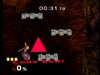
- Brinstar Escape Shaft: Based on the escape sequences in most Metroid games, Brinstar Escape Shaft appears as the second part of Stage 4 in Adventure Mode. After defeating Samus on Brinstar, a warning message appears, taking the player to the Brinstar Escape Shaft. The player is tasked with climbing up to the escape pod within thirty seconds. If the player fails to reach the escape pod in time, they will lose a stock. Regardless of whether or not the player makes it to the escape pod, they will move on to Stage 5.
Item[edit]
- Screw Attack: An upgrade that Samus has been able to obtain ever since the original Metroid. It allows Samus to somersault into enemies in the air, killing many instantly. In Melee, a character can pick up this item and perform the same action once they jump, similar to Samus's own up special. The character can also hurl it at an opponent and the opponent will automatically jump up, whirling.
Music[edit]
- 7: Brinstar: A medley of three classic tunes from the original Metroid. The first part of the medley is a techno remix of the first "Brinstar" area music. It is then followed by the short "game start" tune one hears whenever resuming a game file. Finally, a remix of the title screen plays before looping back into the first track. This is heard on the Brinstar stage, and acts as one of Samus's credits themes. It is Song 7 in the Sound Test.
- 8: Brinstar Depths: A synth, techno remix of area music heard later on in the original Metroid, where Samus is particularly close to her encounter with Kraid. A bridge section consists of the short tune played in item rooms in the original Metroid. This is heard in the stage Brinstar Depths, and acts as one of Samus's credits themes. It is Song 8 in the Sound Test.
- Samus's Victory: The victory theme of Samus is an orchestration of the jingle heard when Samus finds a new item or power-up in the Metroid games. It is Song 41 in the Sound Test.
Trophies[edit]
In Super Smash Bros. Brawl[edit]
A fairly decent amount of content from the Metroid franchise appears in Super Smash Bros. Brawl.
Fighters[edit]

- Samus/Zero Suit Samus (Starter): Unique to Brawl, Samus can transform into Zero Suit Samus. Unlike other transformations, the player can switch between the two via Final Smash rather than their down special (or in Samus' case, also by a series of taunts). While only Samus is shown on the character selection screen, the player can start the match as Zero Suit Samus by holding down a certain button depending on the controller when selecting Samus.
- Samus: Shown in trailers as a returning character for Brawl, Samus Aran has been visually touched up to look like her more detailed incarnation in the final sequence of Metroid: Zero Mission, but otherwise plays similar to her Melee incarnation. Her Final Smash, the Zero Laser, is a huge beam that literally blows off her own armor to become a pile of throwable Power Suit Pieces and renders her as a new playable character, Zero Suit Samus.

- Zero Suit Samus: The suitless version of Samus from Metroid: Zero Mission is playable via Samus' Final Smash. She fights acrobatically and carries a projectile attack in the form of her handheld Paralyzer gun, which she also uses as the basis for her Plasma Whip and Plasma Wire special attacks - both of which can be used for tether recovery. Zero Suit Samus' Final Smash involves a huge, blinding ball of light forming around her, returning her to her status with the Power Suit.

On the final character select screen (after all characters are unlocked), Samus shares the fourth column with fellow Famicom/NES-originated characters Ice Climbers, R.O.B., and Pit.
Bosses[edit]
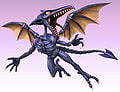
- Ridley: Samus's arch enemy Ridley makes an appearance in the Subspace Emissary as a boss that Samus and Pikachu encounter in a facility on the Island of Ancients shortly after Samus regains her Power Suit. It would seem he is working for the Subspace Army, but no information really exists on his storyline importance.
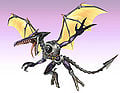
- Meta Ridley: Later in the game, when a slew of characters are escaping from the self-destructing Subspace Bomb Factory on Captain Falcon's Falcon Flyer, a rebuilt Ridley in his "Meta" form as seen in Metroid Prime appears. While he is canonically just a modified Ridley, the fight plays out nothing like the previous Ridley fight. It is worth noting that Metroid is the only represented franchise to feature more than one boss fight.
Stages[edit]

 Melee Stages: Brinstar (Starter): One of the few stages to return from the previous game, it is mostly unchanged from Melee.
- Norfair (Starter): A new stage set in the fiery depths of Zebes, this stage, like previous Metroid stages, features rising lava. In addition to this, lava can come from the sides of the screens too, as well as in an enormous wave from the background that forces players to fight to stay inside a temporary safe zone to avoid damage.

- Frigate Orpheon (Starter): Set in the opening area of the first Metroid Prime, which contains the Parasite Queen, this stage has an interesting twist. When the warning siren sounds, the stage flips, and what was once above the players becomes the new platforms to fight on.

Item[edit]
- Screw Attack: The Screw Attack item returns in Brawl. However, the item is now placed on the user's body when equipped rather than holding it. This means it cannot be thrown at other players.
Assist Trophy[edit]
- Metroid: A Metroid latches its body on a character's head and starts draining their health, increasing the character's damage percentage in the process.
Music[edit]
Original tracks[edit]
- Main Theme (Metroid) - A rock styled remix of the Brinstar theme from the first Metroid title. Aside from the vocals at the beginning of the track, this is taken almost directly from Metroid Prime Pinball, with the insertion of some extra instruments and the addition of the original Brinstar NES-like remix. It is used on the Norfair stage.
- Ending (Metroid) - An orchestrated version of the credits theme used in both the original Metroid and its remake, Metroid Zero Mission. It is used on the Norfair stage. This song is also played during both Samus and Zero Suit Samus' Classic Mode credits.
- Norfair - A quirky remix of the lesser-known Norfair theme from the original Metroid game. It is the theme of the Norfair stage.
- Theme of Samus Aran, Space Warrior - An orchestration of the credits theme of the SNES hit, Super Metroid. It is used on the Norfair stage.
- Vs. Ridley - A remix of Ridley's theme that is featured in several Metroid games and originated in Super Metroid. It is used on the Frigate Orpheon stage.
- Opening/Menu (Metroid Prime) - A medley of two tracks from Metroid Prime - the title screen and the credits theme (which itself was an extension of the menu theme). With the exception of the vocals at the beginning, the title screen theme is taken directly from the game, while the credits theme is arranged. It is the theme of the Frigate Orpheon stage.
- Sector 1 - An orchestrated version of the background music of the first mission in Sector 1 in Metroid Fusion. It is used on the Frigate Orpheon stage.
Returning tracks[edit]
- Brinstar (Melee) - Taken directly from Melee. It is used on the Brinstar stage.
- Brinstar Depths (Melee) - Taken directly from Melee. It is used on the Brinstar stage.
Source tracks[edit]
- Vs. Parasite Queen - Taken directly from Metroid Prime, this was the track that played when Samus fought the Parasite Queen during the opening section of the game. It is used on the Frigate Orpheon stage.
- Vs. Meta Ridley - Taken directly from Metroid Prime, this was the background music that played during the fight against Meta Ridley. This same, unaltered track was also used in Metroid Prime 3: Corruption. It is used on the Frigate Orpheon stage.
- Multiplayer (Metroid Prime 2) - A track taken directly from the multiplayer mode of Metroid Prime 2: Echoes, which itself was a techno remix of the Brinstar background music from Super Metroid. It is used on the Frigate Orpheon stage.
Victory theme[edit]
- Victory! Metroid Series - The "get item" fanfare featured in every single Metroid game to date except for Metroid: Other M.
Trophies[edit]
Stickers[edit]
Masterpiece[edit]
In Super Smash Bros. 4[edit]
The Metroid series is one of the better represented series in Smash 4. Not only do all characters from Brawl return with updated designs and most secondary content (the Screw Attack item, the Metroid Assist Trophy, the Ridley boss, most stages, and music), but it includes a wealth of new content, including two new Assist Trophies, a new stage, and two new music arrangements. Much of the new content derives from Metroid: Other M, which was released between the releases of Brawl and Smash 4 in 2010.
Fighters[edit]
- Samus (Starter): A galactic bounty hunter who fights to eradicate the Metroid threat. Samus Aran was confirmed to return during the E3 2013 Nintendo Direct. This is the first Smash Bros. title where her orange Varia Suit is no longer based on its design in Super Metroid. It now reflects its design in Metroid: Other M, though it includes details not in the source material, such as perforated metal and black vents between the seams. Her Grapple Beam has been significantly improved as a grab and tether, and the speed of a fully powered Charge Shot has been increased. Due to limitations of the Nintendo 3DS hardware, Samus can no longer transform into Zero Suit Samus by any means. She has two new alternate costumes for 8-Player Smash: one is based on the Light Suit from Metroid Prime and the other is based on her rival from the Prime saga, Dark Samus.

- Zero Suit Samus (Starter): Space Warrior Samus Aran as she appears in the eponymous Zero Suit from Metroid: Zero Mission. She was confirmed to return during the dedicated April 2014 Smash Bros. Direct. Like Fox and Marth, Zero Suit Samus has a composite design that combines elements from several titles, including Zero Mission, Metroid Fusion, and Metroid: Other M. Uniquely to Smash, Samus is equipped with a pair of Jet Boots that emphasize buffs made to her kick-based attacks and jumps. Like the Grapple Beam, the Plasma Wire of her Paralyzer has been significantly improved as a tether. No longer bound to her Varia Suit, Zero Suit Samus summons her Gunship and fires powerful beams for her Final Smash.

Stages[edit]
for Nintendo 3DS[edit]
 Brinstar (Starter): Staged in a cavernous area on Planet Zebes, the setting of the original Metroid and Super Metroid. Acid rises and falls at the bottom of stage and burns players on contact. What resembles a massive egg sac wiggles in the distance, and a Chozo statue is in the immediate background. The acid is more vibrant than it was in Brawl, likely to stand out more on the 3DS's screen. It is one of the possible stages to appear in Level 2 of All-Star Mode as a home stage for Samus. Its Ω form is a spacious floating platform like Final Destination.
for Wii U[edit]

 Norfair (Starter): Staged in a magma-filled cavern deep within Planet Zebes. Like Brinstar, the volatile magma sea rises and falls, often covering the lowermost platforms. Rushing waves of magma periodically engulf the stage's platforms and can only be avoided by entering the protective safe zones. The magma glows more intensely than it did in Brawl. Norfair is large enough to accommodate 8-Player Smash, but the magma does not rise. It is one of the possible stages to appear in Level 6 of All-Star Mode as a home stage for Samus. Its Ω form is a spacious floating platform like Final Destination.
- Pyrosphere (Starter): A spacious arena within the lava-filled sector of the Bottle Ship, the setting of Metroid: Other M. The primary platform is Pyrosphere's Geothermal Power Plant. Secondary floating platforms flank the Power Plant, making the stage similar to Pokémon Stadium 2. The main gimmick of the stage is that Ridley resides here as a stage boss. Otherwise, Joulions and FG II-Graham units appear as enemies that will attack nearby opponents. Zeros also appear but are harmless. They can be picked up and tossed at opponents. Pyrosphere is large enough to accommodate 8-Player Smash, but Ridley does not appear and the background lava is removed. It is one of the possible stages to appear in Level 2 of All-Star Mode as a home stage for Zero Suit Samus. Its Ω form is a spacious floating platform like Final Destination.

Item[edit]
- Screw Attack (status): A badge from the original Metroid. When equipped, the player's first and second jumps are replaced with energized, rotating jumps that damage opponents on contact. It is an iconic item in the Metroid series and serves as the series icon in Smash.
Assist Trophies[edit]
Bold italics denote an Assist Trophy new to the Smash Bros. series.
- Metroid: The eponymous jellyfish-like parasite of the Metroid series. It hovers around the stage before attaching to a nearby opponent's head, inhibiting their motion and increasing their damage percentage. It does not attack the summoner. It also appears as an enemy in Smash Run and Smash Tour.
- Mother Brain: One of the main antagonists of the Metroid series. She is an enormous, disembodied brain with one unblinking eye. In Smash, she is restricted to her Control Capsule and attacks opponents with her Laser Brain Attack from Super Metroid. Though sessile, a swarm of Rinkas hover around her and cause damage on contact. Opponents can attack her to stall her attacks and make her disappear prematurely. She does not attack the summoner.
- Dark Samus: An antagonist from the Metroid Prime titles in the guise of Samus. She fires rapid-fire beams and large spheres of Phazon from her arm cannon to attack opponents. She does not attack the summoner.