


Character legality
Character legality refers to the playability of a character within the context of competitive play. Unlike stage legality, a common and widely established factor within virtually every Smash tournament, character legality is often hotly debated and limited to few specific characters, particularly top tiers who are considered overtly dominant by a majority of the community, whilst also being largely variable, with no uniform ruleset among tournaments; for example, Meta Knight in Super Smash Bros. Brawl and Steve in Super Smash Bros. Ultimate are infrequently banned at various tournaments, although bans remain a minority among major tournaments. Additionally, banning characters can sometimes be avoided if other problematic techniques can be limited or otherwise banned; for example, despite only being considered merely high-tier characters, wobbling is universally banned for the Ice Climbers in competitive play, with the majority of majors forbidding the technique today. Comparatively, their next incarnation in Brawl, were considered incredibly strong, with or without their chain-grab combos. A similar occurrence happened in Brawl, with a small prevalence of infinite chain grabs within the metagame; a few tournaments had banned particularly devastating chain grabs, such as King Dedede's standing chain grab against various characters.
Character legality can also vary amongst formats; in terms of doubles, many team compositions are considered far too strong and are almost always unanimously banned, mainly consisting of two players playing the same high tier, such as double Pikachu in Smash 64, double Meta Knight in Brawl, and double Cloud in Super Smash Bros. 4. Side events may also opt to ban specific characters, such as low tier tournaments banning higher-tiered characters, and Squad Strike tournaments banning Echo Fighters. The following article will only list ban discussions in singles and doubles formats, as character bans in side events are often arbitrary and not out of maintaining balance. Additionally, this article will also forgo characters only accessible via hacking; modifying the game is controversial and not a universal sight within every tournament, and all traditionally non-playable characters remain universally banned in competitive play, largely due to logistical issues, rather than being overwhelmingly powerful.
In Super Smash Bros.[edit]
Pikachu[edit]
Pikachu had a brief ban discussion in 2017. Pikachu is widely considered to be the undisputed best character in the game, having strong agility characteristics, an invincible recovery move in Quick Attack, and one of the best combo games in 64. At the time, Pikachu was considered to have no losing matchups, and was the most represented character in the entire game, leading to various calls for a ban, with a notable supporter in KeroKeroppi.
As of today, no widespread bans have ever came to fruition regarding Pikachu within singles play. As the metagame progressed, Pikachu would gain two new troublesome matchups in Captain Falcon and Yoshi, two of the most combo heavy characters in the game. As Pikachu is a lightweight fighter, it is heavily susceptible to early KOs from combos, with Captain Falcon and Yoshi excelling in combo and kill power. Additionally, despite Pikachu's undisputed placement, its dominance over the metagame is arguably the weakest across the top tiers of the Smash games; while Pikachu is considered the best character in the game, high-tiers and mid-tiers such as Mario, Jigglypuff, Samus, and even the lowest ranked characters like Ness, are common mains in competitive play, and even more common as secondaries; Isai in particular has demonstrated prominence with the entire cast. With a waning grip on the metagame, alongside new troublesome matchups, the ban debate on Pikachu has effectively settled.
In doubles[edit]
While Pikachu remains universally legal in singles tournaments, Pikachu/Pikachu in doubles play remains near universally banned, due to little reason to not use both.[1][2][3] Even with the ban, a large majority of teams in 64 include Pikachu, likely owing to its potent combo game pairing well with other characters.
Formerly, Kirby/Pikachu and Kirby/Kirby teams also have a history of being banned for similar reasons, as Kirby remains the undisputed second-best character in the game. On the contrary, Kirby's dominance in doubles play remains disputed, and a majority of players consider Kirby less problematic in doubles than Pikachu, and remains legal for the majority of doubles tournaments. Even Kirby/Kirby has remained far less dominant than expected, as Battle At The Border '23, which had Kirby/Kirby legal, saw no Kirby-related teams make top 8. As such, while Kirby/Kirby sports mixed legality, other Kirby-related teams typically remain legal.
Much like Smash 64's singles metagame, other lower-ranked characters remain common in doubles play, such as Luigi, and said characters have even won major doubles brackets, such as Snosa IV, with the aforementioned tournament even leaving Pikachu/Pikachu legal.
In Super Smash Bros. Melee[edit]
Melee is an anomaly among the Smash series, as there have been no major efforts to ban characters in it. Regardless, a few characters' legalities have been challenged over the game's lifespan.
Jigglypuff is the most prominent example of this. Jigglypuff is one of the most controversial characters in the game; it arguably contains the single most polarizing archetype in Melee, ranking among the game's lightest characters, but being able to kill opponents incredibly early through a combination of a strong edgeguarding game, and its down special, Rest, one of the strongest moves in the entire game. As a result, Jigglypuff players often play a more campy, whiff-punishing style compared to other characters within Melee, of whom can typically sustain more hits than Jigglypuff. However, many players have found the degree that Jigglypuff can control the game to be incredibly frustrating or unfun to fight against; Jigglypuff can KO almost any character in Melee incredibly easily off of a single opening (given that an opponent presents it), meaning that Jigglypuff players often need to stall out the opponent in order to wait for an opening to secure a stock. Jigglypuff can do this the most out of any other character in the game; it has multiple jumps, as well as rising Pounds, and to top it all off, it can abuse planking to aid its stalling. The most prominent proponent of Jigglypuff legality changes is Leffen; while not the only vocal top player, he has been the most vocal about his disdain for Jigglypuff, and has also supported rules that would target Jigglypuff players, such as a ledge grab limit, and airtime limit.[4]
Despite these concerns, the overwhelming majority of players do not support a Jigglypuff ban. Despite being a top-tiered character, it's considered to lose all of the matchups for every character ranked above it on the tier list; Fox and Marth are often disadvantageous for Jigglypuff, and characters around it have improved their matchups against Jigglypuff; Sheik in particular was formerly considered to lose against Jigglypuff, but as the metagame has progressed, it is generally regarded as an even matchup at worst for characters. Additionally, although Hungrybox has achieved immense success with Jigglypuff, other players have failed to match his success since the early metagame; SDJ is the only other player to have ranked within the top 20 with Jigglypuff since Hungrybox's debut on the scene, and other characters, such as Fox and Marth, have proven to be more popular than Jigglypuff. As such, there remains no ban of Jigglypuff across all majors.
While many players do not support a Jigglypuff ban, many players do, however, support ledge grab limit, not only for Jigglypuff, but for all characters. Many characters can indefinitely stall at the ledge; Marth, for example, can easily shark at ledge with his forward aerial to make himself virtually invincible and unapproachable. In a more extreme example, some characters such as Sheik can fully refresh their ledge intangibility without being vulnerable for a single frame. Additionally, there have been efforts to change rulesets to nerf certain characters, such as a ban on wobbling, and legalizing and talks of banning arcade controllers and Z-jump.
In Super Smash Bros. Brawl[edit]
Meta Knight[edit]
Brawl is notorious for having arguably the strongest character of the Smash series; Meta Knight, who was immediately recognized as the single best character in Brawl, and had remained as such until the end of the game's active lifespan, being ranked as 1st on every tier list released for Brawl. Meta Knight, for the most part, ranks at the top of the pack in terms of almost every attribute across every character, having near unparalleled frame data (particularly his infamous up air, which is easy to spam and hard to respond to), solid KO power relative to the rest of the cast, and arguably the best camping ability in the entire game, with multiple jumps, a nearly unbeatable air-camping and planking strategy, and the single best recovery in the game. With no character even coming close to having Meta Knight's strengths, he was considered to have no losing matchups, and arguably only going even against the Ice Climbers, who never even remotely reached the same highs as Meta Knight. With no other character being able to challenge Meta Knight's position as the single best character in the game, he holds the most major wins at 34, with no other character coming into the double digits of major victories within Brawl's lifespan. As such, Meta Knight remains as the undisputed best character in the entire game, and is widely considered the most "broken" Smash character of all time, and undoubtedly one of the series' best characters of all time.
Within months of the game's release, players realized how strong Meta Knight was, and the character consumed the Brawl metagame. Discussions about potentially banning Meta Knight ensued not long after, but dissenters did not believe Meta Knight was truly broken, with him lacking chain-grabs or a projectile, and argued that, despite being the best, Meta Knight was not dominant enough to be banned, citing other players' strong results with other characters, as well as counterplay to Meta Knight, such as Pikachu's matchup against Meta Knight (which was considered even at the time); Ally's greater outplacing record over Mew2King at the time (though Mew2King would later end up winning the most majors out of any player by the end of Brawl's active competitive lifespan)[5] also bolstered opposition to a ban. Polls around the time showcase the near 50-50 division between players that wanted Meta Knight banned and players that did not, with the former somewhat outnumbering the later.[6][7][8] WHOBO 1 especially escalated the ban debate, with only one player within top 8 not playing Meta Knight in any capacity: CO18, who played King Dedede. In 2009, a poll was conducted by the Smash Back Room in order to determine the legality of Meta Knight, which required super majority (2/3) support to pass.[9] However, the results ended in only a simple majority of support for a ban, and thus no ban was codified in the Backroom's Recommended Ruleset.
Meta Knight's prominence in the metagame only continued since; out of all of Brawl's majors within 2010, all of them, save for two (MLG DC 2010 and Bushido Brawl Impact), had no less than three Meta Knight players make top 8, and Pound 4 had six Meta Knight players make top 8, including Ally, who had picked up a Meta Knight secondary at the time. In 2011 alone, all of North America's majors were won by Meta Knight players; additionally, data compiled by John Numbers had shown that Meta Knight players had won over half of all recorded tournament winnings,[10] definitively proving his dominance. With mounting frustration and criticism towards Meta Knight's dominance, Chia, a member of the Unity Ruleset Committee, posted a poll which once again questioned Meta Knight's legality.[11], which garnered 75.9% support of a ban, thereby cementing a super majority in support. While this poll did not directly ban Meta Knight, the URC opted to ban Meta Knight after it won an internal vote of 14-0, with only 1 abstention.[12] Meta Knight would be wholly banned in all tournaments which followed the URC ruleset after Apex 2012.[13]
Despite the consensus, the ban posed by the Unity Ruleset was entirely ignored by the remainder of major Brawl tournaments in its lifespan. One notable opponent of the Meta Knight ban was Alex Strife, the head TO of the Apex series; Alex had opted to leave Meta Knight legal to appeal to Japanese players, who ran a much more strict ruleset, leaving Meta Knight legal.[14] The only notable tournament which banned Meta Knight was WHOBO 4, an event considered a national tournament, but this remained the only notable exception within Brawl's competitive lifespan. The URC's ruling has been continually ignored in the post-Smash 4 metagame, with Monarch being among the exceptions in having a Meta Knight ban. While he is still seen as the game's best character, the lower stakes of Brawl tournaments following Smash 4's release, especially given that many Brawl tournaments today are relegated to side events where Meta Knight is only slightly less common than he was during the game's heyday, make it unlikely that a ban will ever come to fruition. A few post-Smash 4 regionals have opted to ban Meta Knight, such as Glitch 2, but these are still far from common, and are outweighed by the amount of Meta Knight-legal tournaments today.
Alternatively, instead of banning Meta Knight, there were attempts to change the competitive ruleset to indirectly nerf Meta Knight. These have resulted in the banning of Halberd and Delfino Plaza, as they were Meta Knight's best stages because of the stages' use of semisoft platforms, which allows for sharking from under the stage that no character could match. The Supernova series has opted to introduce a stage clause that allows the opposing player to pick any legal stage if their opponent picks Meta Knight, ignoring the traditional stage striking system in competitive play. This has seen positive reception from competitors, with many also endorsing the clause for Steve in Ultimate. While its effectiveness remains unproven in both games, it has remained in effect with little drawbacks. In addition, bans on scrooging and enacting a lower ledge grab limit of 20 (opposed to the universal edge grab limit of 35) have been put in place due to Meta Knights effective air stalling. Despite the nerfs, Meta Knight remains the undisputed best character in the game, and even with the stage changes, he can still camp on the majority of legal stages, but to a lesser extent than other formerly legal stages.
Ice Climbers[edit]

The Ice Climbers were another contentious character that would see limited bans. They are considered the definitive second best character, with a large gap between the rest of the cast, due to a reliable, inescapable, universal zero-to-death infinite chain grab in their hand-off combos. Additionally, they have an incredibly high damage output, combined with solid frame data on most of their moves, which makes even a lone Ice Climber threatening to the majority of the cast. Their only major weakness is their susceptibility to camping; their worst matchups tend to be against characters who can make themselves difficult to grab, with Toon Link and Meta Knight being two of their worst matchups. However, with the majority of characters in Brawl being unable to keep the Ice Climbers at bay, they possess a near perfect matchup spread, and are considered to be the undisputed second-best character in the entire game, and the only character ranked in the S-tier on the tier list. Near and after the end of Brawl's lifespan, the Ice Climbers' dominance had especially begun to show, with four players ranked within the top 20 with the Ice Climbers as a main or secondary, and with 686M being considered one of the game's best players in the post-Smash 4 metagame.
While not as prevalent as Meta Knight, many have found the Ice Climbers to be broken as well, though bans were even rarer than the already sparse bans for Meta Knight. Some post-Smash 4 tournaments, particularly smaller, less prestigious events, opted to ban Meta Knight and the Ice Climbers, such as the aforementioned Glitch 2. A few tournaments have instead banned the Ice Climbers' hand-off combos instead, such as the aforementioned Monarch, which banned Meta Knight outright.
In Super Smash Bros. 4[edit]
Bayonetta[edit]

The DLC character Bayonetta, upon her debut, was almost immediately recognized as the strongest character in the game.[15][16] She reigned at the top in many attributes, akin to Meta Knight; she had one of the strongest combo games in the entire game, complemented with her absurdly strong kill power, being able to kill opponents off the top of the stage with her up-air at 70%, especially with rage. Her Witch Twist could also KO opponents incredibly early, even without rage, being able to perform a zero-to-death combo off of a downwards After Burner Kick. Her aerials also had incredible range, fast frame data, and incredibly solid kill power. Her most dominant move was Witch Time, as upon countering an opponent's attacks, regardless of strength, she would be guaranteed no less than 3 seconds of slowdown, which allowed her a variety of openings, including unleashing fully charged smash attacks, setting up lethal kill combos, or escaping an otherwise dangerous situation. Combined with Bat Within, this allowed Bayonetta to hold arguably the single strongest defensive game in Smash 4, even stronger than Mewtwo. All of these strengths lead to an extremely potent fighter that could invalidate the majority of the cast. As such, many tournaments had considered banning Bayonetta, most notably in Spain, where the overwhelming majority of players agreed with a ban of Bayonetta.[17]
Bayonetta received various nerfs which toned down her polarizing traits. Update 1.1.5 decreased her knockback on various moves, increased Heel Slide's lag overall (one of her main combo starters), and made Witch Time slightly less effective by increasing its ending lag and making its duration shorter after continuous uses. Update 1.1.6 consisted only of changes to Bayonetta, bringing much more impactful nerfs by adjusting After Burner Kick and Witch Twist's knockback and doubling both moves' SDI multipliers, weakening her combo game, and giving more ending lag to her down tilt and forward aerial, weakening her combo starters. These nerfs initially weakened her perception in the community; though players still agreed she was a strong and well-represented character, as shown in Pink Fresh's victory at 2GGT: KTAR Saga, most believed the traits that made her overpowered had been toned down significantly, and as such, she was no longer considered the best character in the game. This opinion was represented on Bayonetta's placement on the second tier list, where she was ranked 11th.
However, it eventually became apparent that these nerfs only served to delay Bayonetta's rise to the top: though her combo game was weakened, players adopted a more creative playstyle that kept her combo game incredibly strong, and zero-to-death situations remained common. With time, Bayonetta players would see increasing success and dominance, such as CaptainZack and Salem, players who had little impact at the top level before picking the character up. Both made their debut in the top 20 on the PGR v2, then placed top 8 at multiple majors during the PGR v3 season, and ended up inside or close to the top 10 by the end of the season. With many other Bayonetta players placing highly at majors during this time, Bayonetta returned to the #1 spot on the third tier list, though this placement remained debatable by some, who pointed out how Bayonetta lacked major victories at that time, as Pink Fresh was the only Bayonetta player to have won a national-level tournament prior to the tier list's release, with Diddy Kong having historically stronger representation as well. This was addressed in the second half of the year, as Salem won several of the year's largest events, including EVO 2017 and DreamHack Atlanta 2017; became one of two players who had double-eliminated ZeRo in two separate tournaments; and was a contender for the #1 position on the PGR v4. The debut of other strong Bayonetta players during this time, notably Mistake and Lima, made Bayonetta's tier list placement undisputed, and it led to an even larger gap between Bayonetta and the #2 character, Diddy Kong, on the fourth tier list.
2018 was the apex of Bayonetta's dominance: the two best players in the world, MkLeo and Tweek, had respectively picked up a Bayonetta secondary and was already playing Bayonetta, while majors became populated with Bayonetta players, with many open majors during this time featuring 2 or 3 Bayonetta players. This led to half of the top 10 on the PGR v5 being composed of players who played Bayonetta in some capacity. Contributing to Bayonetta's dominance during this time was Ultimate's announcement and release date at the end of the year, leading many top players to retire from the game. This made Bayonetta even more dominant, especially in the summer: both Super Smash Con 2018 and Shine 2018 featured four Bayonetta players in the top 8 and were won by a Bayonetta player. The latter event especially had three Bayonetta players place in the top 3 and became a common example for Bayonetta's dominance at the end of Smash 4's lifespan.
The breaking point for Bayonetta's dominance, however, took place at EVO 2018's Grand Finals, which was a Bayonetta ditto between CaptainZack and Lima. Many players reported to walking out of the tournament before or during the set, and the players' apparent lack of seriousness during the event was heavily criticized. This incident greatly tarnished competitive Smash 4's reputation and is regularly cited as an example of the community's distaste towards the character. Her dominance would last well into the game's final months, with only a single major during this time, Umebura Smash 4 Final, featuring only one Bayonetta player in top 8.
In retrospect, a common argument players have made is that Bayonetta, if not outright broken, deserved a ban in spite of her true dominance only coming in the final years of Smash 4, due to her dominance tarnishing the game's competitive reputation. In the post-Ultimate metagame especially, she has proven to be the most used character by far, with Mistake being considered the best player after Ultimate's release, winning 3 majors at the Supernova series with Bayonetta, as well as having at least one Bayonetta player present in Grand Finals with every event at one of the last remaining Smash 4 tournament series. Supernova eventually banned Bayonetta in singles and doubles formats at Supernova 2025; however, this ban was not enough to save Smash 4's reputation, as Supernova 2025 became the smallest Smash 4 event at a main-series Supernova event. Despite the clear consensus to ban Bayonetta and the age of the game, this was eventually be overturned at Supernova 2026, as Nintendo forbade the tournament organizers to ban her.[18]
Cloud in doubles[edit]
In singles tournaments, Cloud was already considered one of the best characters in the game, but in doubles play, his strengths were further accentuated. With his long reach, Cloud could easily wall out his opponents, which would be especially difficult to counter with a Cloud/Cloud team, and in a 2v1 situation, one Cloud could easily fend off the opponent while the other could camp, while charging Limit. MkLeo/komorikiri and MKLeo/Javi were considered the undisputed best doubles teams in the world; the former went undefeated in every doubles tournament they entered prior to the Cloud doubles ban, and the latter won all but 5 events.
Due to Cloud's dominance in doubles, starting in 2018, many tournaments opted to ban Cloud in doubles, whether entirely, or banning Cloud/Cloud teams only. This has been a largely undisputed ban in the post-Ultimate metagame, with Supernova continuing to ban Cloud/Cloud teams.
In Super Smash Bros. Ultimate[edit]
Steve[edit]

Steve is widely considered the best character in Ultimate and is often seen as "overtuned" compared to the rest of the cast. Steve's biggest strength lies in what many have considered the best move in the entire game: Mine / Craft / Create Block, which aids Steve's recovery, extends his already devastating combo game, aids in his ability to camp the opponent, and can gimp virtually any recovery in the game. Steve's materials also improve his already-respectable kill power into one of the best in the game; his back aerial with a diamond pickaxe in particular is one of the strongest attacks in the entire game. Additionally, Steve's moveset stands as one of the most versatile in the game: many of his special attacks contain wholly unique properties, such as Minecart's unique property as a projectile command grab, and his aforementioned Create Block enables access to a variety of advanced techniques. Despite his immense strengths, he has a few weaknesses, most prominently his poor mobility, rather committal neutral game, and his reliance on materials. Nevertheless, his strengths give him the power to overcome nearly any matchup, only seeming to struggle against characters that can outpace his camping, such as Sonic and Zero Suit Samus, or can easily outspace him in close-quarters combat, such as Cloud and Min Min.
Ban discussions for Steve remain an outlier among other ban discussions, as his power was not immediately realized upon his release due to the COVID-19 pandemic and the online era shifting the metagame, which made assessing a character's viability in offline play difficult.[19] As such, most players did not consider Steve among the best characters in the game until early 2022, over a year after the character's release, when Jake became the first Steve player to place top 8 at a major, at Glitch - Infinite. Many Steve players followed suit, leading to Steve's representation skyrocketing in the first half of the year; most notable among these new Steve players were acola and Onin, two players who went from relatively unknown players to being considered among the game's best players in the span of a year: acola was the first Smash player to win the first supermajor that they attended, and maintained a level of consistency comparable to MkLeo by placing top 8 at all but one event that year, while Onin won Super Smash Con 2022, the largest tournament of the year, over many of the game's best players. Discussion on a Steve ban subsequently gained traction, with many players arguing that too many unknown players were placing well at events and defeating top players because they were playing Steve, leading to Steve oversaturating events: players often pointed to how there were 9 Steve players in the Top 64 at Super Smash Con 2022, while all other characters had less than 4. In addition, proponents argued that the variety of techniques that Steve possessed were hard-to-counter or annoying to deal with.[20] An example was the "Block Spike" technique: Steve players placed a block above the ledge and then used Back Throw to either Stage Spike the opponent if they did not tech, or guarantee a forward smash if they do. This tech was frequently used in tournaments, to the frustrations of many players and viewers. Finally, proponents believed that Steve's increasing presence in the metagame was driving players away from the game, hurting attendance and viewership at events, and drew comparisons to Smash 4 Bayonetta and, in some extreme cases, Brawl Meta Knight.

Even with many players advocating for a ban, there were no serious attempts at banning Steve for the rest of the year, and several top players disagreed on a ban, believing it was too early to implement one.[21] Steve's results sizzled out slightly, as Onin did not win another major after Super Smash Con, and although acola remained one of the best players in the world, his 6-0 loss to MkLeo at Ludwig Smash Invitational and weaker performances at the end of the year convinced several that players were beginning to adapt to Steve's playstyle. However, ban discussions became popular once again with the discovery of Phantom MLG, a technique which allowed Steve to escape out of combos, negate knockback, and counter combos himself.[22] This tech finally convinced many regions to ban Steve, especially following Hungrybox's decision to ban the character from his Coinbox tournaments.[23] By May 2023, 17 out of the 50 states in the United States had banned Steve completely, with many other states seeing bans at a local level, while the entire continent of Australia imposed a nation-wide ban as well. Several large events during this time, such as Gateway Legends 2023, Luminosity Makes Moves Miami, and Regen 2023, also implemented a ban or announced a ban, regardless of what their region's stance was.
In mid-May, however, several regions began lifting their bans, and by August 2023, most regions had either unbanned Steve or continued to have mixed legality, with the Midwest and Australia being the only two major regions that kept a full ban. This was the result of pushback from many players who argued that PMLG's brokenness was greatly exaggerated, as many multi-hit moves effectively negate it,[24][25] the technique requires frame-perfect timing, and said timing varies between moves as well as depending on staling.[26] Others also noted how difficult it was to use it in an actual tournament setting. Notably, UltRank issued a $35 bounty to the first three players who prove they performed the technique in a bracket, with the bounty later raised to $100.[27] The bounty remained unclaimed, and UltRank ended it after two months.[28] Finally, the ban was not unified across all regions, as most scenes outside of North America did not institute a ban. In particular, Japan decided not to ban Steve, and the character remained legal during their Golden Week tournaments, which featured 3 supermajor events that had many international players in attendance. The lack of unified support for a ban, especially with the strongest region in the world, was one of the driving reasons for lifting Steve bans; Hungrybox notably chose to partially unban Steve from Coinbox events due to this lack of support.[29]
In addition, 2023 marked a softer year for Steve compared to other years. Though acola rose to the #1 position and several new Steve players appeared or attended more events, such as Syrup and DDee, acola and Onin remained the only two Steve players who consistently placed top 8 at majors, and as such, were the only two Steve players ranked in the top 50. Even then, Onin's performances that year were also worse than the previous year, leading them to fall out of the top 40. Many players also became known for being good against Steve players: this included Sparg0, whose dominant performance in all of their sets led acola to try out and develop secondaries, and Sonix, who defeated acola in both of their encounters that year. These examples were used by ban dissenters to argue that Steve's dominance was exaggerated or required more context.
The final nail in the coffin came with the release of the Nintendo Community Tournament Guidelines, which went into effect at the end of the year. Though not explicitly mentioned in the guidelines, several organizers have claimed that they could not ban Steve due to the license.[30][31] Some tournaments circumvented this issue by not publicly announcing a ban; nevertheless, the guidelines ended any chance for a unified Steve ban across all regions. By the new year, almost every state in the United States had lifted the ban, with the exception of North Carolina.
Since then, ban discussions have repeatedly risen and subsided depending on activity and wins from Steve players. Most proponents focused on the rise of many other Steve players throughout 2024 and into 2025, with 4 Steve players taking their first major or A tier victory during that time, leading to more Steve players ranking in the top 50 compared to previous seasons. Though arguments for Steve "carrying" his players remain, they were not as strong as they used to be, especially as several Steve players have found success or were previously successful using other characters, including acola with Pyra and Mythra and Syrup with Ness; discussions instead revolve around whether Steve is causing these players to rank higher than they would have if they only played other characters. On the other hand, the anti-ban side has slowly and seemingly gained more traction as time went on. When Max Ketchum created a poll asking whether Steve should be banned at Luminosity Makes BIG Moves 2024, 69.47% of attending players and 62.83% of those who planned on attending supported the ban.[32] Conversely, when the same poll was held for Luminosity Makes BIG Moves 2025, albeit after registration had opened for some time, the support for attending players had shrank to below 50%, leaving Steve unbanned at the event.[33]
To combat the lack of a ban, several community members and organizers have suggested a ban or restriction on specific Steve techniques.[34][35] During the widespread Steve bans in early 2023, many events that kept Steve legal chose to ban PMLG. In 2025, several events such as Supernova 2025 also banned planking, a tech which not only allowed Steve to refresh his grab, but also allowed him to mine under certain stages, granting him safe access to materials.[1]
Ban progression[edit]
The following are various maps compiled by Barnard's Loop, the head organizer LumiRank, who created various maps documenting Steve's legality across the world, primarily North America. It should be noted that all of the info was sourced from local Smash scenes, of which not all could be obtained, particularly in Eastern regions. Additionally, a few markings are inaccurate, as noted on Twitter.
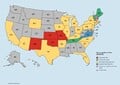 United States, February 2023
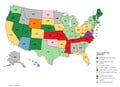 United States, March 2023
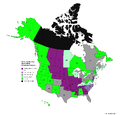 United States and Canada, May 2023
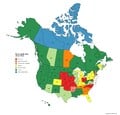 United States and Canada, August 2023
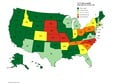 United States, December 2023
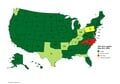 United States, 2024
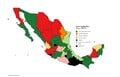 Mexico, May 2023
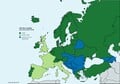 Europe, May 2023


Kazuya[edit]

Though not as widespread as Steve, since Kazuya's release, there have been several discussions regarding a ban, with detractors believing his moveset to also be "overtuned" similar to Steve. Kazuya's large movepool gives him access to a variety of different combos, several of which can serve as a zero-to-death combo regardless of weight or percentage. His most infamous move is Electric Wind God Fist, a move that, while difficult to input, has intangibility, causes paralysis, and has high hitstun, making it a common and spammable combo starter that is often used in the aforementioned combos. Finally, Kazuya's Rage, which activates once he hits 100%, increases his damage output and changes Heaven's Door into a stronger variant called Rage Drive, a move which has super armor, deals significantly more damage, and KOs opponents earlier. Early proponents to Kazuya's ban point to these polarizing attributes as reasons for the lack of effective counterplay against Kazuya aside from adopting a campy and patient playstyle, which they alleged would create boring, unpleasant viewing experiences.
In spite of these discussions, no serious nation-wide ban was ever implemented. The Dallas-Fort Worth region in Texas was the only notable region to ban Kazuya;[36] they initially banned Kazuya, alongside other characters, at three Shockwave events in a month-long experiment in November 2022[37][38][39] before they properly banned the character alongside Steve on April 16th, 2023, though Kazuya's ban has since been lifted.[40] The reason for the lack of implementation is due to Kazuya not being dominant enough for a ban to be considered. For several years, there were only three Kazuya players who were ever ranked in the top 50 — acola, Riddles, and Tea — and all three players played other characters alongside Kazuya, with acola only using Kazuya as an infrequent secondary. Other Kazuya players eventually appeared on the LumiRank, most notably Raki; however, only 2 players, Raki and alice, were ever ranked in the top 50, and both players also played other characters alongside Kazuya. In addition, players developed effective counterplay against Kazuya, utilizing his poor disadvantage state and linear, exploitable recovery to their advantage. This has been apparent with Sonic players, as both Riddles and Tea often switched off of Kazuya when fighting Sonic. Finally, though considered a popular top tier character, Kazuya was never considered one of the best characters in the game, with his tier list placement ranging from 7th to 11th, while his popularity was never at an abnormal level. As such, though there were initially strong pushes to ban Kazuya, a lack of results to support their arguments caused many of these attempts to fizzle out.
Hero[edit]
Legality discussions regarding Hero are unique in that, instead of perceived brokenness, players believe Hero should be banned due to his toolkit, particularly his down special, Command Selection, and smash attacks, relying on randomness.[41] Proponents of a ban have compared Command Select to items due to the move's unpredictable nature, which could give players an unfair advantage in competitive play. Specific commands also received some critique, most notably Wack and Thwack, which have the potential to KO opponents at any percent, though the chances of doing so at earlier percents are extremely low; Oomph and Psyche Up, which, when combined together, can easily destroy shields; Zoom, which players have argued invalidates edgeguarding; and high-power commands such as Kamikaze and Magic Burst. Finally, all of Hero's smash attacks have a 1/8 chance of being a critical hit, which deals considerably more damage and knockback compared to Hero's regular smash attacks. These attributes have led proponents to believe that Hero was unfit for serious competition, as skill alone may not be enough to win matches against a Hero player.
Though several prominent Smashers such as Leffen and Dark Wizzy have advocated for a ban,[42] very few serious ban attempts occurred, especially as many other prominent Smashers, such as ESAM and GimR, opposed a ban.[43][44] As such, there were only two notable Hero bans implemented: South Australia banned Hero on August 15th, 2019,[45] though this ban has since been lifted, and Nintendo France briefly banned Hero, alongside all DLC characters released after September 23rd, 2019.[46] Initial opposition to bans focused on how Hero had several notable weaknesses that led to average representation and results in the early metagame. As time went on, it also became apparent that the issues pointed out by ban proponents were not as serious as initially believed, especially as early KOs due to Command Select and critical hits were extremely rare in practicality. As such, ban discussions peaked in the early metagame before dying down during the online metagame. Even with Hero's better representation and stronger perception in the modern metagame, there have been no serious discussions regarding a Hero ban, effectively settling the debate in favor of Hero.
Another potential concern regarding Hero is the language barrier raised by Command Selection. As Hero is far more reliant on reading text than any other character, being able to read said text is very important (e.g. every effect in Command Selection has been translated into every available language except Dutch). While this issue is not relevant in most circumstances, Hero players traveling to compete abroad could potentially be met with a situation where the game is set to a language that they don't understand, making it difficult for them to read Hero's moves. However, these incidents are rare at best, and most people consider the issue negligible, as the two best Japanese Hero players, Akakikusu and Shion, have performed well at international events that do not use Japanese, as well as Japanese players defeating the American Hero player, BeastModePaul, despite the set playing on an English menu. Because of this, no major tournament has a formal procedure on how to pick a language for Hero players, and as such, all tournaments typically run with the language respective to their region. Opponents are otherwise expected to simply make a gentlemen's agreement on the spot, and a tournament organizer intervening if a complication arises.
Controversy, impact, and regulation[edit]
Character bans are widely controversial in the community, although it varies on a case by case basis.
The central main arguments of banning certain characters is they damage the competitive viability of the game, both as a fair competition, and as a spectator. The majority of characters with ban discussions are often considered too powerful, or can perform "degenerate" strategies in order to invalidate the rest of the cast; characters like Meta Knight or Steve can camp out virtually any character without punishment. Other characters like Bayonetta, the Ice Climbers, and Kazuya can perform zero-to-death (or near zero-to-death) combos based off of one neutral interaction, when other characters often require far more in order to take a stock. The overarching criticism of these characters is that they do not follow the same design philosophies as many other, less potent characters, and them having little-to-no weaknesses to contrast their strengths, making playing against them much more difficult than other characters, or in some players' opinions, "unfair".
On the other hand, each of these arguments have rebuttals from those who oppose a character ban. It is entirely possible that the perceived strength of a character, especially soon after their or the game's introduction, is overblown and stems from a lack of matchup knowledge. Many players argue that simply waiting for characters to properly gather results and players to adapt to them is entirely innocuous and impedes hasty decisions that could cause greater damage with time, seeing character bans as a last resort if less extreme measures were taken beforehand and proved ineffective. Character bans are also seen by some as tantamount to refusing to learn the weak points of these characters and figure out the best ways to exploit them, instead of learning to adapt to the situation and seeing precedent in even characters seen as "broken" developing counterplay and advancing the metagame in a relatively healthy way. From the perspective of a spectator, the storyline of a player defeating a notorious top tier despite insurmountable odds is compelling and exciting to watch. Particularly problematic strategies are often targeted as well, such as a ledge grab limit, or specific glitches that already are considered harmful on a technical level. The former tends to be significantly less disputed overall, as it still allows for their character's representatives to play them with little repercussions in the long term, whilst also making the competitive scene healthier, but regardless, even with stricter rulesets, many of the characters are still often seen as too good, making their true effectiveness questionable.
It should also be noted that other fighting games have banned characters in competitive play; common reasons include being considered too powerful, console-exclusive characters (which typically do not apply to the Smash series as they are typically released on one platform, and in the case of Smash 4, both versions of the game have unified rosters), and over usage. Examples include Super Street Fighter II Turbo's Akuma, Dragon Ball FighterZ's Android 21 (Lab Coat), and Soulcalibur II's Link. Due to the Smash series' greater emphasis on its characters and celebrating Nintendo and gaming compared to being a fighter, however, some opposition to character bans is even on principle, as one of the series' biggest appeals is fighting with mascots who do not fight in their home series, and as such, character bans are seen as contrary to this.
With character bans being uncommon, their impact has yet to be widely documented. Oftentimes, tournaments with character bans will often see their respective representatives not attend said tournament, or enter with secondaries. Syrup is the most notable example of this; as a Steve player with a prominent Ness secondary, he has continued to display competency in Steve-banned tournaments, such as placing 5th at Patchwork 2025: All Patched Up! 9th at Luminosity Makes Moves Miami 2024, results that hold up rather reasonably compared to his performances at Steve-legal tournaments. Conversely, acola has avoided Steve-banned tournaments, which is also partially attributable to the fact that such tournaments are uncommon in Japan. To alleviate the disparity between Steve mains and Steve-banned tournaments, UltRank currently disallows Steve-banned events from negatively affecting Steve players, with wins at these events only helping Steve players.[47]
With there being no official governing body within the competitive Smash scene, character bans are often inconsistent and arguably ineffective at a major level. Attempts to universally ban characters such as Meta Knight have often been in vain, with a majority of Brawl's major tournaments opting to leave the character legal, even with the Unity Ruleset Committee recommending such a ban. Additionally, the aforementioned Nintendo Community Tournament Guidelines have prevented most banning efforts, as licensed tournaments cannot ban Steve in Ultimate, preventing virtually any sizeable tournament from banning Steve, lest they face potential legal action from Nintendo themselves. A notable example was Let's Make Big Moves 2026, who had to lift its Steve ban after being contacted by Nintendo.[48] This ruling also seemingly applies to legacy games such as Smash 4, as Bayonetta was forced to be legalized at Supernova 2026, even several years after Ultimate's release.[18] Despite this, some licensed tournaments have successfully banned Steve by not making the ban obvious during marketing, such as the Patchwork series.
See also[edit]
- Brokenness, a term often correlated with characters who are considered ban-worthy.
- Tournament rulesets, which determine a character's legality.
References[edit]
- ^ a b Supernova 2025 ruleset.
- ^ Snosa 6 ruleset
- ^ Xanadu Origins ruleset
- ^ Is Jigglypuff and the Ice Climbers' wobbling technique 'killing' Super Smash Bros. Melee? Leffen debates the ban discussion
- ^ "Fourth and final community vote about Meta Knight." on SmashBoards
- ^ "Should Metaknight Be Banned? The Poll (LISTEN TO THE SBR PODCAST!)" on SmashBoards
- ^ "Should Metaknight be Banned? **Take 2** (Post-podcast)" on SmashBoards
- ^ "Should Metaknight be Banned? ***Take 3***" on SmashBoards
- ^ "Fourth and final community vote about Meta Knight." on SmashBoards
- ^ "Success/Popularity stuff. Final update coming later today!" on SmashBoards
- ^ "Official URC Poll: Should Meta Knight Be Banned In The Unity Ruleset?" on SmashBoards
- ^ "Meta Knight Officially Banned!" on SmashBoards
- ^ Meta Knight: Banned From Super Smash Bros. Brawl
- ^ ZeRo's video about Meta Knight in Brawl
- ^ The Smash Bros. Community Is Arguing About Bayonetta
- ^ Smash 4 has a problem -- and it's Bayonetta
- ^ Competitive Super Smash Bros. Scene in Spain Prepares to Ban Bayonetta. Nintendo Life.
- ^ a b Y'all have gotta understand, and I mean REALLY understand this doesn't happen while Big N is involved. If they won't let us ban Bayo in a 10+ year old game they don't care about (yes she's legal at SN this year because of them) they're not letting Steve or anyone else get banned.
- ^ Why Minecraft Steve Is Causing Drama in the Super Smash Bros. Community.
- ^ Top 64 Character Representation at Super Smash Con 2022.
- ^ Should Steve be banned from Super Smash Bros. Ultimate events? I asked the pros and community heads, here's how they responded.
- ^ Major Smash Ultimate tournaments ban Steve after discovery of new game-breaking tech.
- ^ Steve is officially banned at the Coinbox for the foreseeable future.
- ^ https://twitter.com/AcidArmyGaming/status/1650674954512244743
- ^ Examples of multihit moves failing to negate PMLG..
- ^ https://twitter.com/ChakkieWFT/status/1648421839637741568
- ^ UltRank's PMLG bounty.
- ^ The bounty's end.
- ^ Steve's partial unban.
- ^ NRW Cup unbans Steve due to Nintendo license.
- ^ HungryBox states that tournaments with a Nintendo license can NOT Ban Steve.
- ^ Steve banned for LMBM 2024.
- ^ Steve remaining legal for LMBM 2025.
- ^ What Can We Do About Steve?.
- ^ (SSBU) You Can't Ban Steve, so Change the Rules.
- ^ Steve and Kazuya Mishima both banned from one of Super Smash Bros. Ultimate's biggest weekly tournament series in Texas
- ^ Ultimate Shockwave 134 - KAZUYA BANNED!.
- ^ Ultimate Shockwave 135 - STEVE & KAZUYA BANNED!.
- ^ Ultimate Shockwave 138 - Steve, Kazuya & ROB Banned!.
- ^ Tourney Locator and Odyssey Smash choosing to ban Kazuya, alongside Steve.
- ^ Smash Ultimate’s newest fighter too ‘random’ for some pro players
- ^ Leffen starts a petition to ban The Hero from Super Smash Bros. Ultimate because of RNG.
- ^ Smash Ultimate pro ESAM explains why Hero shouldn’t be banned.
- ^ Super Smash Con 2019: GimR explains why Hero is ‘broken’ in Ultimate.
- ^ Twitlonger on South Australia's Hero ban.
- ^ Official Super Smash Bros. Ultimate Tournament Bans Hero, Then Unbans Him.
- ^ Status of Vars on UltRank.
- ^ Max Ketchum on Twitter: "Well uh…we got “the call” from the big boys. Crafting will be legal at LMBM 🥲".
| General competitive smash history | |
|---|---|
| In competitive play | 64 · Melee · Brawl · Smash 4 · Ultimate |
| Major Documentaries | The Smash Brothers · Metagame · Smash Documentary: Road to the New Era |
| List of majors | 64 · Melee · Brawl · Smash 4 · Ultimate · PM |
| Tier lists | 64 · Melee (NTSC/PAL) · Brawl (NTSC/PAL/JPN/Post-Brawl) · Smash 4 · Ultimate |
| Misc. | Metagame · Greatest of all time · Stage legality · Character legality · Power ranking · Top 100 Melee Players of All Time · List of largest Smash tournaments · List of largest prize pools in Smash tournaments |

