
Dracula
| Dracula Vlad Țepeș | |
|---|---|

| |
| Universe | Castlevania |
| Debut | Castlevania (1986) |
| Smash Bros. appearances | Ultimate |
| Most recent non-Smash appearance | Castlevania: Belmont's Curse (2026) |
| Console/platform of origin | Nintendo Entertainment System (Famicom Disk System) |
| Species | Vampire |
| Gender | Male |
| Place of origin | Transylvania |
| Created by | Hitoshi Akamatsu |
| Article on Wikipedia | Dracula (Castlevania) |
Dracula (ドラキュラ, Dracula), full title Count Dracula Vlad Țepeș (ドラキュラ・ヴラド・ツェペシュ伯爵, Count Dracula Vlad Tepes) is the main antagonist of the Castlevania franchise. He is loosely based on the titular antagonist from Bram Stoker's novel, Dracula, himself based on the historical figure Vlad the Impaler.
Origin[edit]

Dracula is a vampire who serves as the dark lord of a haunted castle in Transylvania, commanding an army of monsters to wage war on God and humankind. He has a variety of dark magic at his disposal, such as teleportation, conjuring projectiles and transforming into different beasts, which frequently occurs as he nears defeat. He is primarily opposed by the Belmont clan of vampire hunters. Though the Belmonts and other heroes repeatedly kill him, Dracula typically revives alongside his castle once every century, and he boasts followers who have resurrected him prematurely. While this Dracula is not necessarily the same as the vampire of the same name created by Bram Stoker, with many contradictory elements revealed across the franchise, a version of the events of the novel Dracula are alluded to be canon to the series on several occasions.
Dracula appears in some form in nearly every game of the series, beginning with the original Castlevania, where his revival at the hands of demon cultists is thwarted by Simon Belmont. His manifesto, as offered to Richter Belmont in Castlevania: Rondo of Blood, is that power is all that rules the world. He sees himself above human morality, describing mankind as "a cesspit of hatred and lies". He adds to Maria after his battle with her that he will keep returning "so long as greedy humans exist".
Within the series's official timeline, Dracula's origins are revealed in the series's chronological first game, Castlevania: Lament of Innocence. Originally a human Crusader named Mathias Cronqvist who fought alongside Leon Belmont, the sudden passing of his wife Elisabetha fills Mathias with anger and hatred, declaring war on God. He betrays Leon in search of the mystical Crimson Stone, through which he absorbs the soul of vampire lord Walter Bernhard and becomes a vampire himself. Mathias gains eternal life and changes his name to Dracula Vlad Tepes, while Leon swears that the Belmont Clan would stand against Dracula forever.
Dracula's son Alucard was born following his doomed relationship with a human woman named Lisa. Her execution over accusations of witchcraft reignited Dracula's hatred of humanity, casting a deep rift between him and his half-human son. Alucard would stand against his father over the years, first joining Trevor Belmont's fight in Castlevania III, and later succeeding Richter as protagonist of Symphony of the Night. There, after he is defeated by Alucard, his son tells him the last words of his wife: "Do not hate humans. If you cannot live with them, then at least do them no harm, for theirs is already a hard lot." Alucard then adds that his mother would love the count for all eternity. Dracula asks for Lisa's forgiveness as he fades away, bidding his son farewell.
Throughout the 19th and 20th centuries, the foretold disappearance of the Belmont clan resulted in ordinary humans developing ways to take up arms against him, including the Dominus glyphs wielded by Order of Ecclesia's Shanoa, the Hunter Whip wielded by Nathan Graves and the Baldwin clan, as well as the emergence of offshoots such as the Morris and Lecarde families. Dracula would finally meet his permanent demise in the legendary War of 1999, at the hands of Julius Belmont. Castlevania: Aria of Sorrow and its sequel, Dawn of Sorrow, take place decades afterward in the 2030s, serving as the most recent point of the series's timeline. Their protagonist, Soma Cruz, is revealed to be Dracula's newest reincarnation. Soma however, is a kind and heroic young man, although he fights valiantly to resist the influence of Dracula's darkness within his soul. Dawn of Sorrow's non-canon Julius Mode depicts an alternate timeline where Soma succumbs to Dracula's influence and becomes the Dark Lord.
Since the original Castlevania, Dracula transforms into his second form when his life bar is depleted. The shape his second form takes varies by game: examples include a giant bat, a giant head, a demon, or simply his humanoid form with enhanced abilities. The original intention of this second form, according to original game director Hitoshi Akamatsu, was that the demonic form appearing from Dracula's headless body was a manifestation of the "Curse of Man". When Simon defeated the demon, the evil energy that was released was precisely what cursed him, rather than the Count placing the curse on him himself. It is also important to note that when Simon delivered the final strike to Dracula, the latter's body parts could be seen ejected in different directions, hinting that Dracula would eventually come back, foreshadowing the events of Simon's Quest. In the instance of the transformation seen in Dracula's Curse, members of the original development team would confirm that the third phase of the final battle was not Dracula, but rather an eldritch deity, the same one who had granted Dracula his dark powers prior to its retcon in Lament of Innocence. Starting with Rondo of Blood, it was retconned that this demonic form was indeed one of Dracula's abilities, brought upon him by the then unseen Chaos, which acted as the true final boss of Aria of Sorrow.
Dracula has even made a few playable appearances, such as in the fighting game spin-off, Castlevania Judgment. His reincarnation, Soma Cruz, is the protagonist of Castlevania: Aria of Sorrow and Dawn of Sorrow and is also playable in Harmony of Despair. In the rebooted Lords of Shadow series, protagonist Gabriel Belmont becomes a vampire and comes to be known as Dracula. Konami's Dracula has made various crossover appearances, containing Castlevania elements as opposed to portraying a common public domain Dracula, such as being the sole Castlevania racer in Konami Krazy Racers, being playable as a killer in the multiplayer survival horror game Dead by Daylight, getting a Bomberman counterpart in Super Bomberman R, and having his boss moves given to a generic Dracula character in Konami's video game adaptation of Animaniacs.
In Super Smash Bros. Ultimate[edit]
As a stage element[edit]
Dracula appears as a background character on Dracula's Castle. When the moon disappears and bats gather around Dracula's coffin, lightning will flash and reveal Dracula's shadow in one of the windows.
As a boss[edit]
| Dracula | |
|---|---|
  
| |
| A boss in | Ultimate |
| Universe | Castlevania |
| Location | Dracula's Castle |
Dracula appears as a boss in Classic Mode and Adventure Mode: World of Light. In Classic Mode, he is fought by Luigi, Pac-Man, Simon, Richter and Sephiroth. In World of Light, he is fought at the end of the Dracula's Castle dungeon in the Dark Realm, and must be defeated before the player may challenge Dharkon. He reappears during the final stage as part of the boss rush phase leading up to the Galeem and Dharkon fight. He does battle on a stage resembling the Dracula's Castle stage, but with a flat and empty layout that extends to the side blast zones. Nothing to Lose usually plays during the fight in the first form, which will change to Black Night when he changes to his demon form, but Dwelling of Doom plays in Pac-Man's Classic Mode, Dance of Illusions in Richter's Classic Mode, and Galeem / Dharkon during the boss rush.
Defeating Dracula in Classic Mode is a challenge, which unlocks the Black Night music track. Defeating Dracula in the Dracula's Castle dungeon in World of Light rewards the player with the Dracula and Dracula (2nd Form) spirits.
Dracula is a two-phase boss. Dracula begins the fight in his regular humanoid form, based on Ayami Kojima's artwork for Castlevania: Symphony of the Night. The battle opens with Dracula on his throne holding a glass, which he tosses aside as he gets up, swings his arm and breezes his cape, then warps onto the stage to start the fight. Like in his own series, Dracula moves about the stage by teleporting in a beam of light. Dracula only takes damage when hit in the head, which has traditionally been his weak point since his first appearance. Attacking any other part of his body creates a small mist effect, which resembles Alucard's mist transformation.
When his health bar is depleted, Dracula will transform into a large green winged demon, as depicted in Symphony of the Night. His health is fully restored, and he uses an entirely different set of attacks. Unlike his first form, Dracula's second form may be damaged by hitting any part of his body and will walk and jump instead of warping for mobility.
Moveset[edit]

First form[edit]
| Move | Damage | Description |
|---|---|---|
| 3-Way Shot (3WAY弾) | Dracula takes a step back and wraps himself in his cape, then flings it open to launch a spread of three fireballs forward. This first appeared in the original Castlevania, and is referred to as Hellfire (ヘルファイア) in the Castlevania series. | |
| Straight Shot (直進弾) | Dracula takes a step back, then holds out his arm as he launches a series of large dark fireballs forward. The fireballs alternate between being just above the ground and at about Dracula's height, which is high enough to miss short or crouching characters. This originates from Castlevania: Rondo of Blood, and is referred to as Dark Inferno (ダークインフェルノ) in the Castlevania series. | |
| Omnidirectional Shot (全方位弾) | Dracula wraps himself in his cape, then flings it open and holds his arm out to his side, launching multiple sets of red and blue magic orbs. These orbs either revolve around him with sets flying in an alternating clockwise and counter-clockwise fashion as they spread outward, or fly straight with sets alternating between all cardinal and diagonal directions. The red orbs are more powerful than the blue ones and can be absorbed. The revolving version of the move resembles one used by Graham Jones in Castlevania: Aria of Sorrow, which used Dark Inferno's fireballs instead of orbs. The straight flying version is based on Dracula’s main method of attack in Castlevania: The Adventure. The move is known as Dark Inferno (Diffusion) (ダークインフェルノ(拡散)) in the Castlevania series. | |
| Pillar of Flame (炎の柱) | Dracula raises his arm, and harmless flames appear on the ground, either with many appearing at once or in a sequence. After a moment, these flames erupt into tall fire pillars that hit multiple times. At low health, he combines it with one of the above three moves. It resembles a combination of his primary attack in Castlevania III: Dracula's Curse, Dario's fire pillars in Castlevania: Dawn of Sorrow, and one of his attacks in Castlevania: Harmony of Despair. The attack is referred to as Pillar of Fire (火柱) in the Castlevania series. | |
| Bat Rush (コウモリ突進) | Dracula thrusts his cape upwards, then transforms into a swarm of bats and rushes ahead to deal darkness damage. This originates from Castlevania: Portrait of Ruin, and is known as Bat Moon (バットムーン) in the Castlevania series. Some characters, like Squirtle, can crouch underneath this attack to dodge. |
Second form[edit]
| Move | Damage | Description |
|---|---|---|
| Tracking Shot (追尾弾) | Dracula spits a series of spirits, which initially float up in front of him before flying towards the player's current location. These spirits disappear upon reaching their destination, and they may inflict the poison status upon hitting players. Up to five spirits will be made depending on the difficulty. This move originates from Portrait of Ruin, and is known as Curse Chaser (カースチェイサー) in the Castlevania series. | |
| Fire Shot (炎弾) | Dracula charges up, then spits a widespread of three fireballs aimed at the player, which explode on contact. It originates from his triple fireball attack in Castlevania, and is referred to as Hellfire (ヘルファイア) in the Castlevania series. | |
| Shockwave (衝撃波) | Dracula charges up, then spits an electric wave forward, which is nearly as tall as him. This was one of his primary attacks in Rondo of Blood. Despite its appearance, it actually deals aura damage. | |
| Rip Apart (切り裂く) | Dracula swipes in front of him with his claws, potentially doing so three times on higher difficulties. He may either perform it in place or while taking a step forward. The final swipe deals darkness damage. | |
| Strike (たたきつける) | Dracula does a wide overhead swing with his claws, which deals darkness damage and can meteor smash. He may either rear back and perform it in place or take a step forward. | |
| Trample (踏みつぶす) | Dracula jumps, then slams his fist into the ground, producing a shockwave that moves to both ends of the stage. The initial jump, falling punch, and shockwave all deal damage. | |
| Dracula jumps to a different spot on the stage. His landing deals damage. |
Spirits[edit]
Dracula also appears as three different spirits.
Dracula and Dracula (2nd Form) can be obtained by defeating the boss in the Dracula's Castle sub-dungeon in World of Light.
Soma Cruz can be obtained by enhancing the Dracula spirit at level 99.
Primary spirits[edit]
| No. | Image | Name | Type | Class | Slots | Base 
|
Max
|
Base 
|
Max
|
Base 
|
Max
|
Ability | Series |
|---|---|---|---|---|---|---|---|---|---|---|---|---|---|
| 1,075 | |
Dracula |  |
★★★ | 3 | 2925 | 8800 | 1594 | 4796 | 1331 | 4004 | Can Be Enhanced at Lv. 99 | Castlevania Series |
| 1,076 |  |
Soma Cruz | |
★★★★ | 3 | 4843 | 12110 | 2510 | 6275 | 1893 | 4734 | Giant Killer | Castlevania Series |
Support spirits[edit]
| No. | Image | Name | Class | Cost | Ability | Series |
|---|---|---|---|---|---|---|
| 1,077 |  |
Dracula (2nd Form) | ★★★ | 2 | Unflinching Charged Smashes | Castlevania Series |
Gallery[edit]
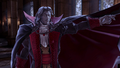 Screenshot of Dracula as he appears in Ultimate.
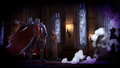 Dracula's appearance in Super Smash Bros. Ultimate.
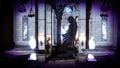 Dracula's shadow as seen in the Dracula's Castle stage.
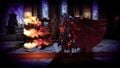 Hellfire.
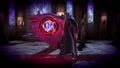 Dark Inferno.
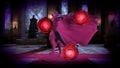 Magic orbs.
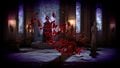 Bat Moon.
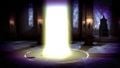 Dracula teleporting.
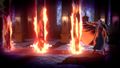 Fire pillars.
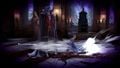 Dracula's body becomes mist if attacked anywhere other than his head.
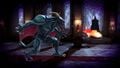 Fire burst.
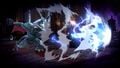 Electric wave.
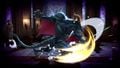 Claw combo.
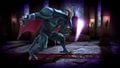 Ghost Chaser.
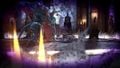 Shockwave punch against Richter.
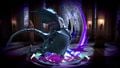 Dark claw.


Names in other languages[edit]
| Language | Name |
|---|---|
 Japanese |
ドラキュラ, Dracula |
 English |
Dracula |
 French |
Dracula |
 German |
Dracula |
 Spanish |
Drácula |
 Italian |
Dracula |
 Chinese |
Dracula |
 Korean |
Dracula |
 Dutch |
Dracula |
 Russian |
Дракула |
Trivia[edit]
- Dracula casts a shadow in the Dracula's Castle stage, despite vampires traditionally being unable to cast shadows, as they lack a soul.
- Dracula and Rathalos are the only third-party bosses in Adventure Mode: World of Light.
- Dracula and Galleom are the only two bosses not to be fought by any of the "Original 8" fighters.
- Dracula's glass-throwing entrance as a boss references his introduction in Castlevania Chronicles, where he does so after sipping blood from it. This is also seen in its more well-known iteration in the opening sequence of Symphony of the Night.
External Link[edit]
- Article on the Castlevania Wiki.
| Bosses | |
|---|---|
| Super Smash Bros. | Master Hand · Metal Mario · Giant Donkey Kong · Fighting Polygon Team |
| Melee | Master Hand · Crazy Hand · Giga Bowser · Fighting Wire Frames (Male · Female) |
| Brawl | Master Hand · Crazy Hand · Petey Piranha · Rayquaza · Porky · Galleom · Ridley · Duon · Meta Ridley · Tabuu · Fighting Alloy Team (Red · Blue · Yellow · Green) · False characters |
| Smash 4 | Master Hand · Crazy Hand · Master Core · Fighting Mii Team |
| Ultimate | Master Hand · Crazy Hand · Rathalos · Galleom · Giga Bowser · Galeem · Dharkon · Dracula · Ganon · Marx · Fighting Mii Team · False characters |
 Castlevania universe | |
|---|---|
| Fighters | Simon (SSBU) · Richter (SSBU) |
| Assist Trophy | Alucard |
| Boss | Dracula |
| Stage | Dracula's Castle |
| Item | Death's Scythe |
| Other | Dracula's Castle |
| Spirits | Spirits |
| Music | Ultimate |

