
Unused content (SSBB)


The following is all unused content that is known to have been at least considered during development of Super Smash Bros. Brawl before being altered, rejected, cut, or abandoned prior to the final release.
Masahiro Sakurai noted that during the first year-and-a-half of development, the project plan was revisited in order to determine what elements were possible to include within the game's development schedule and scope[1]. Many cuts and revisions to planned game content were said to occur during this point in time.
Fighters[edit]
Brawl's project plan was written on July 7, 2005, and featured all characters present in the final game but Sonic, who was a late addition. Masahiro Sakurai has confirmed that several characters present in the project plan were cut mid-development due to time constraints, though he could not divulge which characters specifically were cut.[2][3] Both leftover data in Brawl's code and interviews conducted after its release have been partial indications on the identities of these characters.
Many of the known cuts in Brawl appear to be clones or otherwise derivative of other characters in the game, inline with a directorial choice to de-emphasize clones in favour of emphasizing characters' unique characteristics.[4]
Sakurai stated that characters present in the Subspace Emissary needed to have their presence confirmed from an early stage of development.[5] He cited Wolf as a character who was on the brink of being cut, and that the inclusion of characters such as him, Toon Link, and Jigglypuff was only confirmed partway through development, hence their exclusion from the mode. As he further stated that "4-5 other characters" could have been included if they had extra time, it can be reasoned the various other cut characters were similarly deprioritized at that early stage, but time and resources did not permit their development to resume.
All cut veterans, as well as some initially-dismissed newcomers, would be revisited for Smash 4 and Ultimate.
Discovered in Brawl's files[edit]
The following characters are known to have at least partially entered development, as multiple unused character data files were found in the disc in the following order. Sometimes colloquially referred to as "The Forbidden Seven", they consist of:
The Forbidden 7 appear in the game's Instance Slots[6] between R.O.B. and Snake. This section also encompasses the above-mentioned near-cuts Jigglypuff, Toon Link, and Wolf.
As the files themselves are empty, the filenames are the sole indication of their identities. Despite this, it can be argued that there is little ambiguity over them:
- The identity of "pra_mai" is ambiguous, but evidence generally suggests it to represent the Pokémon species Plusle and Minun, serving as potential replacements for Pichu. Primary evidence includes that "PRAMAI" is grouped in the Instance Slots together with fellow Pokémon Jigglypuff and Mewtwo. Their Japanese names are pronounced as Purasuru and Mainan, and プラマイ (Puramai) is actually a Japanese colloquial word that literally means "plus or minus". Plusle & Minun appear in the final game as one of three Pokémon trophies with a special unlock criteria, a trait exclusively shared by cut veterans Mewtwo and Pichu. They share bodily proportions and an Electric-type skillset with the latter, who is the only cut veteran with neither presence in the files nor an explicit replacement in the final game (as Toon Link is to Young Link).
- While the Ice Climbers have separate character files for the two characters, it is unknown how exactly PRAMAI would have functioned. The "PRAMAI" filename is inconsistent with their trophy and other Pokémon filenames, which use their full official romanizations, but is likely developer shorthand; Mewtwo's cut victory theme is simply "MYU2", and Toon Zelda's trophy also has a filename discrepancy.
- "mewtwo" can be reasonably assumed to be Mewtwo, who appeared in Super Smash Bros. Melee. "mewtwo" has the most unused data out of the other scrapped characters, all of which are empty: an unused fanfare, a graphics effect file (
ef_mewtwo.pac), and a Wii Remote selection sound. Mewtwo is the only removed character to not be a clone; as an arguably unjustified cut, the relative extensiveness of its data suggests it was indeed strongly intended for inclusion in Brawl. - "roy" can be reasonably assumed to be Roy, who appeared in Melee. While lacking some data compared to "mewtwo", "roy" has both a graphics effect file (
ef_roy.pac) and an unused fanfare, suggesting his development advanced further than most other cuts. - "dr_mario" can be reasonably assumed to be Dr. Mario, who appeared in Melee. However, compared to files for "mewtwo" and "roy", "dr_mario" has the least data available, having only one unused character file (
ef_dr_mario.pac).- After Dr. Mario's return in Smash 4, it was discovered that several of his data files are named "mariod". This name matches a set of files found in Brawl's data; they mostly contain either duplicates of Mario's data or blank space. While initially assumed to be a debug version of Mario, this suggests that Mario's data was duplicated to recreate Dr. Mario at some point in Brawl's development, but left unfinished.
- Interestingly, some of Yellow Alloy's moves have traits reminiscent of Dr. Mario's, most notably his forward aerial.
- "toon_zelda" can be reasonably assumed to refer to the cel-shaded Zelda from games such as The Legend of Zelda: The Wind Waker, much like Toon Link. The name "Toon Zelda" would be used officially years later in Hyrule Warriors Legends, referring to the similarly designed Zelda from The Legend of Zelda: Spirit Tracks. The Zelda (Wind Waker) trophy ingame is not actually referred to as "toon_zelda" in the code of the game, while the trophies for Mewtwo and Dixie are referred to as "mewtwo" and "dixie" respectively, but it is otherwise fairly unambiguous to whom the designation refers.
- "toon_sheik" has been subject to debate, as a cel-shaded variant of Sheik has never appeared in the Zelda series before or after Brawl's release. It is sometimes theorized that "Toon Sheik" may have been a codename for Tetra, Zelda's alter-ego in The Wind Waker. However, Tetra is explicitly a separate character from Sheik in-universe, and her trophy is not titled as such. Further, a Twilight Princess design for Sheik was specially-created for Brawl by the Zelda team[7], whom Eiji Aonuma cited as having supervised original design work for her and the other Zelda characters[8], leaving the possibility that the same could have been true for a bespoke Wind Waker incarnation of Sheik.
- "dixie" is Dixie Kong, a major character from the Donkey Kong Country series. She is the sole member of the Forbidden 7 whose removal was explicitly addressed by Sakurai; Dixie Kong was intended to be teamed with Diddy Kong, so the two could be tagged out for each other in the midst of battle, similar to how they played in Donkey Kong Country 2: Diddy's Kong Quest. However, the idea was cut due to technical issues with its implementation, so Diddy was left as a solo fighter instead.[9] No other data for Dixie has been found, with the exception of her associated trophy and sticker.
All seven characters have IC-Constants, but they appear to be placeholder values, with the exceptions of "Toon Sheik", who is able to wall-jump, and Dixie Kong, who can both wall-jump and wall-cling.
The inclusion of the character files led to the formation of a rumor that was later proven false.
Considered[edit]
The following characters were considered during the planning stages of the game - some more strongly than others - but ultimately discarded before development began.
- During the game's pre-planning stages, Animal Crossing characters were in consideration to represent the GameCube era, with Sakurai even remarking with a laugh that he could envision them fighting with shovels and nets. They ultimately did not make it into the project plan[10], as the prospect of Animal Crossing characters fighting each other didn't suit the image of that series.[9] The series instead received extensive non-playable content, including a stage, several songs, trophies, and items, in order to ensure its popularity was acknowledged. Villager was added to the next game with that very arsenal, and Sakurai reaffirmed the character had previously been dropped for "[not being] suited for battle".[11]
- On Melee's website, Sakurai had previously acknowledged the unsuitability of Animal Crossing characters fighting in Smash in response to a fan commenting on the cruelty of the idea. Sakurai then humorously snapped himself out into not rejecting the idea before trying to make it work, seemingly echoing his later stance that conceptual inappropriateness was the greater issue than the ability to conceive a moveset.[12]
- The inclusion of Miis was briefly acknowledged as a possibility, but dismissed near-immediately. They were rejected, along with other casual-focused elements of the Wii's system features, partially in order to differentiate Brawl from the variety of existing casual-focused software in its lineup.[13] Miis became playable in Smash 4, as part of three different potential fighting styles, although they could not be used online. Upon their inclusion, Sakurai elaborated upon their previous rejection, stating that "it didn't seem right at the time for Miis to be punching and kicking", and further had concerns around online bullying and that they were not yet considered as established characters in their own right.[14][15] They reappear in Super Smash Bros. Ultimate, which allows them to be played online, albeit without visible nicknames.
- Geno was considered for inclusion in Brawl, as Sakurai knew about the character's popularity, and he also felt that Geno could easily fit into Smash. Although he personally wanted to include him, his hopes ultimately fell through, presumably due to legal issues involving Geno's rightsholder, Square Enix.[16] Geno's Mii Gunner outfit, appearing as DLC in Smash 4 and Ultimate, was added as a consolation prize instead.
- Pokémon Trainer went through multiple iterations - one featured exclusively first-stage starters (i.e. Squirtle, Bulbasaur, and Charmander); and another featured exclusively final-stage starters (i.e. Blastoise, Venusaur, and Charizard). Sakurai chose the final lineup due to a strong desire to include Charizard, finding Squirtle to have more personality than Blastoise, and Ivysaur commonly being overlooked by fans. This allowed a balance of multiple stages of evolution and sizes to be depicted.[9]
Other[edit]
- Pac-Man was reportedly suggested by Shigeru Miyamoto to be a potential third-party character in Brawl, but Masahiro Sakurai, thinking of Pac-Man's iconic "pizza-shaped" design, politely dismissed the request as it seemed far-fetched.[17] He was eventually added to the series in Smash 4.
- Nintendogs was dismissed from the start of development as being unsuitable for a fighting game. Sakurai cited the inclusion of Assist Trophies from it and Animal Crossing as a way to please fans of their respective games instead;[18] a shared image of the project plan shows a Shiba Inu, together with Villager, as examples of characters who are unsuited for fighting, but could be potentially featured as items.[10]
- Young Link was expressly acknowledged as having been intentionally excluded from the beginning of development, in order to instead represent the Zelda series's then-current divergence into the Twilight Princess and Wind Waker paths.[4] He is the only character from a previous game confirmed to have been deliberately removed from planning, and only he and Pichu have no reference in the game files.
- Krystal from the Star Fox series was explained to have been realistically impossible to include over Wolf as a result of time constraints. The knowledge cultivated from implementing Fox and Falco was applicable towards Wolf, allowing for him to be realized with limited time and effort - unlike Krystal, who would have needed to been created from scratch. Sakurai elaborated that a third Star Fox character likely would not have made it into Brawl if Wolf wasn't as popular and/or easy to add.[19]
- Furthermore, Sakurai compared Krystal to Waddle Dee, Dry Bones, and Baby Peach as one of an endless amount of characters that one could question the disclusion of as a playable character.
- When asked if Ridley was ever considered for inclusion as a playable character in Brawl, Sakurai expressed doubt that his inclusion would have been feasible, though entertained the task's possibility had him and the development team put their best efforts into it. Additionally, Sakurai humorously noted that - even in such a circumstance - Ridley might have turned out slow.[20]
Stages[edit]
- Similar to some Melee early screenshots, the initial Pokémon Stadium 2 had no graphics on the jumbotron in the background.
- Shadow Moses Island also had an outdoors area; while Snake can briefly be seen in it from the Nintendo World Report 2007 trailer, it can only be seen via hacked cameras in the final game.
- In the E3 2006 trailer, Snake's cardboard box can be seen in the background of the stage when the Nintendog appears; this does not occur under normal circumstances in the final game.
- Additionally, Battlefield had no upper platforms when the Nintendog appears, being simply a flat version of the same stage. This would later be added in Smash 4 as Ω forms, where it was similarly shown unannounced at E3.
- In Bridge of Eldin's files, a model of Colin tied up to a spear can be seen, referencing the scene where Link must rescue him after being kidnapped in Twilight Princess. However, it goes unused; the model also has an animated flag, and Colin himself is hidden by other models.[21]
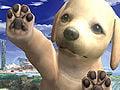 A scene from the 2006 trailer. Notice how Snake's box is located at a normally inaccessible part of the stage and how the upper platforms are missing.
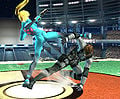 Notice how the jumbotron behind Pokémon Stadium 2 is blank, while this never happens during normal gameplay in the final version.
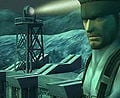 An early screenshot of Shadow Moses Island, depicting a location inaccessible in the final version of the game.
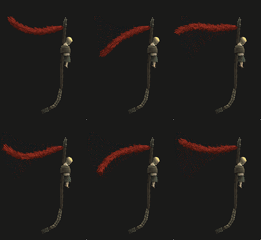 Unused model of Colin tied up to a spear.


Gameplay[edit]
- Some of the series symbols were initially the same as in the previous two games, but they were revised as time went on; the Mario series mushroom icon was refined and given spots, the Poké Ball icon has the top half colored in to properly represent how it is usually red, the Screw Attack icon was given more bends and another outline, and the Yoshi egg's angle was changed, with a slightly different arrangement of spots.
- Characters seen in E3 2006 and Nintendo World 2007 had different game renders than the ones in the final product. Most have their poses remain identical, but with emphasis on the shading of design; meanwhile, Snake's pose is completely different and has slightly different coloration.
- Mario still had his upscaled Super Mario 64 voice clips from Melee in E3 2006 and Nintendo World 2006 trailers. This was changed to unique voice clips that would be used in the final version of Brawl and subsequent Smash games since the "Snake Joins the Brawl" trailer.
- Multiple characters had their attacks changed between the game's development and release:
- Kirby, in the E3 2006 trailer, is showing attacking in midair with his Hammer as he did in Melee. However, the final build instead shows Kirby spinning horizontally.
- Kirby also has unused animations of him walking with his hammer, along with releasing it with full force; this suggests Kirby's hammer was to have a mechanic that allowed it to be charged. In the final build, King Dedede has a similar ability with his Jet Hammer. This option was finally given to Kirby beginning in Super Smash Bros. 4, with the ability named Hammer Flip.
- When Fox was revealed in the Nintendo World 2007 trailer, he has his Blaster in his hand during the whole battle despite the fact that he only uses the blaster when using his standard special move in the final release. Additionally, animations left in the game data show both Fox and Falco inspecting the environment before putting their blasters away; they appear to have been intended for a mechanic where overusing the Blaster would cause it to overload or misfire.
- Link's Spin Attack was also changed over time. In the first and second trailers, it is given the appearance that there are two strikes on top of each other; in the final game, however, there is only one strike. The early Spin Attack also lacked the red overlay on the slashes.
- Pikachu's Quick Attack was also altered; in the first trailer, it is shown making 2 "bip" sounds, one with each teleport as in Melee. However, in the final version, the sound was altered significantly, and it only makes one sound, on the first teleport.
- Wolf has an unused animation that matches Fox's neutral infinite. Masahiro Sakurai revealed Wolf was included late into Brawl's roster due to his similarities to Fox and Falco, effectively confirming it as a leftover from being cloned off of Fox before Wolf was re-worked into a pseudo-clone.
- Snake, in particular, had many differences from the final product. In early screenshots, he is shown grabbing some characters with more accuracy; one picture shows Snake grabbing Ike from his right arm and mouth similarly to how he performs stealth kill in the Metal Gear series, but every character gets grabbed by the head in the final version. Snake's mines also were considerably more realistic-looking, sporting a drab, dark grey-green look instead of the light grey seen in the final game.
- Kirby, in the E3 2006 trailer, is showing attacking in midair with his Hammer as he did in Melee. However, the final build instead shows Kirby spinning horizontally.
- In trailers, characters were also shown to be Blast KO'd after they crossed the upper blast line. In the final game, normal characters can only be KO'd this way in The Subspace Emissary. This idea would later be implemented into Smash 4 and Ultimate, in which all characters have a random chance of being Blast KO'd via the upper blast line.
- E for All 2007 had a playable demo of Brawl available. This demo was lacking several starter characters: Kirby, Zelda/Sheik, Pokémon Trainer, Ice Climbers, King Dedede, Wario, Olimar, and Lucas are all starters in the final game, but were unavailable in the demo. The demo did, however, allow Sonic to be playable, to celebrate him being announced in October 2007.
- The character Perry from Super Princess Peach was intended to appear as part of Peach's moveset, where she would use him as a parasol rather than her own in the final game. His trophy textures (PeachTexC through PeachTexF) are named after Peach's textures, and Peach's parasol model (WpnPeachKassar) contains his Japanese name (カッサー, Kassā).
- In the game's files, some characters have textures depicting visual battle damage; Meta Knight has a large gash over his helmet, Captain Falcon has a cracked visor that would've revealed his face (evident by the unused eye texture he has) and sword wielders like Link and Marth have their weapons being cracked. In an article released shortly after Brawl,[22] Masahiro Sakurai stated these textures were originally part of a game mechanic he wanted to include that involved breaking character equipment, causing disadvantages to skilled players if they broke and required a respawn to repair. While the idea was cut due to lack of time, the textures were incorporated in the Final Smash trophies of certain characters and the false characters of the Subspace Emissary (however, the glow around them makes it barely noticeable). This would later be incorporated starting in SSB4, as seen with Little Mac receiving bruises at high damage in Super Smash Bros. for Wii U and Robin with his Fire Emblem-based durability system. Olimar and King K. Rool would follow receiving battle damage at high percents and during Screen KOs, while Steve would follow Robin with his Minecraft-inspired durability system.
- There also exists some unused palette swaps for characters on the game's disc. One such unused costume was a blue-colored Luigi, under the name FitLuigi02.pac/.pcs. Unusually, this costume has its shadow model integrated into the primary model, rather than having it as a separate model.
- An unfinished Assist Trophy file with Ridley's name exists, suggesting that Ridley was at some point planned to be an Assist Trophy.
- Like the first two games, most characters were planned to grunt when they were hit by a strong attack that resulting in medium or high knockback. However, characters only grunt after a second in the actual game, preventing these yells from being heard. These sound effects can still be found within Brawl's data, and they later returned in SSB4 for heavy knockback if the character reused their old voice clips; however, these will only play for heavy knockback as the Screen KO in that game is silent.
- The announcer counted down the final ten seconds of the match in every battle.[citation needed] This was reduced to five seconds in the final game.
- The announcer additionally has an unused line for speaking the name of the game at the end of the opening movie. Pat Cashman even stated he was unsure why this was removed from the final version.
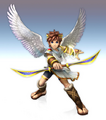 Early artwork of Pit, with more feathers and heavier shading.
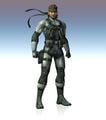 Early artwork of Snake, with slightly different colouration.
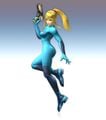 Early artwork of Zero Suit Samus, with heavier shading and front lighting.
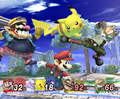 An earlier version of the characters' series symbols.
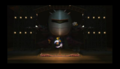 Kirby using his side special (in the air) from Melee on Halberd in the E3 2006 trailer.
 Kirby walks around with the hammer...
 ...and stops to swing it.
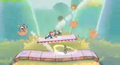 Link's Spin Attack is considerably more slanted, and has no red effects to it.
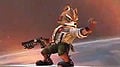 Fox with his Blaster in his hand, as seen in the Nintendo World 2007 trailer.
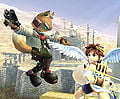 Early screenshot showing Fox with his Blaster in hand.
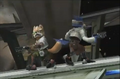 Fox and Falco look around before holstering their weapons.
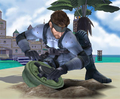 Snake's original down smash mine.
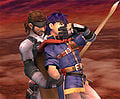 Snake has a considerably different grip on Ike than in the final game.
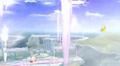 Mario and Link are Blast KO'd after passing the upper blast line, which doesn't occur in ordinary gameplay.
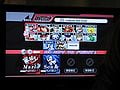 The E for All 2007 character select.
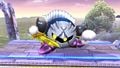 Meta Knight with a cracked mask.
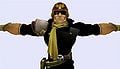 Captain Falcon with a chipped visor.
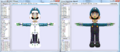 Luigi's unused blue palette swap (left), compared to the used one.


Solo[edit]
- Multiple scenes in The Subspace Emissary were cut due to time constraints, which leaves some parts of the story out; however, an update on the DOJO!! explained these removed cutscenes. Among the explanations include how the Subspace Army takes over the Halberd and King Dedede unintentionally stalls Meta Knight from preventing it from happening.
- A TV spot for Brawl also shows Mario instead of Kirby fighting Petey Piranha. This is likely because Petey was originally supposed to blast Kirby out of the arena, making players use Mario to duel him, although Mario and Kirby switched roles later. However, after completing the Subspace Emissary, players can revisit Midair Stadium using any character (including Mario) and face Petey.
- The font for enemies in The Subspace Emissary during development was slightly different and considerably more spaced out. Additionally, an early screenshot of "The Battlefield Fortress" shows a considerably less overcast and brighter sky.
- An early classic mode screen appears in the ISO file as well. Unusually, it uses a sound effect from Melee.
- In a screenshot of Brawl's Classic Mode on the DOJO!!, a battle against a giant Meta Knight is depicted with two allies, whereas in the released version of Brawl, there is only one ally on the Kirby stage in a giant battle there. Additionally, no giant battles past stage two give the player two allies.
- The Pokémon Trainer has unused jumping, falling, and landing animations that one can presume were intended to be used for traversing stages. In the final game, he simply Space Jumps when his Pokémon gets too far offscreen. This animation was later used in Super Smash Bros. Ultimate when playing as Pokémon Trainer in the hub world in Adventure Mode: World of Light.
- A file inferred to be part of controlling menu and display elements for the Subspace Emissary contains an unused display element, labelled "InfAdvLevel0000", which appears to display a level number and a bar labelled "pp" which is animated from full to empty in 50 frames. Based on other filenames, its purpose appears to have been to display a level number before beginning the stage.
- There is an unused collection of character portraits which can be found in nearly every one of the Great Maze shadow character battle rooms under the name bossmae01_2.
- Most of the characters are just in a neutral pose, looking off in one direction or another, but Link, Kirby, Pikachu and Snake are using their E3 2006 portraits, Lucas is in his default T-pose, and Mr. Game & Watch is using his Melee artwork. Sonic, Jigglypuff, Toon Link, and Wolf are notably absent due to their later inclusion in the game.
- Aside from Rayquaza, all of the bosses don't use their official artwork from Brawl. Petey Piranha uses artwork from Mario Golf: Toadstool Tour, Meta Ridley uses concept art from Metroid Prime, Ridley uses his artwork for Super Metroid, and Porky uses the original sprite from Mother 3. Both Galleon and Duon appear to use what is likely part of their official character design sheet, with Duon completely lacking shading.
- Most of the characters are just in a neutral pose, looking off in one direction or another, but Link, Kirby, Pikachu and Snake are using their E3 2006 portraits, Lucas is in his default T-pose, and Mr. Game & Watch is using his Melee artwork. Sonic, Jigglypuff, Toon Link, and Wolf are notably absent due to their later inclusion in the game.
- Text in the game's ISO indicates an online "beat-em up" mode referred to as "Slipspace" was planned, but for whatever reason cut from the game. Its name, as well as the surviving text around it, implies that it may have been intended to function as a continuous match, in which players could drop in and out of to be replaced by other players. The coding is very much primitive, with no existing servers in place, rendering it totally unplayable. Additionally, the mode is limited to "With Anyone", with no coding pertaining to a "With Friends" variant, and the flavor text in the friend's lobby uses the text for Home-Run Contest. The timer shown below can be toggled from 1 to 60 minutes.
- In addition to the Slipspace mode documented above, every 1-player mode, including Event Matches, Training, Break the Targets, All-Star and Boss Battles, can be selected as an available option online, but none of them function correctly. For most of these, it is unlikely that they were ever planned to be allowed online, and were merely implemented as such to safeguard against crashing. Surprisingly, however, the online variant of Boss Battles appears to have been worked on quite considerably, with toggleable difficulty settings and a Co-Op High Score implemented, implying that it was a rather late omission from the game. [23]
- Two unused cutscenes from The Subspace Emissary can be found in the ISO, but they're just heavily corrupted duplicates of the "Snake's Cardboard Box" and the "Lucario Discovers Snake" cutscenes in that order. They occur immediately after those respective cutscenes in memory, and have the filenames "13-00_end" and "33-01_end" (the non-corrupted cutscenes have the same filenames, only without "_end" in the titles). [24]
- Interestingly, the corrupted variant of "Snake's Cardboard Box" features completely different lighting, appearing much grainier than the cutscene used in-game.
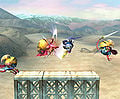 A less gloomy version of The Battlefield Fortress.
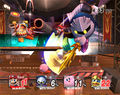 A screenshot of Classic mode on the DOJO!! depicting two allies in a battle against giant Meta Knight.
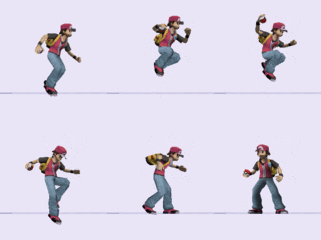 Unused jump animations for the Pokémon Trainer.
 A mysterious "level" bar.
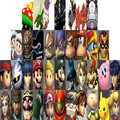 bossmae01_2.


Names[edit]
- Wario Bike, Drill Rush, Summit, Halberd, Rainbow Cruise, and "Flower Blooms in the Echoes" were originally called Wario Chopper, Triple Dash, The Summit, Battleship Halberd, Rainbow Ride, and, "Flowers Bloom on the Notes" respectively. It is unknown why the names were changed, although Rainbow Ride was likely changed because it was a Melee stage that had been misnamed "Rainbow Cruise" in that game (although it remains "Rainbow Ride" in the PAL regions, again because it was called "Rainbow Ride" on the PAL version of Melee).
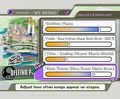
- The description for the My Music options originally said, "Adjust how often a song will appear on this stage." It has since been revised in a general tone to say, "Adjust how often songs appear on stages." Along with this, one piece of music that was planned for the Delfino Plaza stage was later moved to Luigi's Mansion, that track being Castle / Boss Fortress (Super Mario World / SMB 3).
- One minor change was made to the Friend roster before release. In a pre-release version of Brawl, the friend roster would display friends as "on-line" and "off-line", but in the final release, the hyphen was removed. This meant that the friend roster would instead display friends as "online" and "offline".
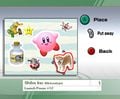 An early version of the sticker album.
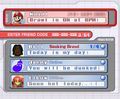 An early version of the Friend roster.


Masterpieces[edit]
- In all versions of the game, a Masterpiece of Donkey Kong Country was intended to be in included.
- In the American and PAL versions, Masterpieces featuring Fire Emblem: Mystery of the Emblem and EarthBound are believed to have been planned to be included, as their data is found on the disc. Another theory, however, is that the games were simply leftover data from importing the data of the Japanese version. EarthBound was later a masterpiece in all versions of Super Smash Bros. for Wii U.
Sounds[edit]
- Sound effects from the Melee version of Link's special moves can be found in the game's data, possibly as a placeholder until new sound effects were made.
- Unused sound effects can be found in Mr. Game & Watch's sound folder. These sound effects are distinctly different than Mr. Game & Watch's usual sound effects, as they aren't comprised of bleeps but rather unusual noises.
- Multiple characters have unused victory quotes that can be found in the game files, such as Captain Falcon saying "Yes!" in a more calm manner, Meta Knight saying "Now, my power is without rival.", Pikachu shouting "Pikapi!", and Sheik doing a victory cry.
- Kirby has two alternative voice takes for his Hammer move alongside an unused voice line for his initial jump.
- Ike has two unused voice lines for his Counter where he says "Gotcha!" (can still be heard in his Sound Test) and "You're through!" upon activation. In the final game, Ike only says "You're open!" when his counter is successful.
- Ike additionally has a voice clip of saying "Take this!".
- Lucario saying "The Aura is stored." can be found in the game files. The quote is grouped next to the quote where Lucario says "Watch the power of the Aura!", implying it was going to be another voice clip for Aura Storm.
- The voice clip sounds unusually choppy for unknown reasons. Likely the result of data corruption or possibly different parts of Lucario's voice clips combined together.
- The Announcer has two unused narrations for "Fighting Alloy Team" and "Stage Clear". They were removed in the PAL regions.
- More sounds like one of Mario's grunts, Pikachu screaming, and one of Zelda's grunts are in the Sound Test. Others like Pit saying "Here we go!" and Snake saying "There!" are in the game's files, but missing in the Sound Test.
- Some of these sounds are later used in subsequent games; Meta Knight in Super Smash Bros. 4 uses one of his unused yells for his down smash, and Snake in Super Smash Bros. Ultimate may say "There!" when detonating the C4.
Music[edit]
Scrapped[edit]
Many unused tracks exist on Brawl's disc. The reason for their removal is unknown, though some common beliefs are due to copyright issues, limited space, or simply personal preference by the developers.
All tracks in this list point to a dummy stream file that produces no sound when played back; similar to the unused character files, this leaves only the index name to determine what the music track was intended to be. However, the more equivocal names make it more difficult to determine the specific cut tracks.
It should be noted that the songs in this section, as all the songs used in the final product, follow a chronological trend.
| File Title in Brawl's code | Category (based on prefix) | Track Identity Theories |
|---|---|---|
| snd_bgm_A11_MLRPG02 | Mario | Unknown track assumed to be from Mario & Luigi: Partners in Time (titled Mario & Luigi RPG 2×2 in Japanese). |
| snd_bgm_A12_MORINOKINOKO[note 1] | Mario | Japanese translates to "Forest's Mushrooms"; its position in the music list suggests the track was the Toadwood Forest theme (also from Partners in Time). The original music's dark tone suggests it would have been played in the underground variant of Mushroomy Kingdom. |
| snd_bgm_C06_KAZENOSAKANA | The Legend of Zelda | Japanese translates to "Ballad of the Wind Fish", a notable track from The Legend of Zelda: Link's Awakening, as well as an unrelated track from The Legend of Zelda: Majora's Mask. It is placed before "Tal Tal Heights" (also from Link's Awakening), suggesting it is from the former game. |
| snd_bgm_E04_COCKIE | Yoshi | Unknown track assumed to be from Yoshi's Cookie. |
| snd_bgm_G06_COMMAND | Star Fox | Unknown track assumed to be from Star Fox: Command. |
| snd_bgm_J01_STAGECHANGE | Fire Emblem | Assumed to be used for the stage transitions for Castle Siege. Others assume that it may have been a stage transition theme from a Fire Emblem series game, similar to "Preparing to Advance". |
| snd_bgm_J05_ERABARESHI | Fire Emblem | Assumed to be a shortened form of the Japanese "Erabareshimono-tachi" (選ばれし者達), which translates to "The Chosen Ones", a track from Fire Emblem: Mystery of the Emblem. |
| snd_bgm_K02_SENTOUONIISAN | Mother | "Sentouonii-san" is the Japanese name for the New Age Retro Hippie, an enemy from EarthBound whose battle theme is similar to one from Mother, where a similar enemy also appeared. Likely not included due to the track's similarities to Johnny B. Goode by Chuck Berry. |
| snd_bgm_K03_EIGHTMELODIES | Mother | "Eight Melodies", a term describing two different tracks: one from Mother and one from EarthBound. |
| snd_bgm_K04_SMILEANDTEARS | Mother | "Smiles and Tears", the ending theme from EarthBound, which is based on the game's "Eight Melodies". This song would later be remixed for Super Smash Bros. 4. |
| snd_bgm_K06_BECAUSE | Mother | Assumed to be "Because I Love You", a track from EarthBound. Notably, this song is the basis of "Fourside" from Melee, which is absent from this game. |
| snd_bgm_M14_WARIOSTAGE | Wario | Track of unclear origin in the Wario universe. It is placed between two of WarioWare, Inc.'s microgame themes. |
| snd_bgm_N04_RADIOTAISO | Animal Crossing | The Japanese "Radio Taisō" translates to "Radio Exercises", a track from Animal Crossing. |
| snd_bgm_Q03_SPORTSMEDLEY | NES/GameBoy tracks | Assumed to be a medley of tracks from the generic sports titles on the NES, such as Soccer. |
| snd_bgm_R01_WILDTRACKS | Miscellaneous tracks | Japanese name for the game Stunt Race FX; assumed to be a track from that game. |
| snd_bgm_S01_MAINTHEME | Metal Gear | Assumed to be the main theme of a Metal Gear game; as it is placed before "Encounter" from Metal Gear Solid, it is most likely the main theme of that game. Likely not included due to plagiarism accusations related to the theme, which also caused it to be removed from Metal Gear Solid: Portable Ops and Metal Gear Solid 4: Guns of the Patriots.[25] |
| snd_bgm_S09_BEATMANIA | Metal Gear | Assumed to be the remix of the Metal Gear Solid main theme from Beatmania. Likely not included for the same reason as the above track. |
| snd_bgm_T04_HOWTOPLAY | Super Smash Bros. | Assumed to be the "How to Play" music, which does not have its own music file in Brawl. |
| snd_bgm_U05_UCANDO | Sonic the Hedgehog | Assumed to be "Sonic - You Can Do Anything", a track from non-North American releases of Sonic CD (which used "Sonic Boom" instead). Likely not included due to copyright issues regarding the lyrics, which caused the 2011 version of Sonic CD to replace the song with an instrumental cover.[26] |
| snd_bgm_W22_DX55 | Super Smash Bros. | A removed track from Super Smash Bros. Melee -- the 55 may suggest that it was a rip of the Melee version of "Menu 2", track #55 in that game's Sound Test. Another hypothesis is that it was to be one of the other tracks from Melee to not be present in Brawl, such as "Fourside" or "Yoshi's Story". |
| snd_bgm_W32_DX81 | Super Smash Bros. | Assumed to be another removed track from Melee. It is unclear what the track was specifically meant to be, as Melee's sound test only has 80 tracks. |
| snd_bgm_X12_SIMPLEINTRO | Super Smash Bros. | Assumed to be used in the intros for Classic Mode. |
| snd_bgm_X14_ENDING | Super Smash Bros. | Assumed to be used in the endings for Classic Mode. |
| snd_bgm_X24_HOW2PLAY | Super Smash Bros. | Assumed to be another track for the How to Play video. |
Along with the above music files, unused song files intended for use in The Subspace Emissary were found. Their intended purpose remains unknown, though it can be speculated to either have been background music (as few tracks exist exclusively to The Subspace Emissary) or as fanfares:
- snd_bgm_Y06_ADV06
- snd_bgm_Y12_ADV12
- snd_bgm_Y18_ADV18
- snd_bgm_Y19_ADV19
- snd_bgm_Y20_ADV20
- snd_bgm_Y21_ADV21
- snd_bgm_Y22_ADV22
- snd_bgm_Y23_ADV23
- snd_bgm_Y24_ADV24
- snd_bgm_Y25_ADV25
- snd_bgm_Y26_ADV26
- snd_bgm_Y27_ADV27
- snd_bgm_Y28_ADV28
- snd_bgm_Y29_ADV29
- snd_bgm_Y30_ADV30
Other[edit]
- The November 2006 Nintendo World trailer features a unique remix of the main theme, not found in the game files, that is seemingly a modified amalgamation of Menu 1 and the opening theme.
- An image on the project plan, discussing My Music, suggests "The Legend of Zelda (March)" and "Saria's Song" as music options for Temple. The latter song is completely absent from the game; no song by the former name exists in the game, though it could have been a proof-of-concept title for the marching band-style "Main Theme (The Legend of Zelda)" remix.[27]
Notes[edit]
- ^ The title is also similar to "Beware the Forest's Mushrooms", a piece of music from the Square-developed game Super Mario RPG: Legend of the Seven Stars. However, since Nintendo and Square Enix did not collaborate making this game, as well as due to the track's placement, it's unlikely to be this track.