

Super Smash Bros. Melee
- "Melee" redirects here. For the game mode, see Versus Mode.
| “ | Within Nintendo, we've had a lot of discussion about which of our most popular characters should be ready to appear in games when Nintendo GameCube comes to market. We think we've got a great answer. | ” |
| —Shigeru Miyamoto moments before the Melee trailer was unveiled to the public at E3 2001. | ||
| Super Smash Bros. Melee | |
|---|---|
  | |
| Developer(s) | HAL Laboratory Intelligent Systems |
| Publisher(s) | Nintendo |
| Designer(s) | Masahiro Sakurai |
| Released |  November 21, 2001 November 21, 2001 December 3, 2001 December 3, 2001 May 24, 2002 May 24, 2002 May 31, 2002 May 31, 2002 December 14, 2002 December 14, 2002
|
| Genre(s) | Crossover Fighting game Platforming Party |
| Mode(s) | Single-player, Multiplayer (2-4) |
| Ratings | ACB: G8+ ELSPA: 11+, 3+ (re-rating) ESRB: T PEGI: 3[1] |
| Platform(s) | Nintendo GameCube |
| Media | GameCube Optical Disc |
| System requirements | 11 blocks of memory (an additional 2 or more blocks are needed for each snapshot saved) |
| Input methods | GameCube controller |
Super Smash Bros. Melee (大乱闘 スマッシュ ブラザーズ DX, Great Fray Smash Brothers Deluxe), often shortened to "SSBM" or "Melee" (スマブラDX), is the second installment in the Super Smash Bros. series published by Nintendo. The game was released for GameCube on November 21st, 2001, in Japan, and December 3rd, 2001, in North America, shortly after GameCube's launch, and then on the following year in Europe and Australia on May 24th, 2002, and May 31st, 2002, respectively. The game was directed by Masahiro Sakurai and was primarily developed by HAL Laboratory.
Like its predecessor Super Smash Bros., Melee features gameplay unique from that of other fighting games that emphasizes movement and ringouts. This sequel greatly expanded on the foundation of its predecessor, including more characters and stages, sharper and more in-depth gameplay, and a wealth of single-player content. Melee is also one of the two games in the Super Smash Bros. series to be rated T by the ESRB, with the other being its sequel, Super Smash Bros. Brawl.
Melee received universal acclaim, with many critics praising the game's expansion and refinement from its predecessor, as well as its visuals, tight controls, multiplayer mode, and orchestrated soundtrack. However, its single-player modes, large number of clone characters, and similarity to its predecessor received criticism.
Opening movie[edit]
The opening movie of Melee mostly uses FMV videos from its E3 2001 trailer, along with some gameplay footage.
The FMV scenes were given particularly close attention by the developing team; according to Sakurai, the team wanted to create an entire, high-quality FMV sequence in the game to highlight the then newly released GameCube console's graphical power in comparison to previous consoles. The development team worked with three different animation studios in Tokyo, Japan, to finish the FMV opening.
An earlier version of the opening movie was released on Melee's Japanese website in November 2001.[2] The early movie is nearly identical to the final game's, but the clips of actual gameplay differ.
In addition, continuing the trend started in the previous game, the opening also directly segues into the title screen with the announcer calling out the game's title.
It is the first pre-rendered cutscene in the series.
Fighters[edit]

The cast of 25 playable characters, 26 if including Zelda's alter ego Sheik, includes all 12 characters from Super Smash Bros. and 13 newcomers (14 counting Sheik). Of these, 14 are available from the start of play (15 if Sheik is included), including all the veteran characters except Jigglypuff and Luigi, and 11 more which can be unlocked.

Of the new characters, the greatest number are from The Legend of Zelda universe if Zelda/Sheik are counted as two characters to go with Ganondorf and Young Link, although the Mario series also takes three new character slots for Bowser, Princess Peach and Dr. Mario added. On top of these, two universes add two characters each, with the Fire Emblem series making its Smash Bros. debut with Marth and Roy (with Roy making his debut in any game), and the Pokémon universe adding Pichu and Mewtwo to its two existing characters. The three other characters added are Falco, a second character from the Star Fox series, Mr. Game & Watch, and the Ice Climbers from two highly venerable Nintendo series.
| Veterans (12) | ||||||
|---|---|---|---|---|---|---|
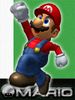 Mario 
|
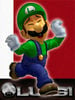 Luigi
|
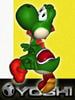 Yoshi 
|
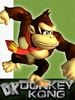 Donkey Kong 
|
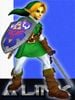 Link 
|
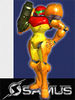 Samus 
|
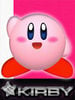 Kirby 
|
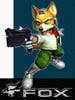 Fox 
|
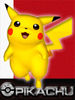 Pikachu 
|
 Jigglypuff
|
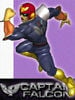 Captain Falcon 
|
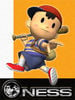 Ness 
|
||
| Newcomers (14) | ||||||
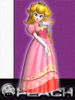 Peach
|
 Bowser
|
 Dr. Mario
|
  Zelda/Sheik
|
 Ganondorf
|
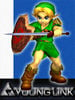 Young Link
| |
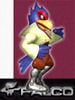 Falco
|
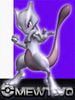 Mewtwo
|
 Pichu
|
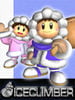 Ice Climbers 
|
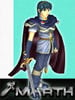 Marth 
|
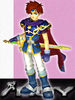 Roy
|
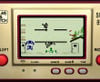
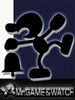 Mr. Game & Watch 
|
Bold denotes unlockable characters.
Stages[edit]

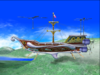
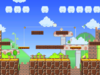
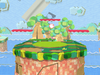
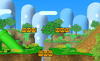
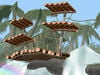
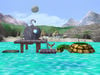
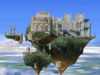
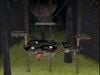
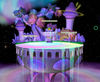
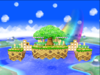
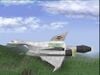
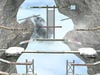
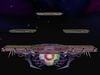
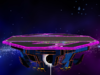
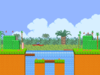
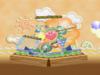
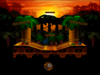
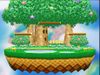
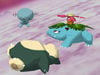
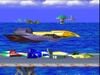
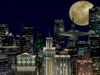
There are 29 stages in Melee that can be played in VS. Mode: 18 starter stages and 11 unlockable stages. Three stages return from Super Smash Bros. as Past Stages, all of which are unlockable. Each universe, except for the Fire Emblem universe, has a stage. The EarthBound and F-Zero universes, which previously did not have any stages, receive stages for their respective universes. Most universes have two stages; the exceptions are the Ice Climber and Game & Watch universes, which have only one, and the Mario universe, which has four. Counting Past Stages, the Donkey Kong, Kirby, and the Yoshi universes have three stages. For the first time in the series, Battlefield and Final Destination can be played in VS. Mode; previously, they were restricted to single-player modes.
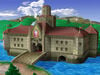


1-player stages[edit]
These stages cannot be unlocked and can only be played under certain circumstances.
- Target Test Stages
- Snag the Trophies
- Race to the Finish
- Mushroom Kingdom
- Underground Maze
- Brinstar Escape Shaft
- F-Zero Grand Prix
- Rest Station
- Home-Run Stadium
- Goomba
- Entei
- Majora's Mask
Modes[edit]

1-Player[edit]
- Classic Mode
- Adventure Mode
- All-Star Mode (must be unlocked)
- Event Match
- Stadium
- Training
Multiplayer[edit]
- Versus Mode
- Special Melee
- Camera Mode
- Super Sudden Death
- Giant Melee
- Tiny Melee
- Invisible Melee
- Slo-Mo Melee
- Fixed-Camera Mode
- Single-Button Melee
- Lightning Melee
- Stamina Mode
- Tournament Mode
Other[edit]
Unlockables[edit]
The game features several points to be unlocked, most of which include the trophies, unlockable characters, and stages. Some of them are unlocked by a special way, like achieving a certain distance on the Home-Run Contest, while others are obtained by the Lottery. For a full list, see List of unlockables (SSBM).
Some unlockable elements in SSBM were left out, but can be seen with an Action Replay cheat disc. See Debug menu for more details.
Development[edit]
1999-2000: Conceptualization[edit]
Conceptualization of Super Smash Bros. Melee began almost immediately after the previous entry was released, even before Nintendo GameCube development kits were widely distributed. Masahiro Sakurai was quietly tinkering with the design plan, mostly by himself with no knowledge of what the final hardware specifications would be. He publicly denied that he was working on a new Smash title until the 1999 Electronic Entertainment Expo (E3) event, where he announced he was working on a "Smash game for the GameCube."[3] HAL Laboratory returned as lead developer of Melee, with Sakurai as the head of production. When final GameCube development kits reached the team, they discovered that they were much easier to use then Nintendo 64 kits.
The optical disc format also let the team use streaming playback for the first time, which allowed the use of real musical instruments for music tracks. The final soundtrack ended up using a mix of real music recordings and synthesized instruments, though Sakurai assured that the differences would be nearly unnoticeable. These tracks are an inspiration for the founding of the Press Start: Symphony of Games concert series, which was an annual orchestral concert hosted by game industry veterans that featured arrangements of video game music that ran from 2006 to 2015. Neither music were released on Nintendo Music as of now.
The game was one of the first games released on the GameCube and highlighted the advancement in graphics from the Nintendo 64. The developers wanted to pay homage to the debut of the GameCube by making an opening FMV sequence that would attract people's attention to the graphics.[4] HAL worked with three separate graphic houses in Tokyo to make the opening sequence, with Sakurai personally storyboarding the intro instead of spending the New Year with his family. On their official website, the developers posted screenshots and information highlighting and explaining the attention to physics and detail in the game, with references to changes from its predecessor.[5]
2001: Crunch development and E3 2001[edit]
The game was in development for 13 months, and Sakurai called his lifestyle during this period "destructive" with no holidays and short weekends.[6] Unlike the experimental first Super Smash Bros., he felt great pressure to deliver a quality sequel, claiming it was the "biggest project I had ever led up to that point". Despite the painful development cycle, Sakurai proudly called it "the sharpest game in the series... it just felt really good to play", even compared to its successor, Super Smash Bros. Brawl.[6] Sakurai also felt pressured to make the game as content-rich as possible to help it stand out from both other games at the time and its predecessor. Trophies were born out of this desire for content. Since the team was only able to make a limited amount of playable characters, trophies acted as representation for characters and franchises that did not make the cut otherwise as fanservice and a history lesson with background information attached to each trophy.
On the game's official Japanese website, the developers explain reasons for making particular characters playable and explain why some characters were not available as playable characters upon release. Initially, the development team wanted to replace Ness with Lucas, the main character of Mother 3, but retained Ness in consideration of delays.[7] The game's creators later included Lucas in the game's sequel, Brawl.[8][9] Video game developer Hideo Kojima originally requested the inclusion of Solid Snake to Sakurai, but the game was too far into development. As with Lucas, development time allowed for his inclusion in Brawl.[10] Similarly, Sonic Team head Yuji Naka confirmed that Sonic was ultimately not added due to time constraints;[11] like Snake and Lucas, he later became playable in Brawl. Wario was strongly considered for Melee's roster; while Sakurai expressed that he would have included Wario if he had time to add one more character,[12] he explained that he had opted to instead allocate the team's limited development time to implementing other characters such as Mewtwo or Marth and Roy, and also wanted to avoid having an excessive number of Mario characters.[13] Marth and Roy were initially intended to be playable exclusively in the Japanese version of Melee. However, they received favorable attention during the game's North American localization, leading to the decision for the developers to include them in the Western version.[14][15] This decision is often credited for popularizing the Fire Emblem brand outside of Japan to the point of convincing Nintendo to release the series internationally starting with Fire Emblem: The Blazing Blade, localized as simply Fire Emblem. Additionally, Sakurai stated that the development team had suggested characters from four other games to represent the Famicom or NES era until the developers decided that the Ice Climbers would be in the game.[16] The developers have noted characters that have very similar moves to each other on the website;[17] such characters have been referred to as "clones" in the media.[18]
Nintendo presented the game at E3 2001 as a playable demonstration.[19] Shortly after, the game's website was officially launched on May 17, 2001.[20] The next major exposition of the game came in August 25, 2001 at Space World 2001, when Nintendo displayed a playable demo that was updated from the previous demo displayed at E3. This demo had only ten characters to choose from; Yoshi, Donkey Kong, Pikachu, Ness, Mario, Samus, Link, Bowser, Fox, and Captain Falcon.[21] Nintendo offered a playable tournament of the game for fans in which a GameCube and Melee were prizes for the winner.[22] By September 2001, the list of characters available at launch was revealed, which included five unlockable characters labeled with a question mark, in the same way Smash 64 did for its four hidden characters.[23] This led to speculation as to who would be in the game besides those that were revealed at E3 2001 and in magazines. In Japan, a few magazines featured a section dedicated to the Super Smash Bros. community, such as Nintendo Dream's "Smash Bros. Fan Club", where they would showcase updates of the game and ask them questions, such as which characters they wish to see in the upcoming game.[24]
Before the game's release, the Japanese official website included weekly updates, including screenshots and character profiles.[25][26] Nintendo followed this trend with Brawl, in which there were daily updates by the game's developer, Masahiro Sakurai.[27] Japanese gaming magazine Famitsu reported that Nintendo advertised the game in between showings of the Pokémon: The First Movie across movie theaters in Japan.[28] The game was also showcased in magazines in its last months before release.[29][30][31][32]
2002-08: Post-release[edit]
After the game's release in Japan, a few magazines have published more information about the game, including Nintendo Dream publishing an issue dedicated to Melee along with an interview with Sakurai in January 2002.[33][34][35][36][37][38] It was released a month later in the United States, then in 2002 in the remaining regions, with numerous differences between the Japanese, American, and European and Australian copies. The community would name these versions "1.00