Mario (universe)
| Mario (universe) | |
|---|---|
 
| |
| Developer(s) | Nintendo Various |
| Publisher(s) | Nintendo Various |
| Designer(s) | Shigeru Miyamoto Takashi Tezuka |
| Genre(s) | Platformer Puzzle Racing Sports Party Action-adventure Role-playing |
| Console/platform of origin | Arcade |
| First installment | Donkey Kong (1981) |
| Latest installment | Mario Tennis Fever (2026) |
| Article on Super Mario Wiki | Mario (universe) |
The Super Mario universe (マリオ, Mario) (also referred to as Mario or Super Mario Bros.) refers to the Super Smash Bros. series' collection of characters, stages, and properties that hail from Nintendo's expansive and highly successful Mario video game franchise. The Mario universe is Nintendo's flagship franchise, and it is flat-out the most successful game franchise in global sales and in history (although the Pokémon franchise has found even greater success when counting non-game media). The Mario universe is a franchise of fantasy video games, and the most popular games are the fantasy adventure platform games called the Super Mario games. Mario himself is Nintendo's mascot and is considered the most famous video game character in the world. Mario and his brother Luigi, along with their many friends and nemeses, have appeared in dozens upon dozens of Nintendo's video games, many of them being best-sellers and several of which are considered some of the greatest games ever released by critics.
As a direct result, there are more Mario-themed characters, items, and properties to be found in the Smash Bros. series than any other Nintendo franchise, not the least of which are fourteen distinctive playable characters who originated from the series between the original Super Smash Bros. and Super Smash Bros. Ultimate: Mario, his alter-ego Dr. Mario, Luigi, Bowser, Princess Peach (who has Toad as an attack), Rosalina (who is assisted by the Lumas), Bowser Jr. (who has the Koopalings as alternate costumes), Daisy (who functions as a clone of Peach), and even the Piranha Plant. The Mario universe is so expansive, in fact, that Donkey Kong, Yoshi and Wario are considered stars of their own sub-universes: Donkey Kong, Diddy Kong and King K. Rool from the Donkey Kong universe, Yoshi from the Yoshi universe, and Wario from the Wario universe. The Wrecking Crew universe is also a sub-universe of the Mario universe, although no playable characters hail from it. It is the most heavily represented universe in the Super Smash Bros. series, by far, with the highest trophy, sticker, and item count in the series, though its number of playable characters is second to the Pokémon universe (nine to ten if Pokémon Trainer is counted as three separate characters). Additionaly, Smash classifies Mario's most famous spin-off, to the point of being more popular with mainstream audiences than the original platformers, Mario Kart as a separate universe, getting its own devoted sound test in Brawl and music playlist in Ultimate, though it does not recieve a unique series symbol. Mario Kart does not have a devoted fighter, but comprises a large chunk of the Mario series' item list and has three stages to itself. In Super Smash Bros. Brawl, the Dr. Mario series and the original Mario Bros. are considered miscellaneous series on the sound test rather than part of Mario, with the prior's stickers also being classified as such, though Mario Bros. is otherwise classified as a Mario game for its stickers and stage.
Franchise description[edit]

By the beginning of 1981, Nintendo had developed a series of cabinet arcade games that were moderately successful in Japan, but its efforts to market them to Western audiences had fallen flat. In the most spectacular representation of this performance, thousands of units of an arcade shooter named Radar Scope, one of the earliest games Shigeru Miyamoto helped develop, were left sitting in warehouse storage. The president of the newly founded Nintendo of America division, Minoru Arakawa, faced financial disaster, so he pleaded with Nintendo CEO Hiroshi Yamauchi to provide him with a new game that he could install as a replacement into Radar Scope machines. Miyamoto agreed to the task of "fixing" the game so it would appeal to gamers, and instead of tweaking the original, he designed an entirely new coin-op game out of the Radar Scope hardware, and created new characters that could then be marketed and used in later games. Miyamoto initially wanted to develop a game based on the Popeye franchise, but Nintendo could not acquire the license to do so in time, so he combined the dynamic of Popeye, Bluto and Olive Oyl with the feature film King Kong. This game eventually released as Donkey Kong.
During development of Donkey Kong, Shigeru Miyamoto created the protagonist, who was meant to assume the role of Popeye, initially titled オッサン, before being renamed to "Jumpman." Due to the unprecedented success of this game, the character immediately became a recognizable icon of the early days of gaming, and made several more appearances afterwards. In the 1982 follow-up Donkey Kong Jr., the character was officially renamed to Mario, named after Nintendo of America landlord Mario Segale. This is also one of the few instances Mario is portrayed as an antagonist, with the titular Donkey Kong Jr. attempting to save his father from capture. Mario would get a starring role in 1983 with the game Mario Bros. that codified many of the elements that defined the franchise afterwards. This game was the first appearance of Mario's brother Luigi, established that they were brothers who dealt with pipes, and fought against enemies like bugs, turtles, and fire balls. Mario would make other appearances around this time on television, various Game & Watch titles, and guest appearances in games like Wrecking Crew and Golf.

A sequel to Mario Bros. was put into development, this time as an exclusive to the then two year old Famicom home console. Miyamoto realized that quick bursts of content would not be enough for at-home play, and attempted to make a more substantial experience, which included long, intricate levels with branching paths and secrets. Partially inspired by Ice Climber with its vertical scrolling gameplay, this game would have smooth horizontal scrolling gameplay. This game would release in 1985 as Super Mario Bros., and quickly became a top seller for the system. When the Famicom was released outside of Japan as the Nintendo Entertainment System, Super Mario Bros. was bundled with the first circulation of consoles. The game is often labeled as the single most influential video game involved in not just the popularization of the side-scrolling game genre, but the direction the video game industry itself would take following the 1983 crash of the American console market, and is often described as the game that began the modern era of video games. Almost all of the game's aspects have been praised on separate occasions; the precise controls, creative power-up system, and well-tuned speed and momentum mechanics came into play against a varied set of level-design obstacles and distinctive enemies, and Mario's whimsical quest through his newly established setting, the Mushroom Kingdom, to rescue his love interest Princess Toadstool from the dragon turtle-like Bowser was timeless. The game became the best-selling video game in history, a record it held for over twenty years before being surpassed by Wii Sports in 2008.
The Super Mario franchise indisputably became Nintendo's foremost property immediately, and Mario himself earned a permanent position as the company's mascot. It became a custom to release a steady stream of Mario-related titles for each and every Nintendo console and handheld launched in the company's history, and even some non-Nintendo developed systems. To date, nearly 300 games feature Mario characters in some way. Many entries into the series enjoyed a high level of success and are often among the top selling titles on any given system, mostly due to brand recognition, but also for the most part by being genuinely polished and innovative experiences that stand the test of time. The early NES and SNES Mario 2D platformers would codify what would make up games of that style. The game Super Mario 64, while far from the first 3D platformer as it has often been misclaimed by gaming press, being predated by titles such as Alpha Waves and Jumping Flash! and developed concurrently to games released closely before or after it such as Crash Bandicoot and Bubsy 3D, would solidify the common cultural idea of how the subgenre would play, with an open-ended sandbox in which a player must explore and find secrets using free analog movement, and was followed up by games in a similar style like Super Mario Sunshine, Super Mario Galaxy, and Super Mario Odyssey, while inspiring series such as Banjo-Kazooie, Spyro the Dragon, and Ape Escape. A hybrid style of 3D Mario game would come into prominence later down the line, taking a linear approach to level design prioritising challenge over secret-finding, and featuring concepts absent from most 3D Mario games such as ? Blocks, flagpoles, and power-ups, with Super Mario 3D Land. The Mario Kart franchise would lay the foundation for cart racing games, and the Mario Party series would lay the foundation for party games. Other notable entries include the game Super Mario RPG: Legend of the Seven Stars, which itself inspired other Mario-centric role playing games such as the Paper Mario and Mario & Luigi series, Dr. Mario as its own series of puzzle games, and a host of sports games like Mario Golf, Mario Tennis, and the Mario & Sonic at the Olympic Games series.
Outside of video games, Mario continues to be a juggernaut in merchandising. Mario's face and name have been featured on countless products including toys, table top games, household items and stationery, apparel, collectible items, feature films, animated series by OVA or cartoon, print media like books and manga, and theme parks. Mario was even used to promote the Olympic games in 2016 and 2020. The Mario brand is estimated to be worth over 36 billion dollars in net revenue.
For movies, while 1993's Super Mario Bros. movie was released to poor reception, 2023's The Super Mario Bros. Movie, made in collaboration with Universal Pictures and Illumination, was significantly more successful in the wake of other video game companies making successful movie adaptations of their franchises in the 2020s, such as the Sonic the Hedgehog films. This, along with 2026's The Super Mario Galaxy Movie, gave way to a collaboration of works from Nintendo's other IPs outside of the Mario franchise and its subsidiary, most of them being majorly present in and including Super Smash Bros. itself, varying from simple references to key characters. Although fans have been thinking of these two movies as being part of a "Nintendo Cinematic Universe", or "Smash Cinematic Universe" in a similar vein to the Marvel Cinematic Universe and the Avengers films, Miyamoto stated that this is not the case.[1] Finally, a third Super Mario Bros. movie is in production thanks to the last movie's cliffhanger and some interviews with actors who have played in both movies.[2]
The Mario setting itself most often stars Mario, a free-spirited and heroic man with strong jumping abilities who is, by this point at least, a celebrity in the colorful and cartoon-like Mushroom Kingdom. Mario is often accompanied by his taller and more cowardly brother Luigi, who is occasionally mocked in-universe for being less famous than his sibling, but also goes on a few adventures of his own. His love interest and the ruler of the kingdom, Princess "Peach" Toadstool, regularly gets taken away by Mario's trouble-making arch-nemesis, Bowser, who is depicted as a menacing figure and/or a comedic one depending on the game. The most common setup for a Mario game is that Mario goes on an obstacle-laden quest to defeat Bowser and save Peach. Mario games rarely devote focus to lore or characterization; Mario, his world, and the established personalities that are his numerous allies and enemies represent Nintendo's primary "tileset" for creating colorful games of various genres that prioritize the quality of the gameplay itself, and Mario games sometimes satirize some conventions in video games like being self-aware of their own game logic and intentionally breaking them to subvert expectations.
The Mario franchise is so big, and its side characters so thoroughly established, that several of these characters are the stars of their own semi-regular releases. Donkey Kong, of which the Mario franchise is technically a spin-off, ironically was demoted to a spin-off and has starred alongside a simian supporting cast of his own in the Donkey Kong Country series that, for a time, were primarily handled by British company Rareware. A pet-like dinosaur companion for Mario named Yoshi was introduced in the SNES launch title Super Mario World, and has been the focus of the self-titled Yoshi series. Mario's timid and cowardly brother Luigi would occasionally receive a starring role of his own, primarily with the acclaimed Luigi's Mansion series. A mischievous anti-hero equivalent to Mario who debuted in Super Mario Land 2: 6 Golden Coins for the Game Boy, Wario, took over the Mario Land series with the renamed Wario Land series and WarioWare series that deliver a more outward parody of video game trends. Princess Peach has also occasionally taken the spotlight with the Nintendo DS game Super Princess Peach and Nintendo Switch game Princess Peach: Showtime!
In Super Smash Bros.[edit]
Being Nintendo's biggest franchise, the Mario universe understandably outnumbers every other universe in Smash 64. It is one of two universes to have two playable characters, and is the only one to have two stages, and a boss character. Yoshi and Donkey Kong also appear as playable characters with their own stages, however they are represented as different universes.
Fighters[edit]
- Mario (Starter): Mario is the mascot of Nintendo, and probably the most well-known video game character in the world. He first appeared in the arcade game Donkey Kong as the main protagonist, and since then, has appeared as the main hero in the Mario franchise. He has appeared in many Nintendo games spanning a large variety of genres. In almost every game that he is playable in, he is the most balanced character. This is also true in Smash 64, as he acts as a balanced starting character. Mario's appearance and moves are based of his appearance in Super Mario 64. An exception is his neutral special, which is his iconic Fireball attack from his sidescroller games. His up special is Super Jump Punch, a rising, multi-hitting punch based on Mario jumping and hitting a Coin Block. His down special is Mario Tornado, a spinning attack loosely on the Spin Jump from Super Mario World.

- Luigi (Unlockable): Luigi is Mario's younger, lankier twin brother who acts as the co-star and deuteragonist of the Mario franchise. He first appeared in the arcade game Mario Bros. as a green palette swap of Mario. Since then, he has started to gain his own personality and abilities. In Smash 64, he appears as an unlockable character. His appearance is based off of Mario Kart 64, which was his last major appearance. Luigi is a clone character of Mario, fittingly enough. However, he possesses his trademark superior jump height and inferior traction, and some of his moves have unique attributes. While his neutral special is also a Fireball attack, Luigi's are green, and they travel in a straight line, unaffected by gravity. His up special is also Super Jump Punch, but instead of being multi-hit, it is a single hit that can cause high damage and knockback if timed correctly. His down special is Luigi Cyclone, a variation of Mario Tornado with only two hits and different knockback.

Boss[edit]
- Metal Mario: A spin-off from a form Mario can take in Super Mario 64, Metal Mario makes his gaming debut as an unplayable minor boss in the 1P Game mode. He is fought in Stage 9, on his own stage, Meta Crystal. His moveset is identical to Mario's, with minor differences. Metal Mario barely flinches to ordinary attacks and is almost unaffected by throws at low percentages. In addition, he has extremely fast falling speed due to his weight. Although he is mute in this game, whenever he moves, he makes metallic sounds.

Stages[edit]
- Peach's Castle (Starter): This stage takes place in the sky above Peach's Castle from Super Mario 64. The actual castle itself can be fully seen in the background. There are two main platforms, the top which is a long bridge that players can go through. The bottom platform has a larger block moving left and right underneath it. On the top two corners there are two floating, inward-angled platforms that move slowly up and down. There is also a floating Bumper on the top center of the stage that slowly moves left to right.

- Mushroom Kingdom (Unlockable): The game's only unlockable stage, Mushroom Kingdom is an audiovisual throwback to the original Super Mario Bros. In the middle of the stage is a long pit. Above the pit are two platforms that move up or down depending on the weight on them. On either side of the pit are suspended platforms and Warp Pipes that players can go through. Piranha Plants will occasionally come out of the pipes and can damage players. A Pow Block will randomly spawn in the air that players can interact with.

Items[edit]
- Fire Flower: This power-up is a semi-sentient orange flower imbued with the power of fire. In many Mario platformers, Mario and Luigi can pick this up and gain the ability to launch fireballs from their hands. In Smash 64, however, it is used more as a weapon that can be wielded to project a continuous stream of fire into the area in front of the wielder.
- Starman: This power-up is found in many Mario platformers. It is a glowing yellow star with eyes that bounces around after being spawned. If Mario touches it, he will be made invincible for a short period of time, during which any enemy that touches him will be instantly defeated. In Smash 64, touching a Starman will make the player invincible for a total of 10 seconds.
- Green Shell: Koopa Troopas come in different colors of shells. A green-shelled Koopa is the most common Koopa found in several Mario games. It walks off the edges of platforms, and if jumped on by Mario, it recedes into its shell. The shell can either be kicked or thrown at enemies. In Smash 64, a Green Shell can be thrown at players to cause them damage.
- Red Shell: A red-shelled Koopa is found in many Mario games. Unlike a green-shelled Koopa, a red-shelled Koopa does not walk off edges, but it can recede in its shell after being jumped on and the shell can be kicked in the same way. In Smash 64, after a Red Shell is thrown, it will actively target the nearest player on the ground, damaging them in the process.
- Bob-omb: This common enemy is a walking black bomb that patrols around and explodes in many Mario games. In some games, a Bob-omb can be picked up and thrown at an opponent as a volatile projectile. In Smash 64, a Bob-omb can be picked up and thrown at to cause a big explosion. If not picked up, it will start to walk on its own until it self-destructs.
Music[edit]
- Peach's Castle Sky Stage: A remix of the original stages music from the original Super Mario Bros. It is in fact, a mixture of the world ground and underground themes. It is heard on the stage Peach's Castle.
- Ancient Kingdom Stage: The original chiptune theme from the first stage of the original Super Mario Bros. It is heard on the stage Mushroom Kingdom under normal circumstances.
- Ancient Kingdom Stage (Finale): The original chiptune "Hurry Up" version of the normal stage music heard in the original Super Mario Bros. It is heard on the stage Mushroom Kingdom when there are 30 seconds left and during Sudden Death.
- 15: Mario Wins: The victory theme of both Mario and Luigi is an orchestration of the standard "Stage Complete" theme heard on the original Super Mario Bros.
- Starman: A remix of the "invincible" music that would occur when Mario picks up a Starman in Super Mario Bros., and it occurs when the player picks up the Starman item during a match.
In Super Smash Bros. Melee[edit]
Melee has a lot more Mario content than before. Three new characters join Mario and Luigi as playable characters, and the Mario universe continues to have the most stages and items, along with having the most trophies. Three bosses also appear, one being considered half Mario, half Smash Bros. property. Sub-universe characters Yoshi and Donkey Kong return as well.
Fighters[edit]
- Mario (Starter): Mario returns as a starter character, now having his appearance being based on Nintendo 64-era artwork, such as Super Mario 64 and Mario Kart 64. When making the transition from Smash 64 to Melee, Mario was neither strongly buffed nor strongly nerfed. This again makes him a balanced fighter without any glaring advantages or disadvantages. He can now wall jump just like in his games, and is now given a side special, which is the Cape from Super Mario World. The Cape reflects projectiles and spins characters in the opposite direction.

- Luigi (Unlockable): Luigi returns as an unlockable character, whose appearance is once again based on his design in Nintendo 64-era artwork, such as Mario Kart 64. Luigi is no longer a full on clone of Mario, but is considered a semi-clone. This is because he gained a few new neutral attacks. Luigi also gained a side special, which is Green Missile. This move can be charged, and once let go, Luigi is launched sideways like a rocket, causing damage. Luigi is notable for having the longest wavedash in the game. Overall, Luigi got a slight buff compared to his previous appearance.

- Peach (Starter): Peach is the princess of the Mushroom Kingdom who usually gets kidnapped and must be rescued by Mario. She first appeared in Super Mario Bros., where she needed to be rescued from the evil Bowser. In Melee, Peach is a new starter character, with her appearance being based around Nintendo 64-era artwork, such as Super Mario 64 and Mario Party 3. She is a lightweight character with the unique ability to hover in the air when holding the jump button. Her neutral special is Toad, a counterattack where she pulls out Toad to reflect damage. Her side special is Peach Bomber, a horizontal attack where Peach attacks with her hip. Her up special is Peach Parasol, where Peach pulls out her parasol to slowly float down. Peach's down special is Vegetable which is based on a way to attack in Super Mario Bros. 2. Peach would pull out a turnip (occasionally an item) from the ground, and throw it at opponents.

- Bowser (Starter): Bowser is the main antagonist of the Mario franchise who first appeared in Super Mario Bros. Bowser constantly tries to kidnap Princess Peach and take over the Mushroom Kingdom with his army of Koopa Troopas, Goombas, and others. In Melee, Bowser is a new starter character, whose appearance is based on Super Mario 64 and Mario Kart 64. Bowser wields great power and bulk, but is lacking in agility due to his heavy weight. His neutral special is Fire Breath, an attack taken directly from Super Mario 64 where Bowser breathes fire in front of him. His side special is Koopa Klaw, where Bowser slashes and bites his opponent. His up special is Whirling Fortress, which is loosely based on the Koopalings going in their shells and spinning sideways. Bowser's down special, Bowser Bomb, comes from Super Mario Bros. 3 where Bowser would jump up and perform a ground pound.

- Dr. Mario (Unlockable): Dr. Mario is simply Mario in a doctor's uniform from the puzzle spin-off series, Dr. Mario. In it, Mario dresses up as a doctor and throws Megavitamins into a bottle to destroy three species of Viruses trapped within. In Melee, Dr. Mario appears as a new unlockable character. He is a clone of Mario with some slightly altered specifications. In general, Dr. Mario's attacks are stronger than Mario's, but with slightly shorter reach and recovery. He has a different neutral special, Megavitamins. These are pill projectiles that act similar to Fireballs, except they do a little more damage and have a slightly longer range. His side special is Super Sheet, which is slightly slower, longer and more powerful than Mario's Cape. His up special is Super Jump Punch, just like Mario but a bit stronger. His down special is Dr. Tornado, similar to Mario's down special but it is a little stronger and deals less hits.

Bosses[edit]
- Metal Mario: Metal Mario returns in Melee to play the same role of minor boss again. Metal Mario is encountered in the eleventh stage of the Adventure Mode. Here, Metal Mario must be fought on the stage Battlefield, after the player defeats the fifteen Fighting Wire Frames. Just like before, Metal Mario is a heavy, flinch resisting clone of Mario. The only difference from Smash 64 is that he does not resist as much knockback. One should note that the player can play as and fight against a Mario under the effect of the Metal Box.

- Metal Luigi: Metal Luigi makes his first, and only appearance as a single character in Melee. Here, he plays the role of minor boss along with Metal Mario in the eleventh stage of the Adventure Mode. The player can only fight against Metal Luigi if Luigi has already been unlocked. Naturally, Metal Luigi is a heavy, flinch resisting clone of Luigi. Just like Metal Mario, Metal Luigi is mute and only makes metallic noises when moving. One should note that the player can play as and fight against a Luigi under the effect of the Metal Box.

- Giga Bowser: Giga Bowser is the gargantuan and powered up version of Bowser. He makes his gaming debut in Melee. Because he only appears in Smash Bros., and his trophy is under the Super Smash Bros. universe, he is considered half Mario, half Smash Bros. property. In Melee, he is the secret final boss of both the Adventure Mode, and the Event Mode. He is fought on the stage Final Destination in both instances. Although he is more than twice the size of Bowser, his moveset is almost identical to Bowser's. His attacks are considerably stronger in power, knockback, and range.

Stages[edit]
- Mushroom Kingdom: Princess Peach's Castle (Starter): Taking place on the rooftops of Peach's castle, this stage is far more representative of the castle in its Super Mario 64-onward incarnation. Occasionally, one of three colored buttons spawn on the stage, and when pressed on, some "!" blocks and two semi-solid platforms of the same color will spawn. Sometimes, a Banzai Bill will appear from a random side of the screen (including the top) and move in a slow straight path until it crashes into the castle, creating an explosion.

- Mushroom Kingdom: Rainbow Cruise (Starter): In homage to the final stage of Super Mario 64, this stage is an aerial obstacle course that has a scrolling camera. It starts off on a flying ship (with two semi-solid platforms) that is facing left. After some time, the ship sinks, and players must travel through many moving and collapsing platforms. This is when the players must keep up with the scrolling camera. The stage moves in a clockwise order and at the end, it returns to where it started, getting ready for another cycle to start.

- Mushroom Kingdom (Starter): The spiritual successor to the Mushroom Kingdom stage of the original Smash Bros., this Mushroom Kingdom stage is once again a homage to the original Super Mario Bros. The stage is split up into three sections: two walk-off small sections on the left and right, and one main section in the middle. Between the outer ones are two pits. Above the ground, the are rows of Brick Blocks than can be broken. Sometimes, "?" blocks may appear instead. Hitting one of these blocks will make an item spawn.

- Mushroom Kingdom II (Unlockable): This stage functions as a throwback to Super Mario Bros. 2. Like Mushroom Kingdom, this stage consists of three sections, the left and right which are walk-offs. The middle section is a little lowered, and between the sections are pits. The waterfall in the background can produce small logs which players can stand on until they fall into the pits. Randomly, Birdo appears as a stage obstacle shooting out eggs from her mouth. Pidgets can also appear riding on carpets that players can stand on.

Adventure Mode stage[edit]
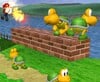
- Mushroom Kingdom: Based on the overworld levels in Super Mario Bros. games, Mushroom Kingdom is the first part of Stage 1 in Adventure Mode. The player is tasked with getting to the flagpole at the end of the level, much like in the original Super Mario Bros. Goombas, Koopa Troopas, and Koopa Paratroopas appear as enemies to impede the player's progress. Near the end of the stage, the player must fight a horde of Yoshis. After finishing the stage, the player then fights Mario and Peach on Princess Peach's Castle. However, if the player reaches the flagpole with a 2 in the seconds place (ex: XX:X2:XX), Luigi will replace Mario and the player will get the chance to unlock Luigi after clearing Adventure Mode if he hasn't already been unlocked.
Enemies[edit]
- Goombas: First appearing in Super Mario Bros., these brown creatures are described as traitors to the Mushroom Kingdom that operate under the employ of Bowser. They walk sideways and damage whoever they bump into, but are easily defeated by bouncing off their heads. They act the same way in Melee where they appear on the first stage of Adventure Mode.
- Green Koopa Troopas: First appearing in Super Mario Bros., these turtle-like henchmen of Bowser's army who walk off ledges and retract into their shells when jumped upon, and the shell can be picked up and thrown or kicked at other enemies in many Mario games. This is fully reflected in their appearances in Melee, where they appear on the first stage of Adventure Mode.
- Red Koopa Troopas: First appearing in Super Mario Bros., these red shelled versions Koopa Troopas do not walk off ledges, but they still retract into their shells when jumped upon, and their shells can still be used at items to throw and kick at other enemies. This is fully reflected in their appearances in Melee, where they appear on the first stage of the Adventure Mode.
- Green Koopa Paratroopas: First appearing in Super Mario Bros., these are Green Koopas Troopas that have white wings on their shell. They fly in set patterns, and when Mario jumps on them, they lose their wings and convert into regular Green Koopa Troopas. This is fully reflected in their appearances in Melee, where they appear on the first stage of Adventure Mode.
- Red Koopa Paratroopas: First appearing in Super Mario Bros., these are Red Koopas Troopas that have white wings on their shell. They fly in set patterns, and when Mario jumps on them, they lose their wings and convert into regular Red Koopa Troopas. This is fully reflected in their appearances in Melee, where they appear on the first stage of Adventure Mode.
Items[edit]
Bold italics denote an item new to the Smash Bros. series.
- Fire Flower: Returns from Smash 64 with a different design.
- Starman: Returns from Smash 64 essentially unaltered in function and purpose.
- Green Shell: Returns from Smash 64, essentially unaltered in function and purpose.
- Red Shell: Returns from Smash 64 essentially unaltered in function and purpose.
- Bob-omb: Returns from Smash 64, essentially unaltered in function and purpose.
- Freezie: Freezies are enemies from the original Mario Bros. that kill Mario and Luigi upon a contact. In Melee, when it appears, it slides in one direction and will fall off the stage if not picked up in time. It can be hurled at opponents to encase them in a slab of ice, and they will be temporarily frozen as others attack him or her and pile on the damage without any knockback.
- Super Mushroom: An iconic power-up from the original Super Mario Bros. that carried on to almost every other Mario game. In many of its appearances, the Super Mushroom increases whoever grabs it in size and extends their life meter by one. In Melee, if a player touches one, they grow in size and increase their bulkiness and strength for a short period of time.
- Poison Mushroom: An item from Super Mario Bros.: The Lost Levels. Poison Mushrooms looked similar to Super Mushrooms, but would actually hurt Mario, instead of making him bigger. In Melee, the Poison Mushroom is an item that looks like the Super Mushroom but will cause the character it touches to temporarily become tiny, and therefore much weaker and lighter.
- Metal Box: An item based on the Green Block from Super Mario 64. This would provide Mario with a Metal Cap, allowing him to change into Metal Mario, giving him much greater weight and power, also making him immune to toxic gas. In Melee, albeit without the cap; characters temporarily into a living metal model of themselves, increasing their resiliency but also their dropping weight, and making them mute.
Music[edit]
- Princess Peach's Castle: An orchestrated remix of the famous stage music from the original Super Mario Bros, with elements of the same game's "underground" theme overlapping with it. It is heard on the Princess Peach's Castle stage in Vs. Mode, and also as the primary music for Mushroom Kingdom Adventure. It is also used as Bowser's credits theme. It is Song 1 in the Sound Test.
- Rainbow Cruise: A medley of two Mario series tracks. The first half of the track is the remixed first half of an energized tune heard in Super Mario 64, while the second half is a remix of the underwater theme heard in Super Mario Bros. It is also used as Peach's credits theme. It is Song 2 in the Sound Test.
- Mushroom Kingdom: A perfect preservation of the original chiptune normal stage music heard in the original Super Mario Bros., appearing on Mushroom Kingdom as the primary track. It is Song 21 in the Sound Test.
- Mushroom Kingdom (Finale): The original chiptune "Hurry Up" music heard in Super Mario Bros. It is heard on the stage Mushroom Kingdom when the match's timer reached thirty seconds. It is Song 22 in the Sound Test.
- Mushroom Kingdom II: The original chiptune normal stage music heard in Super Mario Bros. 2, appearing on Mushroom Kingdom II as the primary track and as Luigi's credits theme. It is Song 23 in the Sound Test.
- Mushroom Kingdom II (Finale): The original chiptune Boss music in Super Mario Bros. 2, appearing on Mushroom Kingdom II as the primary track when the match's timer reached thirty seconds. It is Song 24 in the Sound Test.
- Super Mario Bros. 3: A synthesized rock-based medley of the first stage music and the first overworld music in Super Mario Bros. 3. It is heard as a secondary track on Yoshi's Island and the single-player Mushroom Kingdom Adventure. It is also used as Mario's credits theme. It is Song 30 in the Sound Test.
- Dr. Mario: A synthesized remix of the Fever music track first heard in the original Dr. Mario and all of its sequels. This is heard as a secondary track on both Mushroom Kingdom and Mushroom Kingdom II. It is also used as Dr. Mario's credits theme. It is Song 36 in the Sound Test.
- Mario's Victory: The victory theme of Mario, Luigi, Peach, Bowser, and Dr. Mario is an orchestration of the standard "Stage Complete" theme heard in Super Mario Bros. It is Song 38 in the Sound Test.
- Starman: A remix of the "invincible" music that would occur when Mario picks up a Starman in Super Mario Bros., and it occurs when the player picks up the Starman item in a match. It is Song 77 in the Sound Test.
Peach's Castle N64 is also used in Melee. However, it only plays during Luigi's introduction cutscene in Adventure Mode and does not appear in the Sound Test.
Trophies[edit]
In Super Smash Bros. Brawl[edit]
In a maneuver both traditional and expected, Super Smash Bros. Brawl is rife with Mario-based content. In addition to every previous character from the universe (sans Dr. Mario, making Brawl the only Smash Bros. game to cut a Mario character) returning, the sub-franchise revolving around series anti-hero Wario has been recognized as its own universe for this game, as well as Diddy Kong joining Donkey Kong as the second Donkey Kong fighter. Yoshi returns as well. Discounting the sub-universes, Mario is third only to Pokémon and Zelda in terms of total characters (counting the Pokémon Trainer as three separate characters and Zelda/Sheik as two) and has twice as many stages as the next most represented franchise. Brawl is also the last game in the series to have an unlockable Mario stage.
Fighters[edit]
Four characters from the Mario franchise are playable in Brawl, not counting any sub-franchises, in which case the total number is eight. On the final character select screen (after all characters are unlocked), the first two columns are dedicated to the playable Mario characters, with the first column being the Mushroom Kingdom denizens, and the second column being the sub-series stars.
- Mario (Starter): Mario, the face of gaming, was given a slight character model redesign for his appearance in Brawl as his appearance is based on his current design from the later Mario games, such as Luigi's Mansion, Super Mario Sunshine and Mario Party 4. He is also armed with F.L.U.D.D. this time around, replacing the Mario Tornado from the previous games. Like the rest of the Brawl roster, Mario has a new Final Smash. His is a massive fireball that expands as it engulfs the stage, called the Mario Finale. Mario is ranked 31st on the tier list, his balance an impediment when others excel in many areas.

- Luigi (Unlockable): Luigi returns as an unlockable veteran once again. He remains similar to his brother, but has been further differentiated from him with several new attacks. In addition, Luigi still retains his Luigi Cyclone, giving him another special move unique from Mario. Like Mario, his appearance is also based on his current design from the later Mario games, such as Luigi's Mansion and Mario Party 4. Luigi's Final Smash, Negative Zone, creates a huge circular field of energy that has random effects on enemies caught inside. He is ranked 28th on the tier list, his bizarre physics both a boon and a curse.

- Peach (Starter): Peach reappears from Melee. Her model has been updated to match her current design introduced in Super Mario Sunshine. Her new Final Smash, Peach Blossom, involves Peach blowing numerous kisses that damage all enemies and put them to sleep while a vast amount of peaches fall from the sky. Though she has fallen from her high Melee showing to 19th on the tier list, she is still a solid choice and is still the highest ranking of the non-subseries Mario characters.

- Bowser (Starter): Bowser also makes a return after first appearing in Melee. His appearance is based on his current design from the later Mario games, such as Luigi's Mansion, Super Mario Sunshine and Mario Party 4. His newfound Final Smash is Giga Bowser Transformation, in which he transforms himself to Giga Bowser for 10 seconds to increase his power substantially. Bowser is considered the least viable of the Mario universe characters, even when subseries are taken into account, clocking in at 33rd on the tier list. Giga Bowser (in both Brawl and Smash 4) is part of Bowser's Final Smash. So since he appears as a semi playable character and as a Final Smash trophy for Brawl and Super Smash Bros. for Wii U, he leaves the boss roster until his appearance in Super Smash Bros. Ultimate.

Boss[edit]
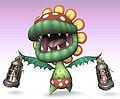
- Petey Piranha: A recurring character in contemporary Mario games, Petey appears in the Subspace Emissary mode as the first Boss fought. He captures Peach and Zelda in cages, and uses them to attack the player. The player's goal is to free one of the princesses by attacking their cage. When Petey is defeated, the most damaged cage is broken, and the princess inside is saved. The unsaved one is then turned into a trophy by Wario.