
Sephiroth
- For fighter info, see Sephiroth (SSBU).
| Sephiroth | |
|---|---|
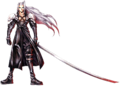
   Official artwork of Sephiroth from Crisis Core: Final Fantasy VII and Monster Strike. | |
| Universe | Final Fantasy |
| Debut | Final Fantasy VII (1997) |
| Smash Bros. appearances | Ultimate |
| Most recent non-Smash appearance | Final Fantasy Resonance (2026) |
| Console/platform of origin | PlayStation |
| Species | Human/Jenova hybrid |
| Gender | Male |
| Place of origin | Nibelheim |
| Created by | Yoshinori Kitase Kazushige Nojima Tetsuya Nomura Hironobu Sakaguchi |
| Designed by | Tetsuya Nomura |
| Voice actor | Toshiyuki Morikawa |
| Article on Wikipedia | Sephiroth (Final Fantasy) |
Sephiroth (セフィロス, Sephiroth) is the main antagonist of Final Fantasy VII, its high-definition remake, and other related media. The archenemy of Cloud Strife, Sephiroth has become Square Enix's most iconic villain from the Final Fantasy series.
Sephiroth made his Super Smash Bros. debut as a downloadable fighter for Super Smash Bros. Ultimate on December 22nd, 2020. He was made available early to those who completed the limited-time Sephiroth Challenge from December 17th.
Origin[edit]

As the antagonist of Final Fantasy VII, Sephiroth is cruel, heartless, and psychologically manipulates others in order to accomplish his goals - particularly Cloud, whose past he is inexorably linked to. A skilled swordsman who wields the Masamune, he was formerly admired by many as a hero, before being driven into madness by the events of the Nibelheim Incident. From then on, he seeks godhood, the destruction of all life on the Planet, and the continued pursuit of Cloud.
Sephiroth was born as part of a series of experiments known as the Jenova Project, conducted by the mega-corporation Shinra. This project utilizes the cells of the extraterrestrial lifeform Jenova, who was mistakenly believed to be part of an ancient race known as the Cetra. On a mission to Nibelheim with fellow SOLDIER Zack Fair and low-level guard Cloud, Sephiroth uncovers the truth of his origins and is insanity-stricken. He burns the village to flames and slaughters its civilians, declaring Jenova his "mother". At the climax of the Incident, Sephiroth was confronted by Cloud and left for dead, falling into the Lifestream with Jenova's severed head. The fallout from this, and Cloud's own injection with Jenova cells, created a deep psychological bond between the two.
Five years later, Sephiroth was revealed to have survived the incident. His body, now residing in the planet's core, had merged with the Lifestream, initiating a "reunion" that would summon Jenova's cells back to him. Driven by vengeance, he has Jenova's body assume his form to pursue Cloud. Sephiroth haunts Cloud's psyche and mind-controls him, forcing him to surrender the Black Materia that allows Sephiroth to summon the world-ending Meteor. He kills Aerith Gainsborough in cold blood and reveals the truth of Cloud's false memories, proclaiming him to be a puppet.
Cloud is able to overcome his shattered mind with Tifa Lockhart's help, and the party returns to the Northern Cave for the final showdown against Sephiroth's true body. After two transformations, Sephiroth's consciousness attacks Cloud's mind, where he is finally defeated. His second form, Safer Sephiroth, is a seraphic entity whose right arm is replaced by a twisted wing, originating his nickname as the "One-Winged Angel".
The game's film sequel, Final Fantasy VII: Advent Children, reveals that Sephiroth's death was not permanent; his will persists in the Lifestream, and the continued existence of Jenova cells allows him to continue to craft new bodies for himself. The film depicts the appearance of three Remnants of Sephiroth - Kadaj, Yazoo, and Loz, each representing three aspects of his personality, and sharing a goal to revive Jenova - and Sephiroth in turn, still seeking to remake the Planet in his image.
Following a showdown with Cloud in the ruins of Midgar, Kadaj merges with Jenova's remains, reviving Sephiroth and taking on his form. Sephiroth engages in one last duel with Cloud, now possessing a single black wing hearkening back to his final form. Cloud emerges victorious once again, telling Sephiroth to remain in his memories where he belongs. Sephiroth's final words as he fades were "I will never be a memory...", heavily implying he will return one day.
As the series's most popular and famous antagonist, Sephiroth appears frequently throughout its spinoffs and crossovers with other franchises. Prior to Super Smash Bros., he was playable in both the Dissidia Final Fantasy series and the fighting game Ehrgeiz, and was a bonus boss in Kingdom Hearts I and II. He reprises his role as the main antagonist in Final Fantasy VII Remake, an alternate-timeline retelling of the original story. His role in the story has been drastically changed and expanded, taking on an active role much earlier in the plot. His role in the original game's backstory, up to and including the Nibelheim Incident, was previously expanded upon in its prequel, Crisis Core: Final Fantasy VII.
Although the original Final Fantasy VII did not have voice acting, Sephiroth has consistently been voiced by Toshiyuki Morikawa in Japanese in all appearances since Final Fantasy VII: Advent Children. In English, Sephiroth was voiced by George Newbern in appearances between Advent Children and Final Fantasy VII Remake, where he was replaced by Tyler Hoechlin. Neither of them voice Sephiroth in Super Smash Bros. Ultimate, due to the game's non-union status and budget; like Cloud, Morikawa's performance is used in all international versions. Hoechlin would go on to be replaced by Travis Willingham in Final Fantasy VII Revelation.
In Super Smash Bros. 4[edit]

Sephiroth is mentioned in the description of the Omnislash trophy. Cloud's All-Star Mode congratulations screen in Super Smash Bros. for Wii U references Sephiroth's actions in the Nibelheim Incident, where Cloud watches as Palutena walks through flames similar to Sephiroth's iconic scene. In Cloud's reveal trailer, Cloud's defeat of Sephiroth with Omnislash is recreated with Ike (in his black costume) standing in for Sephiroth.
In Super Smash Bros. Ultimate[edit]
Prior to his formal debut as a DLC character (see below), Sephiroth was given two indirect allusions. The first is in the challenge that unlocks Cloud's Advent Children Fighter Spirit by performing a Cross Slash with a fully charged Limit Break, which features Cloud holding a prone Zelda in a body of water (indirectly alluding to Sephiroth's murder of Aerith in Final Fantasy VII). The second is in Mewtwo's Classic Mode "Psychic Control", where Cloud acts as Mewtwo's "ally" in the third round after his defeat in the second, indirectly alluding to Sephiroth's constant manipulations of Cloud in Final Fantasy VII.
As a playable character[edit]

Sephiroth appears as a newcomer in Super Smash Bros. Ultimate, with his inclusion being announced during The Game Awards 2020 on December 10, 2020. He is the third DLC character of Fighters Pass Vol. 2, and was released on December 22nd, 2020.
Sephiroth's design is based on his appearance in Final Fantasy VII: Advent Children,[1] although his moveset is inspired by his appearances in Ehrgeiz and the Dissidia Final Fantasy series. His Player 7 and Player 8 alternate costumes are based on his coatless appearance during his final boss fight at the end of Final Fantasy VII.
According to Super Smash Bros. series creator and director Masahiro Sakurai, Sephiroth was designed "to feel like a boss character, with boss-like strength that players can enjoy."[1] This motif was further emphasized with a special limited-time mode called the Sephiroth Challenge, which was released via update 10.0.0 and allowed players the opportunity to unlock Sephiroth and Northern Cave as early as December 17th upon defeating him.
Spirit[edit]
 1,439. Sephiroth

Gallery[edit]
 Coatless Sephiroth as he appears in Super Smash Bros. Ultimate.

Names in other languages[edit]
| Language | Name |
|---|---|
 Japanese |
セフィロス, Sephiroth |
 English |
Sephiroth |
 French |
Séphiroth |
 German |
Sephiroth |
 Spanish (PAL) |
Sefirot |
 Spanish (NTSC) |
Sephiroth |
 Italian |
Sephiroth |
 Chinese (Simplified) |
萨菲罗斯, Sephiroth |
 Chinese (Traditional) |
賽菲羅斯, Sephiroth |
 Korean |
세피로스, Sephiroth |
 Dutch |
Sephiroth |
 Russian |
Сефирот |
Trivia[edit]
- Sephiroth is the first unique character and DLC fighter from an already-represented third-party universe, as well as the first playable third-party villain.
- Sephiroth is the second playable third-party fighter to be mentioned in a game before their debut as a playable character, after Ken. Unlike Ken, however, Sephiroth is only ever mentioned by name.
References[edit]
External links[edit]
- Article on the Final Fantasy Wiki
- Article on the Kingdom Hearts Wiki
 Final Fantasy universe | |
|---|---|
| Fighters | Cloud (SSB4 · SSBU) · Sephiroth (SSBU) |
| Stages | Midgar · Northern Cave |
| Other | Aerith Gainsborough · Bahamut ZERO · Barret Wallace · Chocobo · Ifrit · Leviathan · Odin · Ramuh · Tifa Lockhart |
| Trophies & Spirits | Trophies · Spirits |
| Music | SSB4 · Ultimate |
| Related universe | Kingdom Hearts |

