

Marvel vs. Capcom (universe)
| Marvel vs. Capcom (universe) | |
|---|---|
 
| |
| Developer(s) | Capcom Backbone Entertainment Eighting Iron Galaxy Studios |
| Publisher(s) | Capcom Virgin Interactive Entertainment |
| Distributor(s) | Capcom |
| Genre(s) | Fighting |
| Console/platform of origin | Arcade |
| First installment | X-Men vs. Street Fighter (1996) |
| Latest installment | Marvel vs. Capcom Fighting Collection: Arcade Classics (2024) |
| Article on Wikipedia | Marvel vs. Capcom (universe) |
The Marvel vs. Capcom universe (マーヴル VS. カプコン, Marvel vs. Capcom) is a series of crossover fighting games developed and published by Capcom, featuring characters from their video game franchises and comic book series published by Marvel Comics. The series originated as coin-operated arcade games; later releases were specifically developed for home consoles, handhelds, and personal computers.
In 2012, Complex ranked Marvel vs. Capcom at number 37 on the list of the best video game franchises, commenting that "a frenetic pace and over the top effects work together to make this franchise stand the test of time"
The Marvel vs. Capcom series has received generally positive reviews from critics, who have praised its fast-paced gameplay, vibrant visuals, and wealth of playable characters. The series has enjoyed broad appeal, selling approximately 12 million units as of 2024
Within the Marvel multiverse, the Marvel vs. Capcom universe is designated as Earth-30847.[1] The series' iteration of Spider-Man appears in the crossover event Spider-Verse, where he is defeated by Morlun as he hunts Spider-Totems across different worlds.
Franchise Description[edit]

Capcom's partnership with Marvel began in 1993 with the release of The Punisher, an arcade beat 'em up based on the comic book series of the same name. The game was a modest success, with Marvel having reservations about its particularly violent content, but both sides were satisfied enough to uphold the relationship. Capcom then created their first Marvel-licensed fighting game, X-Men: Children of the Atom, in 1994. The project was spearheaded by then-newcomer Katsuya Akimoto, who was a big fan of Marvel comics, with intense encouragement from Capcom USA in the wake of the meteoric success of X-Men: The Animated Series.[2] As the game shortly released after Super Street Fighter II Turbo, Capcom decided to include the then-newly introduced Akuma as a secret boss in Children of the Atom. Marvel Super Heroes soon followed in 1995, being developed in tandem with Children of the Atom[2]. The game was loosely based on The Infinity Gauntlet storyline, and included multiple characters from Marvel's library instead of specifically the X-Men, and even included Anita from Darkstalkers as a secret boss. Many of the gameplay mechanics used in the Marvel vs. Capcom series were first developed and refined in these two fighting games, serving as precursors to the series. In 2011, then-current Capcom USA Strategic Marketing Director of Online and Community Seth Killian stated that many fighting game aficionados, including himself, consider them to have laid the foundation for the series.

The idea for implementing tag teams was allegedly inspired by an easter egg from Capcom's own 1995 fighting game Street Fighter Alpha: Warriors' Dreams. In a secret "Dramatic Battle" mode, two players, controlling Ryu and Ken, were able to fight against an AI-controlled M. Bison at the same time. The easter egg itself had drawn inspiration from the final battle sequence of Street Fighter II: The Animated Movie, which featured a similar fight scene. Recognizing the uniqueness of a team-up concept, Capcom began to work on their next project. After their earlier licensing ventures with Children of the Atom and Marvel Super Heroes, the company decided to combine Marvel's X-Men franchise, their own Street Fighter franchise, and their team-up concept, leading to the creation of X-Men vs. Street Fighter. The game debuted in Japanese arcades in 1996, establishing the series' fast-paced, 2v2 tag team-based gameplay style. Marvel Super Heroes vs. Street Fighter was then released in 1997, which replaced most of the X-Men cast with other heroes from the Marvel Universe and introduced the character assist mechanic. Both games featured Apocalypse as a boss, with the latter having Cyber Akuma as a second boss.
Marvel vs. Capcom: Clash of Super Heroes later followed in 1998, exchanging the majority of the Street Fighter cast with characters from other Capcom video games series, such as Mega Man, Darkstalkers, Cyberbots and Captain Commando, and added Marvel icons War Machine[3], and anti-hero Venom. The game featured Onslaught from X-Men as the final boss.

In 1999, Capcom announced the development of yet another sequel, called Marvel vs. Capcom 2: New Age of Heroes. Marvel vs. Capcom 2 heavily re-used assets from previous Capcom-developed games, including Street Fighter Alpha, Darkstalkers, and the earlier Marvel vs. Capcom titles, resulting in a large roster of 56 playable characters, such as Marvel characters Cable, and Marrow, and Capcom characters Tron Bonne from the Mega Man Legends subseries, and Jill Valentine from Resident Evil. The plot revolved around original character Ruby Heart tracing the source to an evil being known as Abyss, the Armor of Erosion. She summons the greatest heroes to her airship to find the being and defeat it. New Age of Heroes was later ported to Dreamcast, PlayStation 2, and Xbox.

Shortly after the release of the PlayStation 2 and Xbox ports for Marvel vs. Capcom 2, Capcom lost the use of the Marvel license, putting the series on an indefinite hiatus. However, with the resurgence of 2D fighting games in 2008, owing to the success of Street Fighter IV, Marvel requested Capcom to collaborate with them once again. Capcom would announce the development of the next installment in the Marvel vs. Capcom series, Marvel vs. Capcom 3: Fate of Two Worlds in 2010, adding characters such as Zero from the Mega Man X subseries, Albert Wesker from Resident Evil, Deadpool, and Fantastic Four villain Super Skrull. The game was eventually released in 2011, and an updated version of Marvel vs. Capcom 3, titled Ultimate Marvel vs. Capcom 3, was released later in the same year, and added characters such as Phoenix Wright from Ace Attorney, Frank West from Dead Rising (who notably was planned to appear in the initial release of the game), and Marvel icons Doctor Strange and Ghost Rider, both versions of the game revolved around Heroes and Villains teaming up to stop Galactus. The high-definition compilation game Marvel vs. Capcom Origins was then released in 2012.

Following the release of Ultimate Marvel vs. Capcom 3 for the PlayStation Vita in 2012, Marvel's new parent company, The Walt Disney Company, which acquired Marvel in 2009, chose not to renew Capcom's license with the Marvel characters, instead opting to put them in its own self-published Disney Infinity series, which also used Marvel characters. As a result, Capcom had to pull both Ultimate Marvel vs. Capcom 3, Marvel vs. Capcom 2, and Marvel vs. Capcom Origins off their online platforms in 2013. However, in 2016, Disney announced its decision to cancel the Disney Infinity series, discontinue self-publishing efforts, and switch to a licensing-only model, allowing them to license their characters to third-party game developers, including Capcom. Marvel vs. Capcom: Infinite was revealed in 2016, and then released in 2017 and added characters such as X, Jedha Dohma from Darkstalkers, Gamora, and Captain Marvel, with the plot revolving around Ultron and Sigma merging to become Ultron Sigma so they can convert all organic life into their slaves using an improved Sigma virus. Upon release while it was praised for its gameplay, going back to the series' roots with 2v2 teams, it was criticized for its lack of any X-Men or Fantastic Four characters due to Disney not owning the film rights to either series at the time (as both were under ownership of 20th Century Studios at the time), and wanting exclusively Marvel Cinematic Universe characters to promote recent films such as Captain Marvel, and Black Panther and not wanting to promote films they didn't own. Its artstyle was also generally disliked, with the game having gone for a more realistic look instead of the cell-shaded style of the previous entry. In 2019, Disney would later purchase a large portion of 20th Century Studios, giving them access to the X-Men and Fantastic Four lineup of characters, though the merger did not go through—and, in fact, was not even fully announced—until after the second wave of downloadable characters were released for Infinite, adding Winter Soldier, series veteran Venom, Black Widow, Black Panther, Monster Hunter, and Sigma, with the latter three having already appeared in the story mode.

In June 2024, Capcom announced Marvel vs. Capcom Fighting Collection: Arcade Classics for Nintendo Switch, PlayStation 4 and Windows. The compilation features the seven Marvel titles developed and published by Capcom for arcades from The Punisher through Marvel vs. Capcom 2: New Age of Heroes. It notably marks the series' debut on Nintendo platforms, the first time the classic entries have been made available on PC, as well as the first general re-releases for Marvel Super Heroes, Clash of Super Heroes, and New Age of Heroes since the original Marvel vs. Capcom Origins compilation and the remaster of Marvel vs. Capcom 2 were digitally delisted from seventh generation console storefronts. It additionally featured playable versions of previously boss fight-exclusive characters—Magneto, Juggernaut, and Akuma in Children of the Atom; Doctor Doom, Thanos, and Anita in Marvel Super Heroes; and Cyber Akuma in Marvel Super Heroes vs. Street Fighter—as well as featuring Norimaro, an original character based on Japanese comedian Noritake Kinashi, playable outside of Japanese releases of Marvel Super Heroes vs. Street Fighter for the very first time. It would later receive an Xbox One port in 2025.
While the fate of the franchise is currently uncertain, especially after Arc System Works announced they were making their own fighting game with Marvel characters titled Marvel Tōkon: Fighting Souls, the collection confirms there is interest on both sides to continue the franchise.
Gallery[edit]
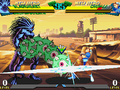
Gameplay of Marvel Super Heroes vs. Street Fighter
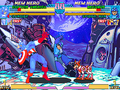
Gameplay of Marvel vs. Capcom: Clash of Super Heroes


Media with elements appearing in the Super Smash Bros. series[edit]
The Marvel vs. Capcom universe has media represented throughout the Super Smash Bros. series with a total of 4 games and medias. The latest game represented in this universe is Marvel vs Capcom 3: Fate of Two Worlds, released on February 15, 2011.
X-Men vs. Street Fighter[edit]
- Playable characters:
 The animation for Shinryuken is largely based on the version of the move found in this game.[4]
 This game is the first to allow use of the regular, horizontal Hadoken in midair, though only by Ryu. Both he and Ken can do so in Smash.
- This game is the first to allow use of the Shoryuken in midair, albeit only by Ken. Both he and Ryu can do so in Smash.
- This game is the first to allow use of the Shinku Hadoken in midair.
- The appearance of Hadoken is largely based on the version found in this game. Which was done in order to look less pale in comparison to the X-Men characters
Marvel Super Heroes vs. Street Fighter[edit]
- Playable characters:
- While Ryu's down taunt was first used by Akuma, this is the first game in which Ryu assumed the stance (as a tag-in pose).
Marvel vs. Capcom: Clash of Super Heroes[edit]
- Playable characters:
Marvel vs. Capcom 3: Fate of Two Worlds[edit]
- Assist Trophies:
- Zero's English voice actor, Johnny Yong Bosch first voiced the character in this entry, and reprised his role in Smash.
Trivia[edit]
- The series is mentioned by name in Super Smash Bros. Direct 4.8.2014
- Ryu's Palutena's Guidance lists "cyborgs, androids, mutants, giant monsters, super heroes, aliens, and demons" as previous opponents faced by him, alluding to the series as a whole.
References[edit]
- ^ https://marvel.fandom.com/wiki/Spider-Verse_Vol_1_2
- ^ a b X-Men: Children of the Atom: An oral history
- ^ At the time, Iron Man's video game rights were tied to another company (reportedly Acclaim Entertainment), which blocked Capcom from using the character in their fighting games. To bypass this, Capcom repurposed Iron Man's existing character sprites and converted them into War Machine.
- ^ https://www.youtube.com/watch?v=fccgHnBQ0YM&t=270
- ^ https://www.youtube.com/watch?v=7xUWnQu2Grs&t=1726

