

Strider (universe)
| Strider (universe) | |
|---|---|
 
| |
| Developer(s) | Capcom Sega Tiertex Design Studios Double Helix Games |
| Publisher(s) | Capcom Sega U.S. Gold |
| Designer(s) | Kouichi Yotsui Tokuro Fujiwara Shinichi Yoshimoto |
| Genre(s) | Hack and Slash Platform |
| Console/platform of origin | Arcade |
| First installment | Strider (1989) |
| Latest installment | Strider (2014) |
| Article on Wikipedia | Strider (universe) |
The Strider universe (ストライダー飛竜, Strider Hiryū) is a series of hack and slash platform game developed and published by Capcom. Set in a dystopian future where Earth is ruled by the tyrannical Grandmaster Meio, it follows the titular Strider named Hiryu as he attempts to end his tyrannical reign for good. The game resulted from cooperation between Capcom and manga publisher Moto Kikaku. the 1989 entry marked the video game debut of Strider Hiryu, after the character was introduced in the 1988 manga Strider Hiryu.
The game debuted on Capcom's CP System arcade board. Various home computer ports were developed by Tiertex and published by U.S. Gold in 1989. The NES version has a different plot than the original. Sega released Strider for its own Genesis console in 1990. Of all home versions, the Genesis adaptation is considered the most successful, winning the Game of the Year and Best Graphics in a Video Game awards from Electronic Gaming Monthly in 1990.
Strider's gameplay is cited as a major influence on the video game franchises Ninja Gaiden, Devil May Cry, and God of War. It became one of Capcom's early hits, praised for its innovative gameplay, diverse and unique music, and multilingual voice samples.
Franchise Description[edit]
The controls of Strider consist of an eight-way joystick and two action buttons for attacking and jumping. The player controls the protagonist Strider Hiryu, a ninja whose main weapon is a tonfa-like plasma sword known as a "Cypher". He can perform numerous acrobatic feats depending on the joystick/button combination used. Pressing the jump button while Hiryu is standing still will cause him to do a regular vertical jump, while pressing the jump button while pushing the joystick left or right will enable him to do a cartwheel jump. Hiryu can also slide under or through certain obstacles and enemies by first crouching down and then pressing the jump button. As well as his sliding move, both jumps can also be used to destroy weaker opponents. Hiryu is able to latch onto certain platforms, and climb across walls and ceilings using a metallic hook. While running down a sloped surface, Hiryu can gain enough momentum to allow him to do a longer cartwheel jump than usual.
Outside of his series Strider Hiryu also appears as a playable character in the 1998 fighting game Marvel vs. Capcom: Clash of Super Heroes, which was followed by Marvel vs. Capcom 2: New Age of Heroes in 2000. Hiryu has also made minor appearances in other Capcom-related games such as SNK vs. Capcom: Card Fighters' Clash, Namco × Capcom, Project X Zone 2 and Adventure Quiz: Capcom World 2, including a small cameo appearance in Ken's stage in Street Fighter Alpha 2. Hiryu was one of the characters intended to appear in the unreleased 3D fighting game Capcom Fighting All-Stars.[1] Hiryu's next guest appearance was in the 2011 fighting game Ultimate Marvel vs. Capcom 3 which marked his character's official 3D debut; this game is also notable as being the first where he is voiced in English. He returned in the sequel, Marvel vs. Capcom: Infinite.
The character has received positive reception both from critics and the general public. In the Japanese Gamest magazine's "Best 100 games of the Year" in 1989, Hiryu ranked 3rd in the "Best Characters" category. Edge issue 84 page 67. That same year, IGN's Travis Fahs noted him "one of Capcom's best loved characters", commenting that "there's no denying the iconic appeal, but for all of his flashy moves and fashion sense, Capcom has never really known what to do with him."[2] In 2012, GamesRadar ranked this "somewhat of an enduring classic" as the 59th "most memorable, influential, and badass" protagonist in games, commenting that his "sheer levels of badass cool have seen him endure long past his clichés sell-by date, making him now an archetype rather than a stereotype."[3]
Gallery[edit]
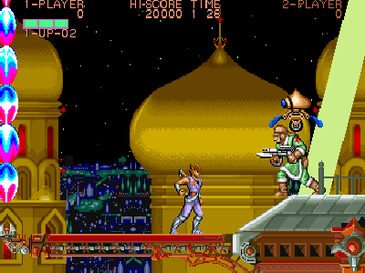
Gameplay of 1989 arcade game
Media with elements appearing in the Super Smash Bros. series[edit]
Strider (1989)[edit]
- Playable Characters:

Trivia[edit]
References[edit]
- ^ JAMMAショーに先がけて公開!「CAPCOM新作対戦格闘(仮称)」 (ja). Game.watch.impress.co.jp.
- ^ Travis Fahs, The Shrouded Past of Strider Hiryu: Celebrating two decades of sword-slashing., IGN, August 20, 2008.
- ^ 100 best heroes in video games, GamesRadar, October 19, 2012.
- ^ Rockman 7. Capcom. Retrieved on 2024-01-07. “With this Slash Claw, I can slice through anything. Incredible dasu. It's like SXrXder HXyuu dasu! Promise you won't say that again”

