


EarthBound (universe)
| EarthBound (universe) | |
|---|---|
  
| |
| Developer(s) | Ape Inc. HAL Laboratory Brownie Brown |
| Publisher(s) | Nintendo |
| Designer(s) | Shigesato Itoi |
| Genre(s) | Role-playing |
| Console/platform of origin | Famicom |
| First installment | EarthBound Beginnings/Mother (1989) |
| Latest installment | Mother 3 (2006) 
|
| Article on WikiBound | EarthBound (universe) |
The EarthBound universe, also known by its Japanese name the Mother universe (マザー, MOTHER) refers to the Super Smash Bros. series' collection of characters, stages, and properties that hail from Nintendo's cult-classic trilogy of Japanese role-playing games. The series was created by Shigesato Itoi, and the franchise's symbol is the Earth, which itself is a recurring motif in the EarthBound series (being represented in both EarthBound and Super Smash Bros. by the Blue Marble). Despite receiving poor sales in its initial release, the EarthBound series has received strong acclaim retrospectively due to its dedicated fanbase and representation in the Smash Bros. series. The games' re-releases have constantly topped the charts as best sellers on the Nintendo eShop and received higher marketing attention than most other ports of legacy titles, most notably EarthBound was the fourth best selling Virtual Console game on the Wii U's eShop (surpassed only by Super Mario World, Super Mario 64 and Super Mario Bros. 3) and the sixth best selling eShop game of all time. The Smash Bros. games represent the franchise with Ness and Lucas as playable characters, along with various other characters appearing as items and enemies.
Franchise description[edit]

An influential Japanese copywriter, actor, and television personality named Shigesato Itoi took a foray into the Nintendo-dominated video game market of the late 1980s despite some initial skepticism from Nintendo's higher-ups about working with celebrities. He and then-Nintendo president Hiroshi Yamauchi formed a new subsidiary called Ape Inc. and Itoi pitched to Shigeru Miyamoto an RPG game set in modern day. this pitch was approved, and the game would release in July of 1989 for Famicom as Mother (with the name being inspired by John Lennon's song of the same name[1]). Itoi wanted to make an unconventional take on the primarily sword-and-sorcery themed RPG genre. The game was set in a humorous rendition of contemporary America realized in the town of Podunk and had the player assuming the role of Ninten, a neighborhood boy with psychic powers who would go on an adventure that would eventually lead to him confronting Giygas, a villain that would become a series regular and one of the few connecting elements of the series. It featured conventional objects such as baseball bats and yo-yos as stand-ins for weapons that could be equipped and a variety of bizarre and comical enemies such as possessed automobiles, crazed animals, and hippies and gang members. It also featured a very odd blend of simplistic character designs and dark themes and undertones. The game sold very well in Japan, and an English localization immediately began, with a planned fall 1991 release date with Earth Bound as the intended Western title. However, marketing executives anticipating the mid-1991 release of the Super NES decided that the prototype NES game would be too costly to produce and market, and the localized product was shelved with no foreseeable plans for a future release. This was the case until 2015, when the translation was finished and released for the Wii U Virtual Console as EarthBound Beginnings.

Itoi returned to design a sequel for the Super Famicom, Mother 2, though the title's development was troubled by a new inexperienced development staff and was stretched across five years, nearly facing cancellation. The project was only saved when late veteran programmer Satoru Iwata joined the development team, now making the Mother 2 project a joint effort by Ape and HAL Laboratory (HALKEN at the time), separate studios based at separate locations (employees would regularly have to travel between studios to work). It was released in August 1994 in Japan and, unlike its predecessor, actually saw a Western localization the following June, under the first public occurrence of the name EarthBound. This game saw new protagonist Ness and his friends and their adventures across time and space to save the world from Gyigas. However, while the game's Japanese sales figures were relatively close to the original's, it sold poorly in the West because of an unusual and ineffective marketing campaign and the fact that American audiences were largely indifferent to JRPGs at the time (this would only end with the 1997 release of Final Fantasy VII, which brought the genre to the mainstream). These poor sales even prevented the game from being released in the PAL regions. Critical retrospectives, however, portray it as not only one of the best RPGs in the 1990s, but also one of the most original, both in its approach to established JRPG mechanics and in its uniquely quirky humor, storyline (which is comparatively more light-hearted than its forerunner), character, and bizarre psychedelic aesthetic, as well as its many parodies of American culture and JRPG - and science fiction - storytelling conventions. Some publications have named it the defining example of a cult classic, with substantial fanbases in both Japan and North America.
More development and release date woes awaited the Mother franchise following EarthBound. Ape Inc. would immediately disband after completion, though most would come back to form the modern day Creatures to assist Game Freak to develop Pokémon Red & Green, which is why they share ownership between Game Freak and Nintendo. Itoi immediately began development of the series' second sequel for the Super Famicom in 1994, which was then moved to the Nintendo 64DD add-on for the Nintendo 64, popularized by the media as the then-upcoming EarthBound 64. When the ill-fated disk drive peripheral was met with commercial failure, the game was cancelled and restarted its development cycle on the Nintendo 64 itself. Itoi's development team was inexperienced with developing three-dimensional titles and the Nintendo 64 hardware itself, and the project remained unreleased even as EarthBound was included by Masahiro Sakurai as an unlockable franchise in the original Super Smash Bros. in 1998. Despite showings at Spaceworld 1999 and high anticipation, Itoi eventually announced the official cancellation of EarthBound 64 in August 2000, citing that he did not want to make anything other than "something truly special" in addition to the project becoming too complex with its interest in three-dimensional graphics. Shigeru Miyamoto subsequently became interested in finding ways to salvage some of the work, though this had to be put on hold because the Mother 3 development team was put on Nintendo GameCube projects. Meanwhile, the translated prototype of the Western version of the NES game was discovered and purchased by a fan translation group, which was modified, retitled "EarthBound Zero", and distributed through the Internet as a ROM image.
Itoi and Nintendo eventually decided to rerelease both Mother titles in Japan as ports compiled on one Game Boy Advance cartridge, Mother 1 + 2, which was released in June 2003 in Japan and included all of the enhancements the English prototype had made to the original Mother; to the dismay of fans, this was never released in the West either. However, Itoi realized he would once again be pressured into reviving his shelved project, an idea he was initially opposed to, but encouragement from fans led to his decision to restart development for the game for Game Boy Advance, which he approached as though he were developing his magnum opus. After three years of development, Mother 3 (essentially now a Game Boy Advance re-creation of EarthBound 64, albeit with a few changes to the plot) was finally released in Japan in April 2006, twelve years after development began and over a year after the launch of the handheld's successor, the Nintendo DS. This Game Boy Advance title returned the series to a two-dimensional aesthetic but placed more emphasis on a serious plot and character interaction and tweaked gameplay elements of its predecessors. The game saw new protagonist Lucas and his adventures with his family and later his newfound friends as they try to save the world from being destroyed entirely. It was released to critical acclaim that praised its new rhythm-based but otherwise simple approach to turn-based combat and, most significantly, tragic storytelling and characterization that achieved a rarely seen degree of depth in titles in the genre.
Unfortunately, Nintendo of America would once more decline to localize the game for Western audiences, once again apparently because of fears that its inconvenient timing at the end of the commercial lifespan of the platform it was based on would negatively affect its sales. The fansite Starmen.net made headlines in October 2008 when it released its own English translation patch that could be applied to a copy of the ROM image of Mother 3. This monumental translation effort was spearheaded by professional translator Clyde "Tomato" Mandelin and the patch received over 100,000 downloads from the website in the first week of its release. Despite the project not being completely legal, it became one of a handful of unofficial video game localization projects that officials in the video game industry did not formally object to, but instead expressed admiration for. In the meantime, the Mother series has regularly appeared in every subsequent Super Smash Bros. game to date, including Mother 3 being focused on in 2008's Super Smash Bros. Brawl, though Itoi has announced that he has no plans to direct a fourth Mother game and reaffirmed this statement several times. In the years to come, developers large and small would create role-playing games that would draw heavy inspiration from the world, humor, and battle system of the Mother series, including the critically-acclaimed Undertale in 2015 by Toby Fox, and Omori in 2020 by Omocat. Although the series is seldom referenced directly by Nintendo, the rights held to it by Itoi have enabled the continued development of merchandise and other projects honoring its legacy, such as a collaborative tribute book and a rearranged version of the first game's studio album.
While never achieving the same mainstream success as Mario or even other RPG franchises, the Mother franchise has received a cult following that has only grown in the wake of the internet and continued representation in the form of cameos and the Super Smash Bros. series. Merchandise being made about the franchise to this day and fan projects that would go on to be successful game releases in their own right is a sign of this fan devotion, as arguably more popular franchises do not share this privilege, such as the now canceled game Oddity, formely Mother 4, who was left in development since 2010.[2] Official merchandise featured, produced, or published by Hobonichi titled "Hobonichi Mother Project" also takes part of it, ranging from cosmetics to plushies and even a live concert titled The Music of MOTHER.
In Super Smash Bros.[edit]
EarthBound is one of the "bonus franchises" in the original Super Smash Bros. - contributing one unlockable character and a song (his victory theme). There are no stages based on EarthBound in the game, so Ness instead has to be fought on Dream Land, Kirby's stage in order to be unlocked.
Fighter[edit]
- Ness (Unlockable): A boy living in the town of Onett, Ness is gifted with psychic powers. He is chosen by a little alien named Buzz Buzz to save the world from Giygas, a malevolent entity which is causing the citizens and animals of his town and others to become hostile. To do this, he must first travel to eight sanctuaries and record the Eight Melodies in his Sound Stone, given to him by Buzz Buzz. Ness then must combine those melodies and make the "Sound Stone Melody", which will give him the power of the Earth necessary to defeat Giygas at the end of the game. (The second half of the melody comprises Ness' victory theme in the first two games of the Smash series.) All of Ness's special moves (PSI Magnet, PK Fire, and PK Thunder) were incidentally used by Paula, not Ness, in EarthBound. Ness is currently in low tier, sitting at 10th out of 12 on the tier list, mainly due to his easily exploitable recovery.

Music[edit]
- 24: Ness Wins: The victory theme of Ness is an orchestrated version of the last several notes of the Eight Melodies (not to be confused with the separate Eight Melodies from its predecessor, Mother) that Ness collects throughout his journey at the eight "Your Sanctuary" spots in EarthBound. This incarnation of the Eight Melodies also appears in EarthBound as part of "Smiles and Tears", which also appears in remixed form in Super Smash Bros. for Nintendo 3DS and Wii U.
In Super Smash Bros. Melee[edit]
EarthBound's representation in the Smash series was expanded significantly upon in Super Smash Bros. Melee, with a returning character, two new stages, a new item, and many new trophies.
Fighter[edit]
Lucas was supposed to replace Ness in Melee but, due to constant delays and then cancellation of EarthBound 64, Ness was kept in at the last minute.
- Ness (Starter): Ness is still the only playable EarthBound character in the game, but he now has PK Flash for his neutral special. As a result, his previous neutral special, PK Fire, has been moved to his side special. Despite his flaws in Super Smash Bros. like his recovery, Ness has suffered an overall nerf, countering most of his buffs. As a result, Ness is currently ranked 23rd out of 26 in the tier list, similar to his Smash 64 tier placement.

Stages[edit]
Melee is the first game to introduce stages for the EarthBound series.
- Eagleland: Onett (Starter): The quaint suburban hometown of Ness, whose citizens and animals become hostile under Giygas' otherwise invisible influence. The red spherical meteor on the hilltop in the background is the alien Buzz Buzz's spacecraft and, when Ness investigates it, he is instructed by Buzz Buzz to go on a quest to save Onett and the world from Giygas' influence. This stage takes place on and around houses and a drug store whose balconies serve as battling platforms. The road in front of the characters on the ground has speeding cars on it, and cars zooming past characters on the ground will almost certainly KO them.

- Eagleland: Fourside (Unlockable): The New York City-inspired urban metropolis in EarthBound manifests as a battle-on-skyscrapers-in-the-nighttime stage for Melee, and in essence, it is the spiritual successor to the Saffron City Pokémon stage from the first Super Smash Bros. The layout of the stage consists of three main platforms with bottomless pits in between buildings, so this is the most conceivable stage where the Wall jump technique can be used to save oneself from a fall. The Monotoli helicopter occasionally appears in the background, landing on the Monotoli building before flying off after a short time. In addition, from time to time a UFO will materialize above the city and serve as an extremely slippery semi-soft platform.

Item[edit]
Melee introduced an item for the EarthBound series as well:
- Mr. Saturn: A race of odd little creatures with big noses, whiskers, and the ability to talk, Mr. Saturns are encountered as friendly NPCs by Ness in EarthBound. They make their home in an area of Eagleland called Saturn Valley, and when they speak the text in the game is presented as hard-to-read kindergarten scrawl, and they often mix the words "boing", "ding", and "zoom" into their speech for unknown reasons. As a Melee item, a Mr. Saturn is an intentional "dud" item. It walks around on its own, and it can be picked up and hurled at opponents for minor damage, but it can be reused this way because it does not disappear after one use. In addition, a thrown Mr. Saturn does 21 shield damage in this game, and several bonuses are available based on the usage of these creatures.
Music[edit]
- Mother: Despite being known as "Onett" in Smash 4, it is not actually heard in the town of Onett or in EarthBound for SNES overall, and is instead a combination of two tracks first heard in Mother. The first is Bein' Friends, which is the overworld theme whenever Ninten has more than one character in his party, and the second is the Eight Melodies that Ninten collects throughout the game. Finally a small portion of title theme is played before the song finishes its loop. The music also ends with an enemy encounter tune, which appears in both EarthBound Beginnings and EarthBound - albeit only for bosses in the latter. It is heard on Onett. It is Song 19 in the Sound Test.
- EarthBound: Synthesized music heard prominently in EarthBound, this is the official theme for the city of Fourside in both the game and in Melee's Fourside stage, with the first half of EarthBound's Eight Melodies inserted at a point (the last half of the original version, incidentally, are used as Ness's victory theme). It is Song 20 in the Sound Test.
- Mother 2: The song's real title is Pollyanna. This is a quaint soft rock remix of the overworld theme in Mother whenever Ninten is the only character in his party. A slightly abridged remix also appeared in EarthBound whenever Ness returns to his house during his quest, with the intro to the original version also being used in that game in Onett when the sun rises. It also appeared in Mother 3. It is used as a secondary track on Onett. It is Song 35 in the Sound Test.
- Ness's Victory: The victory theme of Ness is an orchestrated version of the last four notes of the Eight Melodies that Ness collects throughout his journey. It is Song 47 in the Sound Test.
Trophies[edit]
Movies[edit]
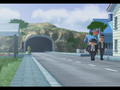 Members of the Runaway Five before Ness teleports in.
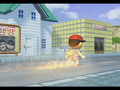 Onett sign with the Runaway Five.


Lucky and Nice of the Runaway Five appear in the introduction movie in Onett. There is also a sign showing a picture of both members that is absent in the Onett stage. The equivalent sign in the stage is moved further to the right and has a different design, with only Lucky being present in the picture.
Sound effects from EarthBound can be heard in the beginning of the Special Movie.
In Super Smash Bros. Brawl[edit]
The content from the EarthBound franchise have been given a boost in representation since Melee with two total playable characters and another item in Super Smash Bros. Brawl.
Fighters[edit]
- Ness (Unlockable): The protagonist of EarthBound was confirmed to be returning in Super Smash Bros. Brawl by the opening sequence of the game and by the official Dojo on February 1st, 2008. He has been slightly buffed from Melee while still retaining his old moveset and voice clips. He gained an additional 10 frames of lag when grab released, making him extremely vulnerable to infinite grab-release follow-ups. Thus, he is ranked 26th on the tier list, being a mid tier character rather than a low tier character in Melee.

- Lucas (Starter): The protagonist of Mother 3 and the most recent hero in the series is a newcomer in Brawl. Although his special moves are similar to Ness's, Lucas's standard moveset is largely different. Some similar moves between the characters differ in function, i.e. whereas Ness would have an attack that deals one solid hit, Lucas has one that deals multiple small ones and vice-versa. One of Lucas's alternate costumes makes him look like his twin brother from Mother 3, Claus. He is ranked 30th on the tier list, being lower than Ness, the lowest of the newcomers in Brawl, and at the very bottom of the lower-mid-tier. He shares the same problem with Ness, having an additional 10 frames of his grab-release animation that leaves him prone to grab-release follow-ups.

On the final character select screen (after all characters are unlocked), the EarthBound characters occupy the eighth column alongside the Fire Emblem characters. Both of these series were originally Japan-only RPG series that later saw at least one entry released in the West.
Boss[edit]
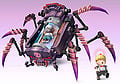
- Porky: Porky Minch appears as a boss in Brawl's Subspace Emissary mode. Porky's supposedly robotic statue form chases Lucas around The Ruined Zoo. Ness retaliates against the giant statue and uses a PK Flash to destroy it. When the statue crumbles, a mechanized spider-looking machine appears with Porky in the center.
Stages[edit]

 Melee Stages: Onett (Starter): One of the stages that returns from the previous game, it only has a few minor changes such as the addition of My Music and the knockback from the cars having been significantly lowered.
 - New Pork City (Starter): An enormous stage akin to Melee’s Temple stage. Based on the locale from the Japan-only Mother 3, a beast known as the Ultimate Chimera makes an appearance here and can one-hit KO players with its bite.

Items[edit]
Bold italics denote an item new to the Smash Bros. series.
- Mr. Saturn: Mr. Saturn is mostly unchanged from his Melee appearance: he inflicts minimal damage when thrown, but now deals 43 units of shield damage, one more than twice as much as its Melee shield damage of 21.
- Franklin Badge: This equippable item from all three EarthBound games is an item in Brawl. In Mother, it reflects the normally one-hit KO Gamma-level PK Beam attack, while in EarthBound and Mother 3, it reflects electricity-based attacks back at the attacker; in Brawl, it is worn by a character for a short while, making him or her immune to all projectile-based attacks which get reflected back in the direction whence it came.
Assist Trophy[edit]
- Jeff: Jeff uses his bottle rocket launcher and launches homing missiles at all opposing characters.
Music[edit]
Original Tracks[edit]
- Porky's Theme: The theme of Porky, main villain of Mother 3, and his Pig Mask Army. The main portion is a remix of His Highness's Theme, taken directly from the Mother 3i soundtrack (with the Log-O-Type part of the song taken from another remix in the Mother 3i soundtrack). It is used on the New Pork City stage.
- Unfounded Revenge / Smashing Song of Praise: A remix and combination of the two boss battle songs of the same name from Mother 3. It is used on the New Pork City stage.
- Mother 3 Love Theme: Taken from Mother 3, this song is a remix of Mom's Hometown and the "Theme of Love" song from the Mother 3 and is the main theme of the game. It is used on the New Pork City stage. This song also plays during Lucas's Classic Mode credits.
- You Call This a Utopia?!: In Mother 3, it is the background music of New Pork City, which is another remix of Porky's Theme. It is the theme of the New Pork City stage.
- Humoresque of a Little Dog: This theme is a remix of the song played in the Drugstores in the first two games, and in Porky's jukebox in Mother 3. It is used on the New Pork City stage.
- Snowman: A cover of a song that plays in every single EarthBound game. It is very similar to the Mother 3+ soundtrack's version, minus the chanting and added instrument after first loop. It is used on the New Pork City stage. This song also plays during Ness's Classic Mode credits.
Returning Tracks[edit]
- Mother (Melee): An arrangement of Bein' Friends from Mother, it was slightly remixed in the transition from Melee to Brawl. It is used on the Onett stage.
- Mother 2 (Melee): An arrangement of recurring series theme Pollyanna (I Believe In You), taken directly from Melee. It is used on the Onett stage.
Victory Theme[edit]
- Victory! EarthBound Series: Ness and Lucas's victory theme. Taken from the title song of Mother, Mother Earth.
Trophies[edit]
Stickers[edit]
Masterpiece[edit]
- Mother 2 (Japan only)
In Super Smash Bros. 4[edit]
The EarthBound universe is once again represented in Super Smash Bros. 4. Initially, Ness returned while Lucas was cut, but Lucas was later on released as a DLC character.
Fighters[edit]
- Ness (3DS: Unlockable; Wii U: Starter): a small-town boy from EarthBound who saves his world from an alien invasion. He returns as an unlockable character in the 3DS version, but is once again a starter in the Wii U version. His appearance and proportions are closer to his original game; he has a thinner body and his clothing has much brighter colors. Some of his new alternate costumes also hold references to key characters from EarthBound. His extra 10 grab-release frames were removed, making him no longer subject to grab-release follow-ups. Overall, most of his moves are buffed, whether they are faster or stronger, making him more viable than in the past three games. Interestingly, some of his custom moves are taken from Lucas's special moveset. Ness is one of the few veterans to be given new voice clips.

- Lucas (DLC): the timid protagonist of Mother 3 who fends off Porky's Pigmask Army. He returns as a downloadable character that was made available for purchase on June 14th, 2015, the same day EarthBound Beginnings was released on the Wii U Virtual Console. Like Ness, he now has brighter-colored clothing, body proportions that match his debut title, and a constant smile. Also like Ness, some of his new alternate costumes make references to other important characters from Mother 3. Similar to Ness, his extra 10 grab-release frames were removed, and despite being slightly nerfed in the transition from Brawl to SSB4, he has indirect buffs from the nerfs of other characters that countered him before, which makes him play relatively better against the rest of the cast than in Brawl.

Stages[edit]
for Nintendo 3DS[edit]
- Magicant (Unlockable): staged in a dreamy realm from Mother and EarthBound. Its appearance primarily derives from Mother, though some elements are from EarthBound. A Flying Man will sometimes appear on the right side of the stage as a hazard. If a player touches one, he will fight along side them like an Assist Trophy. The Flying Man can be launched and defeated by other players. Should one be defeated, another Flying Man will spawn on the same right-side platform. After five Flying Men have been defeated, they will no longer appear in the rest of the match. Characters from EarthBound - the Mobile Sprout, Dungeon Man, and Sky Runner - cameo as platforms. Occasionally, a "rip" in sky will open in the background and shows moments from Mother and EarthBound. Many characters make cameo in this rip, including Ninten, the protagonist of Mother. This is one of the possible stages to appear in Level 5 of All-Star Mode as a home stage for Ness, who is also unlocked on this stage. Its Ω form is a floating platform like Final Destination.

for Wii U[edit]
 Onett (Starter): staged in Ness's hometown from EarthBound. Various vehicles drive on the road in the foreground and will hit grounded opponents. The colors of the stage are more pronounced than they were in Brawl and two mailboxes have been removed. It is one of the possible stages to appear in Level 3 of All-Star Mode as a home stage for Ness and it is large enough to accommodate 8-Player Smash. Its Ω form is columnar and staged on top of the Drug Store.
Items[edit]
- Mr. Saturn (throwing): a bow-wearing being from EarthBound. It can be picked up and thrown as a bouncy projectile that does enough shield damage to cause an instant shield break. Otherwise, Mr. Saturn walks harmlessly around the stage.
- Franklin Badge (status): a badge from the EarthBound series. It reflects projectile attacks when equipped.
Assist Trophies[edit]
Bold italics denote an Assist Trophy new to the Smash Bros. series.
- Jeff: a bespectacled friend and ally of Ness's from EarthBound. He attacks opponents with a bottle rocket. He does not harm the summoner.
- Starman: an extraterrestrial enemy from Mother and EarthBound. It teleports around the stage and attacks opponents with PK Beam. Opponents can attack and ultimately launch the Starman if it accumulates enough damage. It does not attack the summoner. It also appears as an enemy in Smash Run.
Smash Tour items[edit]
- Mr. Saturn (Red): a bow-wearing being from EarthBound. The user can break an opponent's shield more easily.
- Franklin Badge (Red): a badge from the EarthBound series. The user starts battle with the badge equipped.
- Porky (Green): Ness's neighbor and a major antagonist from EarthBound and Mother 3. The user steals an opponent's Tour Items.
- Ultimate Chimera (Red): a toothy monster from Mother 3. The user takes two fighters from the last opponent KO'd instead of just one. It will activate even if the user did not place first in the battle.
Enemies[edit]
Smash Run enemies[edit]
- Starman: an extraterrestrial enemy from Mother and EarthBound. It teleports around the stage and attacks opponents with PK Beam. It also appears as an Assist Trophy. Its PK Beam can be reflected and absorbed only in Smash Run.
- Devil Car: Also known as the Psycho Car in EarthBound Beginnings, the English release of Mother. It attacks opponents by spinning doughnuts and running over them. It has a lot of HP and armor, making it difficult to launch. It cannot be grabbed.
Smash Tour enemy[edit]
- Flying Man: a yellow-and-red birdman from the first two EarthBound games. In Smash Tour, he aids the first player who bumps into him and travels along the board. He launches the next opponent he crosses paths with. He also appears in the 3DS version as a hazard on the Magicant stage.
Mii Costume[edit]
Outfit[edit]
 Flying Man Outfit (DLC): this outfit is based on a Flying Man, a yellow-and-red birdman from the first two EarthBound games who resides in Magicant. Pixelated, two-dimensional Flying Men appear on the Magicant stage in the 3DS version as hazards, but they were originally going to be three-dimensional models. This was ultimately scrapped, but the assets used to make the 3D Flying Man were repurposed for this outfit. The outfit was released with a corresponding hat in the Flying Man's likeness on July 31, 2015 as downloadable content.
Headgear[edit]
Music[edit]
Original Tracks[edit]
Arrangements and remixes unique to SSB4.
- Magicant / Eight Melodies (Mother): an arrangement of "Magicant" and "Eight Melodies" from Mother. It plays on Magicant and Onett.
- Onett Theme / Winters Theme: an arrangement of "Theme of Onett (from "Let the Adventure Begin")" from EarthBound and "Snowman" from Mother. It plays on Onett.
- Smiles and Tears: an arrangement of the ending theme "Smiles and Tears" from EarthBound. It plays on Magicant and Onett.
Returning Tracks[edit]
Arrangements and remixes from previous Smash titles.
- Onett: A medley of the tracks Bein' Friends, Eight Melodies, and MOTHER Earth from Mother. It has been reverted back to its Melee version. It plays on Onett.
- Pollyanna (I Believe in You): an arrangement of "Pollyanna (I Believe in You)" from Mother similar to a vocalized arrangement of the same piece from the 1989 Mother album. This piece was abridged in Smash for Wii U. It plays on Onett.
 Snowman: an arrangement of "Snowman" from Mother similar to its arrangement from Mother 3. It plays on Onett.
- Porky's Theme: an arrangement of "His Highness' Theme" and "LOG-O-TYPE" from Mother 3. It plays on Onett.
- Unfounded Revenge / Smashing Song of Praise: an arrangement of the boss themes "Unfound Revenge" and "Smashing Song of Praise" from Mother 3. It plays on Onett.
- Mother 3 Love Theme: an arrangement of "Mother 3 Love Theme" and "Mom's Hometown" from Mother 3. It plays on Onett.
Victory Theme[edit]
- Victory! EarthBound Series: a flourished arrangement of the first few bars of "MOTHER Earth" from Mother at a faster tempo. It is sourced from Brawl.
Trophies[edit]
Masterpiece[edit]
In Super Smash Bros. Ultimate[edit]
The EarthBound / MOTHER universe returns in Super Smash Bros. Ultimate, with its content from across the Smash series being curated for this installment (barring the Porky boss and Porky Statue hazard). All past fighters, music tracks, stages, items, and Assist Trophies return, with new elements such as a new item and music remixes being added. In English, the original Mother is now consistently referred to as EarthBound Beginnings. This is the first time since SSB where all of the EarthBound series fighters must be unlocked.
Fighters[edit]
- 10. Ness (Unlockable): The small town boy from Onett returns as an u
